



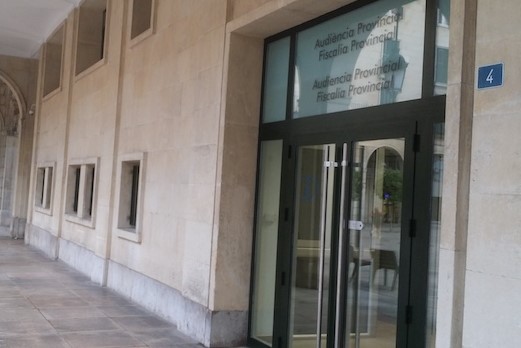
The Alicante Provincial Court has sentenced two men to three and a half years in prison for rigging a wedding in Benidorm to empty a retiree’s bank accounts. The convicted men are a father and son who run a real estate agency in the tourist city. Guillermo, a retiree from the Galician municipality of Oleiros, who was interested in moving to the area, had gone to the agency to buy a property. During the transaction, he befriended them, and the agency owner arranged his marriage to his mother-in-law, the grandmother of the second defendant. This manoeuvre allowed the defendants to access his bank accounts. The wedding was held via videoconference during the lockdown. This gave them effective access to his online banking services, which they used to embezzle 100,000 euro. The ruling acquits a third defendant, the wife and mother of the other two convicted men, as it does not consider it proven that she had any involvement in the events.

The court found it proven that the money was never used to purchase a plot of land but instead ended up in the hands of the defendants, and therefore convicted them of misappropriation. Initially, the man gave them 30,000 euro, but then began to suspect the defendants’ true intentions, refusing to hand over the rest and demanding that everything be documented in writing. For this reason, the defendants transferred the remaining 70,000 euro to their son’s account. The court determined that the money came from the victim’s account and was never used for the intended purpose, thus concluding that the crime was committed.
One of the main obstacles facing the trial was the lack of crucial testimony. Firstly, there was the testimony of the victim himself, who died a few days after returning to Galicia, where he had time to change his will to prevent the defendants from inheriting his estate. However, he was killed in a hit-and-run accident unrelated to these events. The victim’s heirs were represented in the case by lawyers Ignacio Martínez Sánchez de Neyra and Asunción Fieira Busto. The other key testimony was that of the woman he married, who died in 2022 during the proceedings.
The sentence would mean the defendants would go to prison, although it is not a final ruling and can be appealed to the High Court of Justice. However, there are other proceedings stemming from this lawsuit that still need to be resolved through civil court. Among them is the trial regarding the change to the will made by the victim after a confrontation with the defendants. Before his death, the victim had named his new wife as the sole heir to his estate, but he later changed it to designate those who are now acting as private prosecutors. The court also has yet to rule on the ownership of the apartment that the deceased bought from the defendants on Poniente Beach in Benidorm, as it is currently occupied, according to the prosecution. It is unknown whether the residents are squatters or people connected to the defendants.
The events date back to 2019, when Guillermo enjoyed a pleasant vacation in Benidorm, having travelled there from the municipality of Oleiros in A Coruña province. He was so pleased with the trip that he considered buying a property to spend extended periods of time there. Through the defendants’ real estate agency, he found an apartment in the Poniente area and paid 170,000 euro in cash. The prosecution maintains that it was at this point that the defendants began to devise their plan, after realising that the victim was financially secure, had no close relatives to protect his interests, and was elderly.
In this way, the real estate agent introduced him to his mother-in-law, an 82-year-old woman, who, like Guillermo, was a widow and originally from Galicia. The alleged romance progressed during the height of the pandemic, leading to an almost permanent relationship between the accused and their victim. On 13th March, 2020, they registered as a civil partnership, and two months later, on 15th May, in the midst of lockdown, they married before a notary via videoconference. Before the wedding, Guillermo had made a will in favour of his new wife, just before he turned 91. With the marriage, she became a joint account holder. Guillermo withdrew the money to give it to the accused in cash, but he began to suspect something was amiss when he discovered they had accessed his accounts to make transfers of substantial sums, so he started demanding receipts to prove everything.
In this context, a key incident occurred at the notary’s office: the defendants tried to transfer the plot of land to the couple’s son, claiming that Guillermo didn’t want to pay, but the notary refused after detecting the irregularity. When the sale fell through, the 70,000 euro was returned, but not to Guillermo’s account, but rather to his new wife’s. It was then that the woman filed a complaint for gender-based violence, which literally left him homeless, as a restraining order was issued prohibiting him from approaching her. The police eventually admitted him to the Psychiatric Unit of the Villajoyosa Regional Hospital after he had several altercations in public following several days of being exposed to the elements. Once at the medical centre, he fell into a coma. Medical tests revealed abnormal blood work due to benzodiazepine use, and upon regaining consciousness, he told social services staff that he had been deceived and that he only wanted to return to Galicia. The social worker, who testified at the trial, helped him contact his friends so they could lend him money for the bus.
The ruling, however, does not accept as proven all the facts alleged by the prosecution. Specifically, it does not accept as proven that Guillermo died in poverty due to the actions of the defendants, considering that he did possess assets. Nor does it accept as proven any criminal act in the alleged appropriation of the victim’s car by the defendants, arguing that this was a new criminal act added to the prosecution’s case at the time of the trial.