


The calculator once again proves stubborn regarding the rampant housing crisis in Dénia. It indicates that the new officially protected housing (VPO) built by private initiative, which is about to go on sale in the city’s new neighbourhood on Camí dels Lladres, is out of reach for a large part of the population. This is despite the fact that their price is much more affordable than the rest of the new-build properties in the surrounding area and even across almost the entire municipality.

As published this Saturday, a developer will build 90 protected homes in the Residencial La Bocana complex, all featuring three bedrooms. The cheapest of these are priced at around 257,000 euro. Properties of a similar size throughout this area, known as C-1, have previously cost double that amount, yet they remain unaffordable for many.
The Real Cost
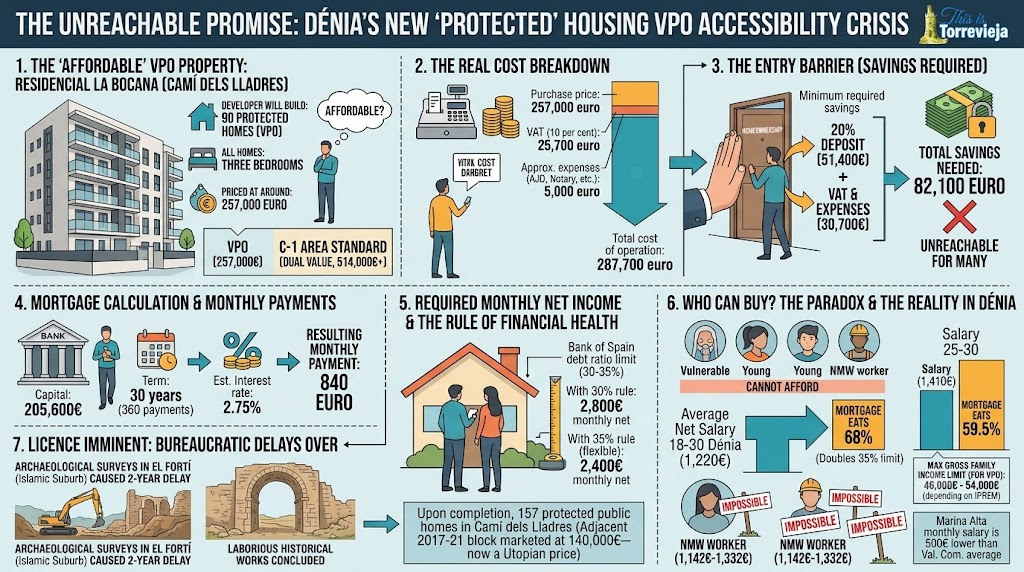
Firstly, it must be noted that a 10 per cent VAT must be added to that 257,000 euro, plus notary, registration, and agency fees, alongside the Documented Legal Acts (AJD) tax. The breakdown of the numbers is approximately as follows:
- Purchase price: 257,000 euro
- VAT (10 per cent): 25,700 euro
- Approximate expenses (AJD, Notary, etc.): 5,000 euro
- Total cost of the operation: 287,700 euro
The Entry Barrier
The second obstacle relates to the complicated world of banking. Banks usually finance a maximum of 80 per cent of the net price of the property, excluding taxes. This means the potential buyer must provide the remaining 20 per cent from their own savings, plus all fees and taxes.
- Minimum required savings: 20 per cent deposit (51,400 euro) + VAT and expenses (30,700 euro) = 82,100 euro in savings.
Mortgage Calculation and Monthly Payments
Once the future resident of Residencial La Bocana has provided that full deposit, the bank will lend 80 per cent of the property price, totaling 205,600 euro. From there, the numbers can vary. However, taking current mortgage market conditions as a reference—with subsidized fixed or mixed interest rates averaging around 2.75 per cent—and a standard 30-year term, the mortgage in the best-case scenario would look like this:
- Requested capital: 205,600 euro
- Term: 30 years (360 monthly payments)
- Estimated interest rate: 2.75 per cent
- Resulting monthly payment: 840 euro per month
Required Monthly Net Income
This is the crucial question: what monthly income must a person earn to purchase a new-build home costing 257,000 euro plus VAT? The Bank of Spain urges that the mortgage payment should not exceed 30 per cent or 35 per cent of monthly net income. This is known as the debt ratio or financial health rule, intended to ensure a buyer’s finances are not choked once the flat is acquired.
If this rule is applied strictly, allocating a maximum of 30 per cent of income to housing, net earnings of 2,800 euro a month would be required. With a more flexible yet riskier domestic economy criterion of 35 per cent, ,400 euro a month would still be necessary.
Who Can Buy?
The paradox of the case is that because it is a VPO, the law establishes a maximum gross income limit for the entire family unit aspiring to buy these flats. Normally, this cannot exceed the barrier of 46,000 to 54,000 euro gross per year, depending on how the IPREM (Public Indicator of Multiple Effects Income) is calculated. This is intended to ensure these properties are destined for middle or low incomes.
However, the problem is that the most vulnerable groups in terms of housing in a tourist municipality like Dénia cannot afford it. This is especially true in a region like Marina Alta, where the monthly salary is 500 euro lower than the average for the Valencian Community.
Young People and Minimum Wages
According to official data from the Tax Agency, the average general wage earner’s income in Dénia is around 20,609 euro gross per year. Applying age coefficients from the INE to the local labour market, estimated net monthly salaries for young people in Dénia between 18 and 30 years old would show an average net monthly income of 1,220 euro, calculated across fourteen payments.
This means that an average young wage earner in this city under 30 could hardly face this purchase alone, as the mortgage would absorb 68 per cent of their monthly income, doubling the maximum recommended financial health limit of 35 per cent.
Even with more optimistic calculations for those aged 25 to 30, where stability increases, the average salary rises to 1,410 euro clean per month if extra payments are pro-rata over 12 months. Yet even then, the mortgage would absorb 59.5 per cent of the total salary, remaining far from the 30 to 35 per cent maximum required by bank risk departments to grant a loan. Therefore, it is practically essential to have two salaries from a couple or significantly more deposit capital.
Even Worse Scenarios
There are, of course, even worse scenarios. In the 18 to 24 age bracket, which is most affected by summer campaigns in the tourism sector and part-time contracts in catering or local commerce, the average net monthly salary is 1,020 euro net per month across 14 payments. Here, the mission is already impossible.
It is equally impossible for anyone earning the national minimum wage, which stays at around 1,142 euro monthly over 14 payments or 1,332 euro in 12 payments with pro-rata extras.
The Licence is Imminent in an Archaeological Zone
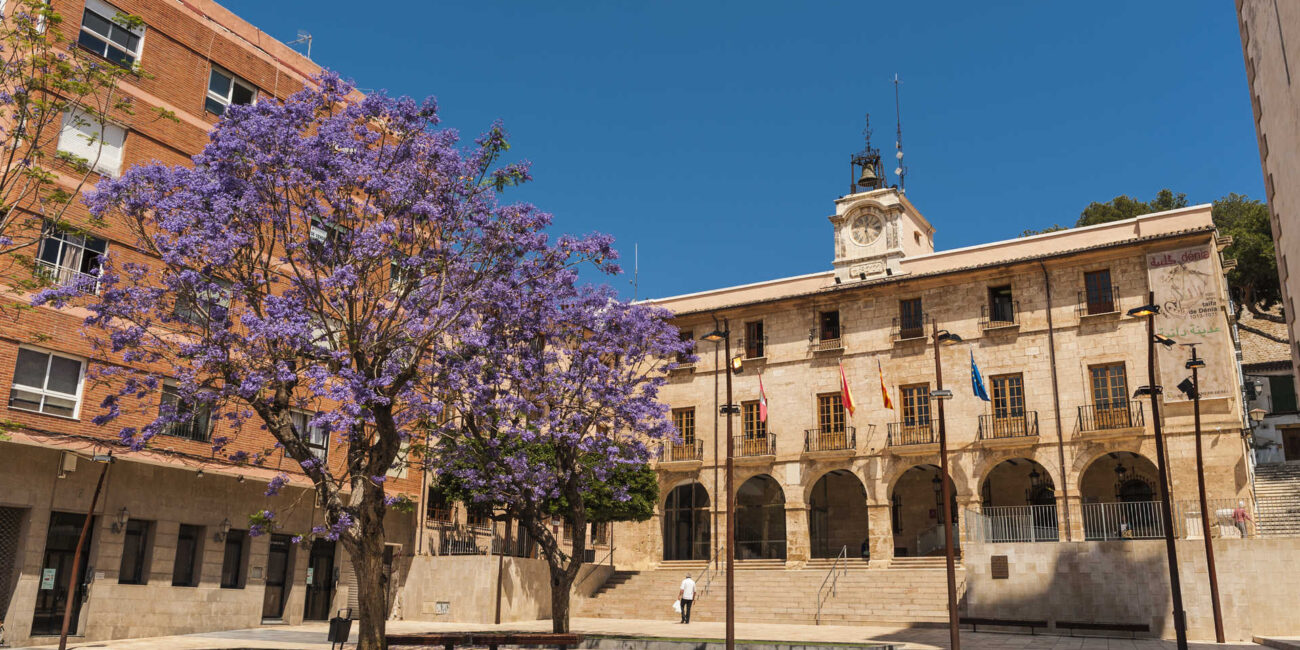
Following recent reports, some voices have warned with indignation that the licence granted by the town council to start work on this residential development has faced up to a two-year delay. When questioned, the Councillor for Territory, Socialist Maria Josep Ripoll, confirmed that the developer has submitted the final missing documentation, meaning the end of the bureaucratic path is now imminent.
Ripoll clarified that this licence has received preferential processing at the town hall, as happens with all promotions involving protected housing. However, the plot where the 90 VPO units will be located had to undergo archaeological surveys because it is situated in the ancient Islamic suburb of El Fortí, which increased the delay. These laborious historical works have now concluded.
When this urban complex is completed, Dénia will have a total of 157 protected public homes on this same street of Camí dels Lladres, given that an adjacent block of 67 flats built between 2017 and 2021 was marketed at 140,000 euro. Half a decade later, that price seems utopian for the stressed housing market of modern Dénia.