


Torrevieja City Council has given initial approval once again to the ordinance regulating urban public transport fares following the correction of a technical error in the document. Transport Councillor Antonio Vidal assured that the correction will not affect the final fares and that the new service, which was awarded in March but is yet to be implemented, “will be launched this summer.” The Socialist Party (PSOE) and Sueña Torrevieja both abstained from voting to submit further objections during the upcoming public comment period.

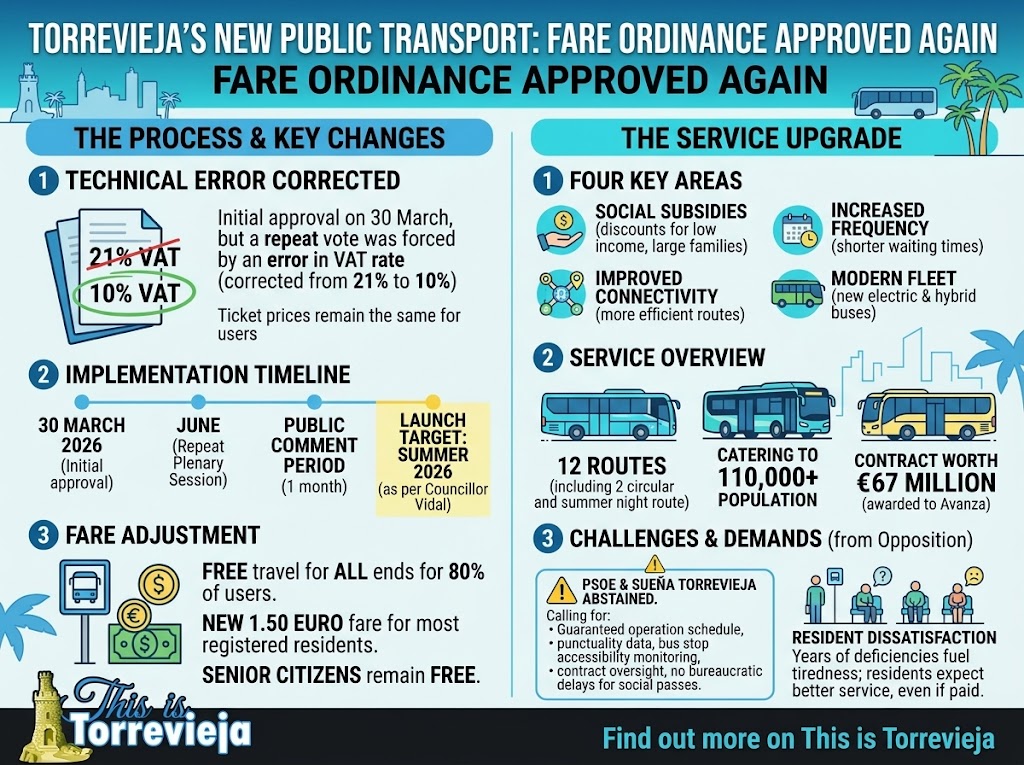
The local authority had to backtrack on processing the ordinance due to an error regarding the VAT applied within the transport fare schedule. Although the document had already been voted on and approved on 30 March, it had to be brought back to a vote at last Monday’s plenary session. The published text mistakenly listed a VAT rate of 21 per cent instead of the correct 10 per cent rate. While the final price of the tickets remains exactly the same—given that the new service will require payment from 80 per cent of users—the distribution between the taxable base and the tax itself had to be adjusted. Consequently, the ordinance had to be submitted to the regular June plenary session for a repeat vote.
Councillor Vidal argued that the ordinance will allow for the implementation of a completely overhauled urban transport system for Torrevieja and La Mata. He outlined the reform based on four key areas: social subsidies, improved connectivity, increased frequency, and a modern fleet of electric and hybrid buses. However, he avoided mentioning the fact that this change brings an end to completely free travel for 80 per cent of users, who will now face a 1.50 euro fare, nor did he address the impact that this processing error has had on the official launch of the service.
Pablo Samper, the spokesperson for Sueña Torrevieja, stated that his group does not question the pricing regulations or social discounts but demanded clear guarantees regarding the actual operation of the service. He requested a line-by-line implementation schedule, data on punctuality, ridership, and incidents, regular monitoring of bus stop accessibility, a dedicated contract oversight committee, and guarantees that social passes will not be delayed by bureaucratic procedures.
Bárbara Soler, spokesperson for the PSOE, recalled that her group had previously submitted objections to the initial approval, all of which were rejected by the governing team. She stated that the technical report failed to explicitly address several of their proposals, including the inclusion of students and single-parent families in the reduced fare brackets. The Socialist councillor pointed out that although the multi-million euro urban transport contract was formalised back in April, the service remains pending. She demanded a specific launch date and cited ongoing problems, such as a lack of reliable information on schedules and punctuality. Both Soler and Samper believe that without the final ordinance being fully approved, the service cannot legally launch, which cannot happen for at least another month due to the mandatory objection period.
Vidal responded that the administrative error would not cause any delays, asserting that the City Council was continuing to work according to a planned schedule, though he has not yet made this plan public. He announced that a press conference will be held in the coming days to announce the official start dates and service conditions. Mayor Eduardo abruptly ended the debate, proceeding straight to a vote without allowing Vidal to make a final closing statement.
The governing team of the Popular Party initially tried to prevent the repeat of the procedure from going to a full council meeting to avoid the mistake being made public, which highlights why the new service has not been implemented nearly four months after being awarded. However, the notary considered that the VAT correction affected an essential element of the ordinance, forcing the public procedure to be repeated.
The new contract, worth 67 million euro, was awarded to Avanza on 16th March and formalised on 24th April. Technically, the upgraded service could have begun at that time. The City Council and the bus company were originally considering 1st July, today, as the start date for the new urban bus service, which will offer 12 lines, including two circular routes and a special summer night route, catering to a local population of over 110,000. It will become a paid service for 80 per cent of users, with only senior citizens remaining entirely free, whereas it is currently free for all registered residents. Currently, the average number of passengers travelling without paying is just over 50 per cent of the total, as the majority of visitors, especially during the peak summer season, do pay the standard fare.
As the calendar progresses, users are becoming increasingly tired of the many deficiencies that have plagued the municipal transport service for years. Local residents argue that the fact that it is currently free does not excuse the issues, especially as the City Council has to pay the contractor for a service that users consider insufficient and defective.
There has been ample room to avoid processing errors, as the bureaucratic process for this ordinance—which ends the free service—originally began on 12th December 2023 with the initial proposal, technical report, and public consultation notice. The preliminary public consultation was posted between 14th December 2023 and 15th January 2024. The process continued into 2024 with submissions to the Generalitat’s pricing commission. Reports on climate impact, regulatory impact, gender impact, and budgetary stability were later incorporated. In October 2025, a sustainability report and a version with updated rates were included, followed by a request to correct deficiencies in November 2025. A second request was submitted to the Pricing Committee with technical documentation regarding auxiliary facilities, electric vehicle charging infrastructure, an economic feasibility study, and a new rate report. The Local Governing Board approved the draft ordinance on 16th January 2026, an errata report was issued on 25th February, and the proposal was initially approved by the Plenary Session on 30 March, before the latest technical error forced this recent vote.