



Official crime balance data from the Ministry of the Interior shows that Torrevieja closed 2025 with 10,089 criminal offences. This represents an 8.3 per cent increase compared to 2024, when 9,316 offences were logged, with the trend persisting into the first three months of 2026. Out of the annual total, 9,067 involved conventional crime and 1,022 related to cybercrime.

The most severe offences recorded included one completed homicide, four attempted homicides, 150 offences involving injury and public brawls, one kidnapping, and 87 offences against sexual freedom, 26 of which were sexual assaults involving penetration.
Neither the Government Sub-delegation nor the security forces operating in the city prefer to frame the total figures as a simple rise in crime, irrespective of public perceptions of safety. They argue that two converging trends explain why the Guardia Civil post in Torrevieja remains the busiest in Spain.
On one hand, citizens are increasingly willing to report specific offences, particularly cybercrime. On the other hand, a boost in personnel and resources has enabled authorities to detect and prevent criminal activity that would otherwise remain unrecorded.
A further critical factor not cited by the Ministry of the Interior is demographic growth. In 2025, Torrevieja experienced the highest population growth in Spain, gaining more than 6,000 new residents. Raising the official census by several thousand residents is a rare occurrence. Official figures from the National Statistics Institute show the population currently stands at over 100,400 residents, whilst the municipal register lists over 113,000 local neighbours.
Property crime and fraud account for the bulk of the statistics. Torrevieja recorded 314 robberies with violence or intimidation, 655 burglaries involving force at residential and commercial premises (568 in homes), 2,953 thefts, 101 vehicle thefts, 99 drug trafficking offences, and 895 computer scams. Over 100 neighbours saw their vehicles vanish overnight following the 101 vehicle thefts.
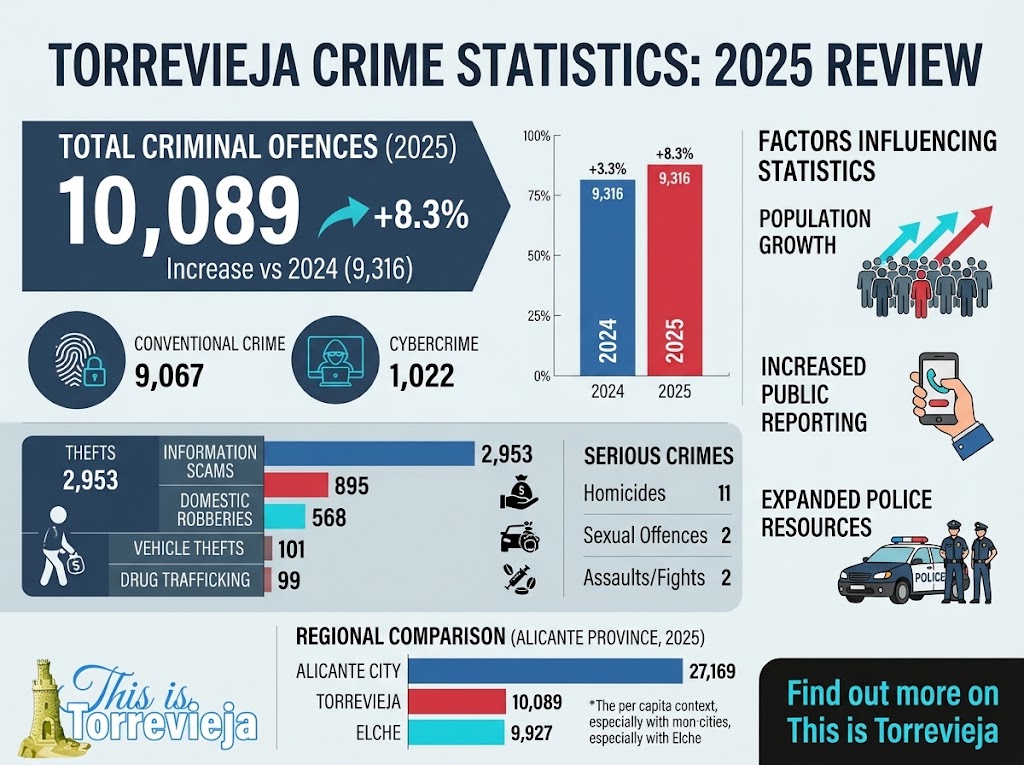
The municipality accounts for 9.1 per cent of all recorded crime in the province of Alicante, ranking second for criminal offences behind the capital city of Alicante, which registered 27,169. By contrast, Elche logged 9,927 offences, Benidorm recorded 6,093, and Orihuela registered 4,987.
Comparing Torrevieja to Elche highlights a striking gap: Torrevieja registered 162 more offences than Elche, despite having an official 2025 population of 100,400 compared to Elche’s 245,557. This means Torrevieja officially holds barely 40 per cent of Elche’s population, though the figures are heavily influenced by floating and tourist populations.
Figures for the first quarter of 2026 reflect a subtle overall decrease. The city closed the period from January to March with 2,008 criminal offences, compared to 2,101 recorded during the same timeframe in 2025.
During this first quarter, completed homicides rose from zero to two, while attempted homicides increased from one to two. Injury and public brawl offences rose from 32 to 36. Offences against sexual freedom held steady at 22, though sexual assaults involving penetration rose from three to seven. Theft remained the largest category, climbing slightly from 519 to 531, while vehicle thefts rose from 25 to 29. Drug trafficking fell from 25 to 20 cases. Computer scams increased by 14.5 per cent, moving from 179 to 205, whereas other cybercrimes dropped from 32 to 22.
Across the wider province of Alicante, the 2025 total reached 111,263 criminal offences, marking a 6.3 per cent rise from the previous year. Conventional crime totalled 91,257 cases, alongside 20,006 instances of cybercrime. Provincial data included 16 completed homicides, 64 attempts, 1,573 injury and brawl offences, nine kidnappings, 1,088 offences against sexual freedom, 2,275 violent robberies, 7,205 break-ins, 28,241 thefts, 1,415 vehicle thefts, 1,187 drug trafficking offences, and 17,175 computer scams.
Other Articles

Torrevieja and Orihuela top Spanish coastal housing sales
Local police in Guardamar track mobile signal to recover handbag