

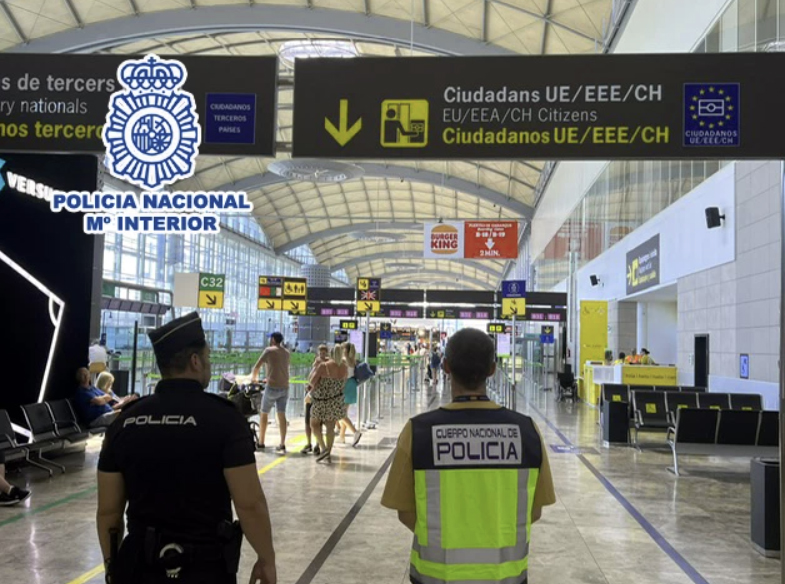
Summer has brought record-breaking figures to the skies of Elche and the wider province, with Alicante-Elche Miguel Hernández airport exceeding its all-time historical passenger record in July by reaching 2.3 million travellers. This represents an 11 per cent increase compared to last year. British tourists continue to drive these figures, while the airport has reinforced its security staff and assistants to operate one of the fastest and most efficient border controls in Spain.

The implementation of the European Union Entry/Exit System (EES) border control for third-country travellers initially caused chaos and long queues at the El Altet facility at the start of the year, where the vast majority of passengers arrive from the United Kingdom. Machine failures, system crashes, a lack of information for travellers, and a short-staffed roster of officers at the airport created a mixture that led to delays, double checks, and frustrated passengers.
Over the months, the system has been refined and border control reinforcements have arrived to transform the situation, creating a swift and coordinated filter despite the massive influx of British passengers landing daily.
Around 30 police officers joined the workforce from Operation Crossing the Strait of Gibraltar and will remain in Elche until September. Half of them are trainee officers straight out of the academy in Ávila, while the other half have arrived from other postings. This reinforcement has made a noticeable difference to border control management, while also covering holiday absences among permanent airport officers.
A National Police officer posted at the airport pointed out that the change is very noticeable, explaining that it allows them to cover absences, speeds up the work, and offers plenty of room to manoeuvre.
The impact is most evident during the night shift. An increasing number of airlines schedule flights between 10.00pm and 1.30am. Thanks to the new additions, a shift that at other times of the year only had three or four officers is now fully covered.
The officer noted that at night, colleagues were previously pulling their hair out, adding that on many occasions the station had to close because there was insufficient staff to run it, causing serious problems. However, during the summer, that problem is not occurring, and despite the large crowd, it is being resolved well thanks to the arrival of extra personnel.
It is not only the arrival of police officers that has helped clear the controls. Over time, and having seen the initial confusion generated by the new biometric machines, travellers have become more informed about the new European measures, largely because airlines themselves began warning passengers when purchasing tickets. The officer recalled that at first it looked as though it was going to be total chaos, but people now arrive prepared and the process moves very quickly.
In addition to this, assistants hired by Aena have provided crucial support. The auxiliary workforce has grown significantly in recent months to assist travellers, showing them how to scan their passports, position themselves, and complete identification as quickly as possible.
Officers are now keeping an eye on September, when temporary staff return to their original posts, trainee officers are reassigned to continue their training, and travellers continue to arrive in record numbers.