


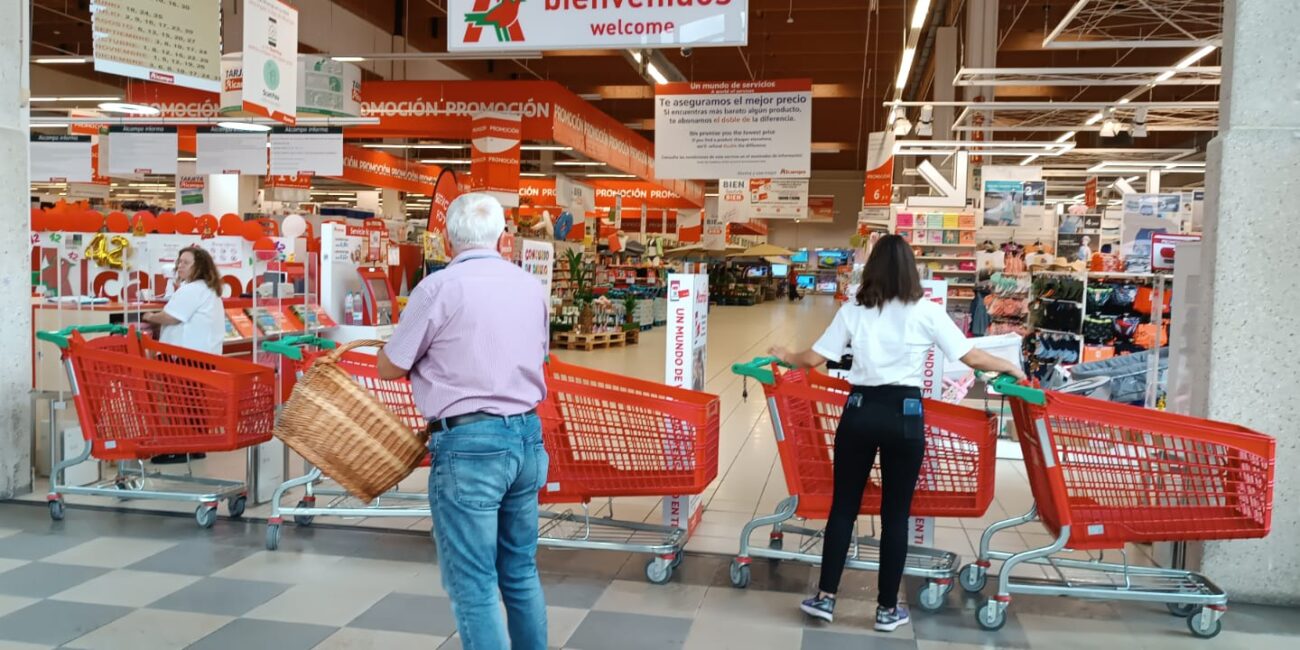
OCU has revealed that supermarket prices have risen by 1.8% compared to 2025, with fresh products seeing a steeper increase of 4.7%. Choosing where to shop remains vital for consumers, with the average saving between supermarkets reaching 1,310 euros per year, and exceeding 4,200 euros in some cities. Dani remains the cheapest chain, while an Alcampo store in Aldaia, Valencia, stands out as the establishment with the lowest prices analysed.

For another year, prices across supermarkets have been compared to determine where filling the shopping trolley is most affordable. Details show which chains and establishments offer the best prices in 2026 and how much shoppers can save based on their choices.
690 supermarkets and four baskets
A total of 690 establishments across 38 cities, alongside online supermarkets, were visited in April and May 2026. The study records prices for food, drugstore, and hygiene products, which make up specific baskets:
- OCU basket: Covers 244 products, including leading manufacturer brands and white-label brands, spanning fresh food, packaged food, drinks, cleaning products, drugstore items, and hygiene goods.
- Fresh basket: Includes only fruit, vegetables, meat, and fish of the same variety and category, such as category 1 Golden apples.
- Brand basket: Products from leading brands with identical names, weights, and packaging types, such as 0.4-degree Carbonell olive oil in 1-litre bottles.
- Economic basket: The cheapest products in the establishment meeting specific definitions, such as 1 litre of UHT whole milk, covering 90 basic consumer goods.
Using these prices, OCU creates an index for each establishment, assigning the cheapest store a base index of 100 to calculate relative differences.
The shopping basket rises by 1.8%
Following several years of sharp increases, the cost of a shopping trolley shows a more moderate rise of 1.8%, compared to 2.5% in 2025. Between April 2025 and May 2026, general inflation stood at 3.2%, while food and non-alcoholic beverage products recorded a lower rate of 2.2%.
Price increases are particularly concentrated in fresh products, which rose by an average of 4.7%. Fish went up by 8.6%, meat by 3.7%, and fruit and vegetables by 3.5%. Packaged manufacturer brand foods rose by an average of 2%, while economic products increased by 0.8%. Conversely, 92 products decreased in price, led by paper napkins, Canary Islands bananas, artichokes, and mashed potatoes.
Evolution of the baskets and cheapest locations
Among major chains, average price rises slowed to 1%, with eight out of 28 major enseignes lowering prices, notably Carrefour Market, Lidl, Mercadona, and Aldi. Meanwhile, the economic basket saw widespread efforts to reduce prices, with Mercadona, Lidl, and Aldi cutting costs to boost competitiveness.
Dani maintains an index of 100 to head the classification of cheapest chains, followed by Family Cash and Tifer at 102, and Alcampo and Supeco at 103. At the opposite end, Sánchez Romero registered an index of 176.
Torrent in Valencia returned as the locality with the lowest average price level, followed by Villarreal and Santa Pola. Conversely, expensive locations included Getxo, Pozuelo de Alarcón, and Majadahonda, alongside Barcelona, Bilbao, and San Sebastián.
Potential savings of 1,310 euros per year
Selecting the right place to shop allows households to save an average of 1,310 euros annually, representing 20% of the family budget allocated to included products. Potential savings vary significantly by location, reaching up to 4,381 euros per year in Madrid and exceeding 4,270 euros in Alcobendas, Majadahonda, and Pozuelo de Alarcón. In Barcelona, potential savings reach approximately 1,823 euros annually, while Mieres recorded the lowest margin at about 381 euros.
Other Articles

Four loggerhead turtles return to the sea after growing up at the Oceanografic