
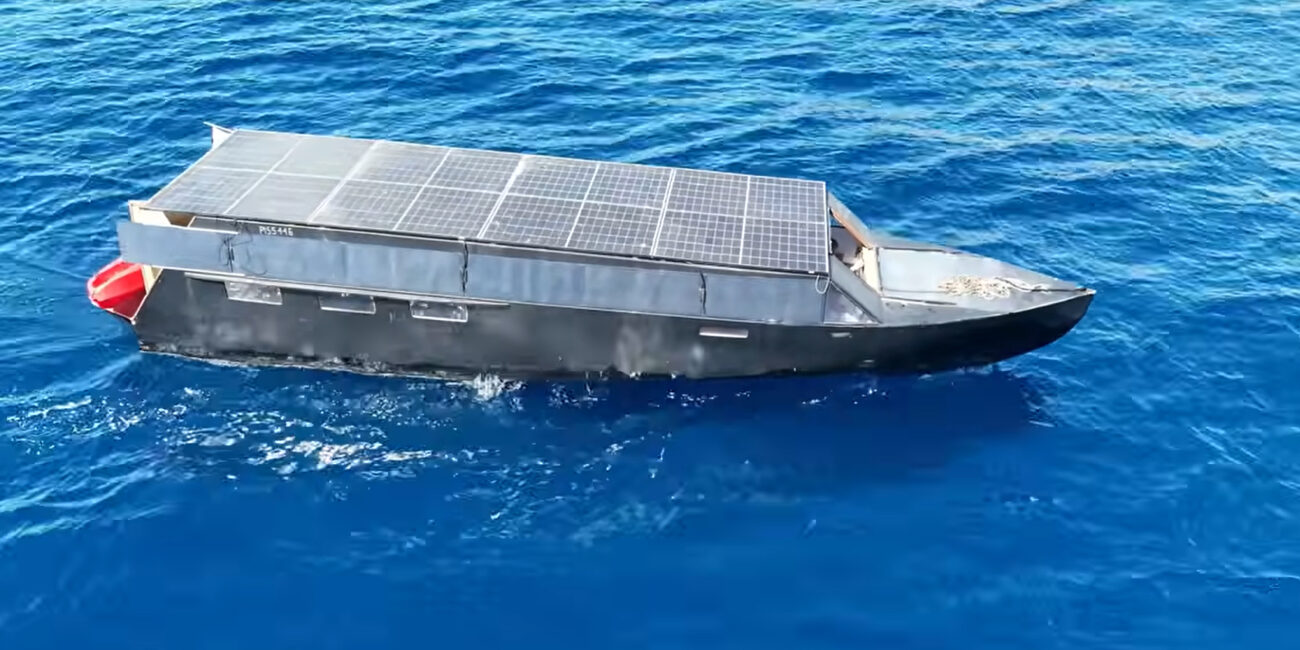
An unusual vessel recently arrived off the Torrevieja coastline, generating excitement and a wide variety of speculation, including humorous and imaginative theories. The craft appeared on Friday afternoon, 25th September, in an area highly visible to both locals and visitors, specifically along the Juan Aparicio seafront promenade, remaining anchored there until its departure on Saturday at around 5 p.m. heading east towards an unknown destination. During its stay, observers witnessed a crew member reaching land using a kayak that had been tied up in the natural pools.

Suggestions ranged from a sarcophagus, Noah’s Ark 2.0, a drug-running boat, a pirate vessel, a spy ship, an aquatic camper, Nosferatu, to even an alien invasion. However, the reality was Finn Lukas Sjöman and his Helios 11, a watercraft designed and built entirely by himself that runs exclusively on solar energy. His visit to Torrevieja followed a journey of more than 5,000 kilometres this summer originating in Finland and travelling to Ibiza. This route connected Scandinavian landscapes, rivers, and canals with the Mediterranean Sea, passing through the waters of Sweden, Denmark, Germany, and France without relying on sails or fossil fuels, using only an electric motor powered by sunlight—something Torrevieja has in abundance.

Acting much like a digital logbook, Sjöman uploaded a video to YouTube on Thursday as part of the True North Yachts project. He explained that he is sailing his prototype solar boat from Portugal to Spain to test its new range and speed following a thorough hull cleaning. The overall goal is to test his experiment, learn from the experience, and ultimately build a fast, 16-metre solar catamaran.
For this invention, he utilised materials such as plywood, fibreglass, and solar panels paired with 48-volt batteries and an electric motor. The resulting craft is an unusual 11-metre-long, 1.5-tonne creation that is both habitable and self-sufficient, featuring an auxiliary sail designed to lower energy consumption during open-water navigation. Its distinct appearance continues to draw curiosity wherever it travels.
A very lightweight hull enables the vessel to travel approximately 145 miles, or 72.4 kilometres, per day when conditions allow, while its flat profile is specially designed to capture energy. Sjöman has compared the boat’s energy consumption to that of a small household appliance, noting that his focus is on efficiency for free-flowing navigation rather than speed or luxury.
Other Articles

Police arrest three Brits on the Orihuela Costa over shooting
Torrevieja police officer sustains minor shrapnel injuries gun mishap