


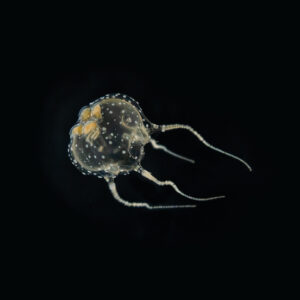

Scientists at the University of Alicante have discovered a new species of tiny jellyfish measuring just a few millimetres in the waters off El Campello, in the province of Alicante.

The species, named Copula lucentia due to its discovery in Alicante waters, measures between one and seven millimetres and was initially encountered during research campaigns conducted by the Marine Laboratory of the University of Alicante in Denia. A joint campaign with the Valencia Oceanogràfic has recently made it possible to collect more than 200 specimens along the coast of El Campello.
This is only the second cubozoan or box jellyfish species ever recorded in the Mediterranean Sea, following Carybdea marsupialis, which was described by Linnaeus in 1758. Researchers noted that the finding highlights how rich in undiscovered biodiversity the Mediterranean remains, despite being one of the most thoroughly studied seas on the planet.
Copula lucentia was identified from specimens collected between 2016 and 2018. Its formal description has now been published in the scientific journal Marine Biodiversity following a combination of morphological studies and genetic analyses carried out in collaboration with international specialists.
Eva Fonfría, a researcher at the University of Alicante and lead author of the study, explained that the discovery occurred during a sampling campaign when the research team noticed that the specimens were unusually small for the time of year and possessed morphological traits that did not match existing records. Those differences led the team to analyse the specimens and compare them with other known species, confirming that they belonged to the Copula genus while possessing sufficiently distinct characteristics to be classified as an entirely new species.
The scientific name Copula lucentia pays tribute to Lucentum, the Latin designation for Alicante. To date, its presence has been documented exclusively in El Campello, making this stretch of the Alicante coastline a significant enclave for further marine research.
“Finding a new species in the Mediterranean, where everything is already so thoroughly studied, is very important,” Fonfría emphasised, stressing the need to continue investigating these organisms to understand their distribution and ecological role within marine ecosystems.
Copula lucentia belongs to the group of cubozoans, which are characterised by a cube-shaped bell. The creature’s body is virtually transparent, featuring four tentacles and small adhesive structures on the upper section that enable it to attach to various surfaces.
The studied specimens were discovered at a depth of less than one and a half metres in environments featuring a mix of rocky seabeds, sandy areas, and seagrass meadows.
César Bordehore, a professor in the ecology department at the University of Alicante and coordinator of the university’s Marine Laboratory in Denia, described the discovery as a milestone for marine research in the Mediterranean.
Despite the breakthrough in identifying the species, numerous questions remain regarding the new jellyfish, particularly concerning its reproductive cycle, its role in the food web, and its stinging capacity.
Live specimens of Copula lucentia can now be observed by the public for the first time at MedusaLab, the laboratory located within the Valencia Oceanogràfic. Due to their minute size, visitors view the creatures through a magnifying lens that reveals their distinct features up close.
Other Articles
Orihuela receives funding to sterilise stray cats in urban colonies
