



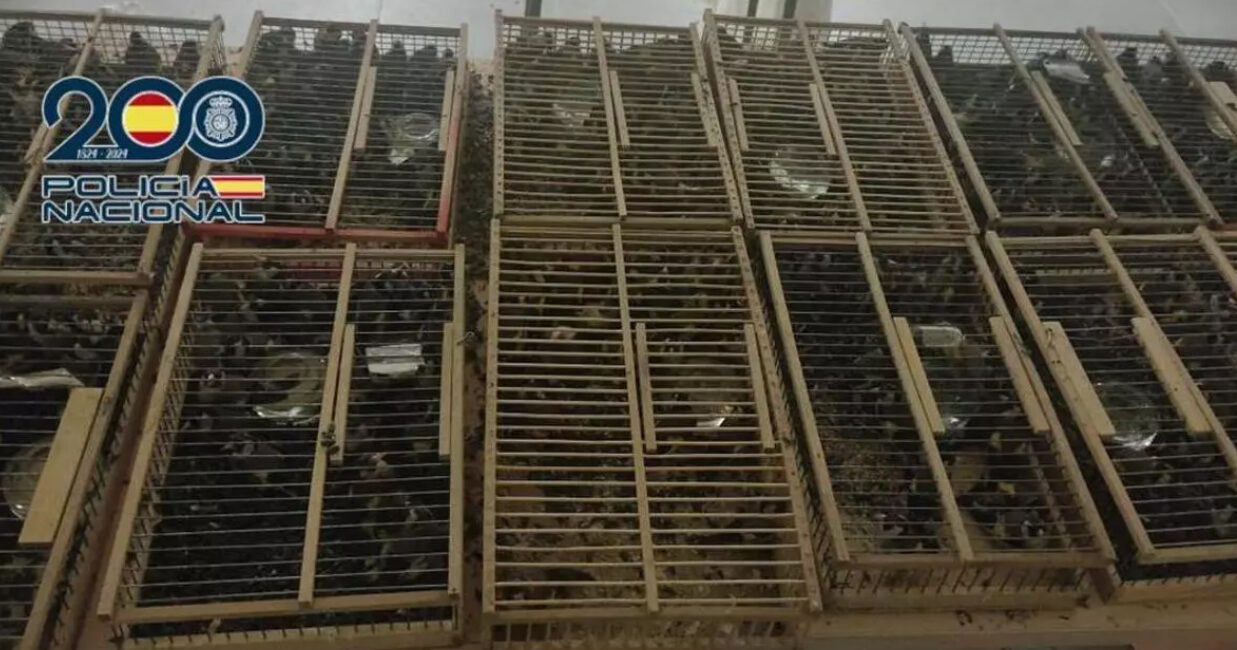
Two men, aged 49 and 52, were arrested by National Police officers in Orihuela on suspicion of committing a crime against flora and fauna. The men were intercepted while transporting twelve large cages in a vehicle that contained 400 European goldfinches, which were intended for illicit trade in France.

The officers were notified of the presence of a vehicle with two men on board during a routine security check conducted by the National Police at the city’s entrance in the early hours. The men made evasive manoeuvres to avoid the police.
The officers intercepted the vehicle and identified its two occupants. They observed several large enclosures in the back seats, which appeared to be filled with wild birds, specifically goldfinches. Then, they examined the trunk and found additional enclosures in the same condition.
One of the agents, who was acquainted with the regulations that govern this species of finch, identified the birds as belonging to the genus Carduelis carduelis, which is commonly referred to as European goldfinches in Spain. He determined that there were approximately 300 to 400 specimens in captivity, and that the cages were in a state of disrepair, with numerous dead birds.
Snapped in Murcia
The inhabitants of the vehicle provided ambiguous responses when asked about the birds’ origin and destination. Nevertheless, they subsequently acknowledged that the birds had been seized in the town of Lorca, located in the Murcia region of Spain, and that their ultimate destination was France. This implies that they were intended for illegal sale and trafficking.
The agents arrested both individuals as alleged perpetrators of a crime against flora and fauna, taking into account the condition of the birds and all extant legislation – national and international – regarding the protection of this type of wild birds.
Analyse
A subsequent analysis of the birds and the conditions in which they were found was conducted following the arrest. This revealed that the caged birds were in deplorable condition, with an exorbitant number of them per cage, which likely caused the death of many of them.
Poachers employ common sunflower seeds to lure and gather a large number of birds in a specific location, with the intention of capturing them with ground nets or “Japanese or invisible” nets. They were being fed with these seeds.
It is certain that the birds were captured within a maximum of seven days, as evidenced by the dark colour of their legs (birds in captivity have light legs) and the abysmal conditions in which they were discovered. This has resulted in exacerbated damage to the species, as it is the breeding season.
In order to preserve the birds that were confiscated, they were temporarily housed at the Animal Protection Center of the Orihuela City Council until they were transferred to the Santa Faz Bird Recovery Center in Alicante, which is the appropriate entity to oversee this species.
Upon arrival, a census was conducted, which revealed approximately 400 goldfinches, as well as 39 deceased specimens in the various cages.
One of the detainees was discovered to have €1,765 in cash among his possessions. This sum was confiscated on the grounds that it was suspected to have been obtained through the illegal sale of wild birds. Upon the conclusion of the police procedures, they will be presented to the assignment magistrate in Orihuela.
Legislation safeguards
In the realm of flora and fauna, legislation has been implemented on a national and international scale to safeguard animal and plant species from the suffering they endure as a result of illegal trafficking. A significant number of these species perish during transport in unsanitary and appalling conditions, which has frequently resulted in the extinction or near-extinction of certain species.
Directive 2009/147/EC is a notable international regulation that establishes a general protection regime for all European wild birds. This regime prohibits their intentional capture, possession, commerce, and, of course, killing.
Additionally, the CITES Convention (International Trade in Endangered Species) regulates international trade and commerce by mandating the submission of legal specimen documentation.
The preservation of wild birds is established by Spanish state law, Law 42/2007 on Natural Heritage and Biodiversity, which prohibits the capture, possession, and trade of protected species without authorisation. Articles 334 and 335 of the Penal Code also safeguard flora and fauna by establishing penalties for imperilled species and non-threatened but protected species.
The capture of this particular species of European goldfinch (Sylvatica spp.) was permitted on an exceptional basis for song training, provided that the corresponding federation card, capture permit, and ownership documents issued by the various autonomous communities were complied with, and hunting seasons and quotas were observed. This was the case until 2018. Nevertheless, the same legislation prohibited such captures going forward in 2018 and 2019.
In compliance with these regulations, birdwatchers who maintain these species of birds in captivity must presently possess a breeder’s licence issued by the respective hunting federations of the autonomous communities. In addition, each specimen must be captive-bred and are required to wear leg bands that identify them with their legitimate proprietor. The objective of all of this is to safeguard endangered species.