

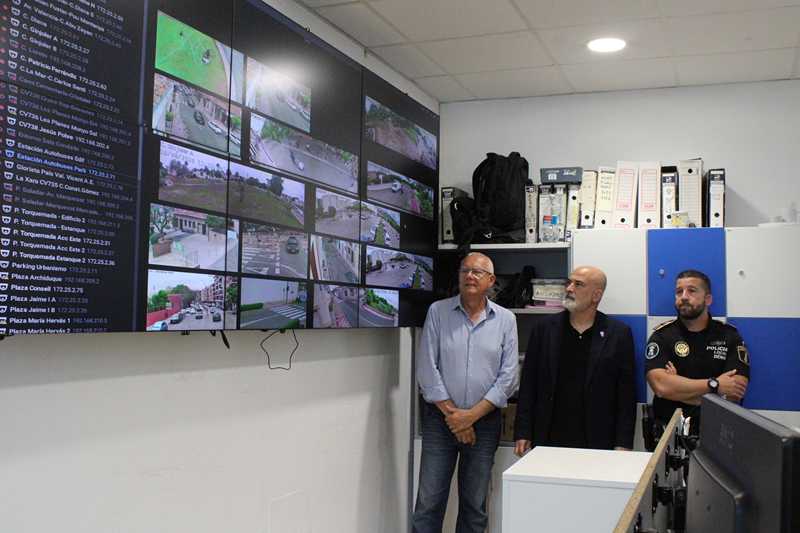
It is like a gigantic window open to Denia in real time. A screen instantly receives dozens of images of daily life across the entire city, whether in the Ayuntamiento square, Calle La Mar, Avenida Alicante , Calle Les Marines, or the exit of Jesus Pobre, to name just a few examples. A total of 85 cameras in public and private spaces are already operating in the municipality, and from next week more will be added, until reaching 253. All of them send their signal to a video system located on the ground floor of the Local Police station, the inner workings of which have been revealed today, Wednesday.

The system, which has been operational for two weeks, was shown by the Councillor for Security, Javier Scotto, and the Chief Superintendent of the Local Police, Jovi Estruch, who explained what these cameras will be used for and, crucially, what they will not be used for, which is something that causes much concern among the public.
Scotto guaranteed that this technology turns Denia into a smart city “of security, prevention, and emergency”. It serves numerous functions. The first is deterrence: “Simply the presence of the cameras already serves as a warning to discourage the offender.” It will also help to control and monitor traffic in real time and, in that same real time, provide a rapid response to a potential emergency.
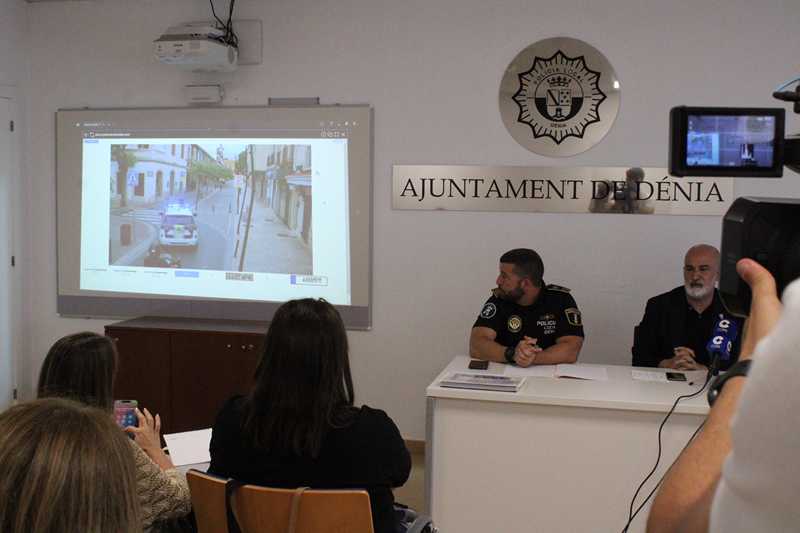
Furthermore, this technology will serve as a tool for resolving investigations. In this regard, the councillor explained that the images will only be intended for the different security forces and the courts. Citizens cannot claim them unless they go through the judicial police and the courts.
With this instrument, “the Local Police will end the anonymity and impunity of criminals, vandals, and antisocial individuals”. It will also enable “a change in the perception of security by the public because the cameras are there to provide peace of mind in parks, streets, and squares in Denia”. In the same vein, Estruch added that the system “is going to represent a before and after in the management of security in the municipality”.
From next Monday, 15th June, the remaining cameras will finish being installed. All of them are equipped with artificial intelligence. There are three types. The engineer from the company that installed the service, Mario Montero, explained that first, there are 180-degree panoramic cameras, which provide context and allow a wide field of vision to be covered with a single lens. Secondly, there are 4K cameras, which have a smaller field but feature high-resolution optics and much higher image quality.
These two types of cameras allow for advanced searches and zooming to select specific areas and detect what is happening at that moment in the corner of a street or in a building: from a serious incident, an assault, or a fight, to a pedestrian falling.
Out of the total, 42 have been installed inside and outside municipal buildings, such as the town hall, the local police station, the care home, the social centre, and the library. The rest are located in streets across the municipality chosen, according to Estruch, “by technical and operational criteria: traffic problems, frequency of accidents, or a repetition of antisocial acts and vandalic damage to urban furniture.”
There is still a third type of camera, the Automatic Number Plate Recognition or LPR cameras, which record all vehicle number plates. They have been placed at the entrances and exits of the municipality and on the roads connecting with Les Marines, Les Rotes, and the Montgo residential developments, “which has allowed us to effectively secure the perimeter of the entire municipality.” The software that manages these cameras allows for the entry of number plates, such as those of stolen vehicles or vehicles used for committing crimes.
The entire system has already borne fruit. In the short time it has been implemented, “we have received numerous requests for collaboration from other police forces and we have clarified three traffic accidents.” Regarding the latter, the system is highly useful because it makes it possible to track vehicles that have fled the scene or clarify the details of an accident when they are confusing or the parties involved disagree.
Another use of the system, since it is equipped with AI, is being able to track missing persons or individuals who may have committed a crime.
The temptation to compare this camera system with George Orwell’s Big Brother is very high. However, Estruch sent “a message of reassurance to the public” and assured that “the purpose of this programme is not to watch over the day-to-day lives of our neighbours and infringe upon their right to privacy, but rather it strictly and scrupulously complies with data protection regulations.”
Closely related to this is the question of who will be able to view the images. The chief superintendent explained that “we have drawn up an internal protocol for the processing and transfer of images to other security forces or to the judicial authority in order to maintain a chain of custody for those images and ensure that any delivery is registered.” Recordings can only be stored for 30 days in the database.
In addition, the Local Police staff have received specific training in using the software for its correct operation “to make it very clear what can and cannot be done,” Estruch added. “We have established different user profiles for the use of this software.” This means that not all officers will have the same access to the images.
Thus, most officers belong to the “basic profile” and will only be able to view live images, those being reproduced at that moment. Then, there is an intermediate profile intended for the accident investigation and reports unit and intermediate ranking officers, who, in addition to the previous permission, “can carry out searches in the historical recordings.”
Finally, a third, higher level has been enabled for inspectors and superintendents, who will be able to download these images, but always as a result of a police investigation or the search for evidence regarding the commission of a crime.
Such a hierarchy follows the principle of “data minimisation” where most of the staff have very limited access. The software features an internal audit system that records all operations carried out by the different users.