

The local government in Alicante will distribute 50,000 identification wristbands this summer to prevent children from getting lost on the city’s beaches. The safety measure has been introduced for the current swimming season to improve security for beachgoers. Alongside the wristbands, the municipality is installing new informative signage regarding the species of jellyfish and weever fish that swimmers might encounter along the Alicante coastline. Additionally, a successful lifesaving and rescue drill was carried out yesterday, Tuesday 16th June, at El Postiguet beach.

The Councillor for Tourism, Ana Poquet, stated that the beaches of Alicante are prepared to welcome thousands of residents and visitors this summer. She requested that the public respect warning signs and listen to lifeguards so everyone can safely enjoy the natural paradise in the city. Poquet noted that the municipality is increasing peace of mind and information on the beaches through the introduction of the wristbands for minors and the informative signs about jellyfish, following an agreement reached with the Vox municipal group.
Upon arriving at the beach, parents can visit the first aid station to request a wristband. They can write the child’s name and a contact telephone number on it. This will allow lifeguards to locate parents as quickly as possible if a minor wanders off or gets lost. The wristbands are waterproof, as is the ink used to write the details, and they are designed so that children cannot easily remove them.
The signage containing information about the most common species of jellyfish and weever fish along the Alicante coast, as well as advice on what to do if stung, is also available at the beach first aid stations. The information has been provided by the Institute of Coastal Ecology and the Department of the Environment of Alicante City Council.
Carmen Robledillo, the spokesperson for Vox, welcomed the realisation of the two initiatives, which the group had previously presented to the municipal plenary session. She stated that these actions demonstrate how simple, low-cost measures can significantly improve beach services, reinforcing family protection and the quality of the tourist destination. Robledillo concluded that her group would continue to present initiatives aimed at making Alicante a safer, more accessible, and better-prepared city.
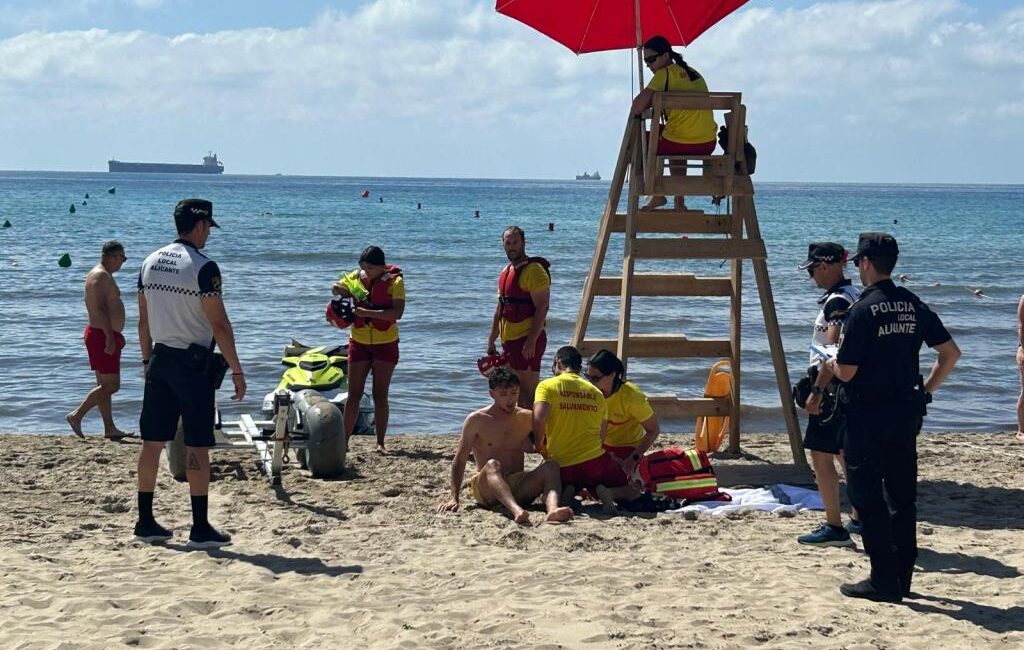
In a separate development on Tuesday, El Postiguet beach served as the setting for a successful rescue simulation conducted by the Lifesaving and Rescue service and the Local Police. The drill involved ten lifeguards, a jet ski, six police officers, and a local police drone.
According to Nohari Perona, the head of the first aid station at El Postiguet beach, the simulated emergency involved a person falling into the water and sustaining a leg injury. A lifeguard spotted the individual from a watchtower and alerted the first aid station. Staff mobilized for the rescue and activated the jet ski protocol, successfully extracting the individual from the water.
The casualty was transferred on a stretcher via the jet ski to the sand, specifically to the lifeguard chair closest to the first aid station. Personnel performed a primary assessment to determine if medical staff were required. As advanced medical intervention was not needed, the individual was moved to the shade of the first aid station for treatment. The total response time was 5 minutes and 30 seconds.
Perona recalled that last year, the Lifesaving and Rescue Service performed seven key interventions and provided more than 4,000 instances of assistance on Alicante beaches. Around 200 of those cases were serious, requiring advanced healthcare assistance.
Other Articles

Body of a snorkeller found floating in the waters of Calpe