


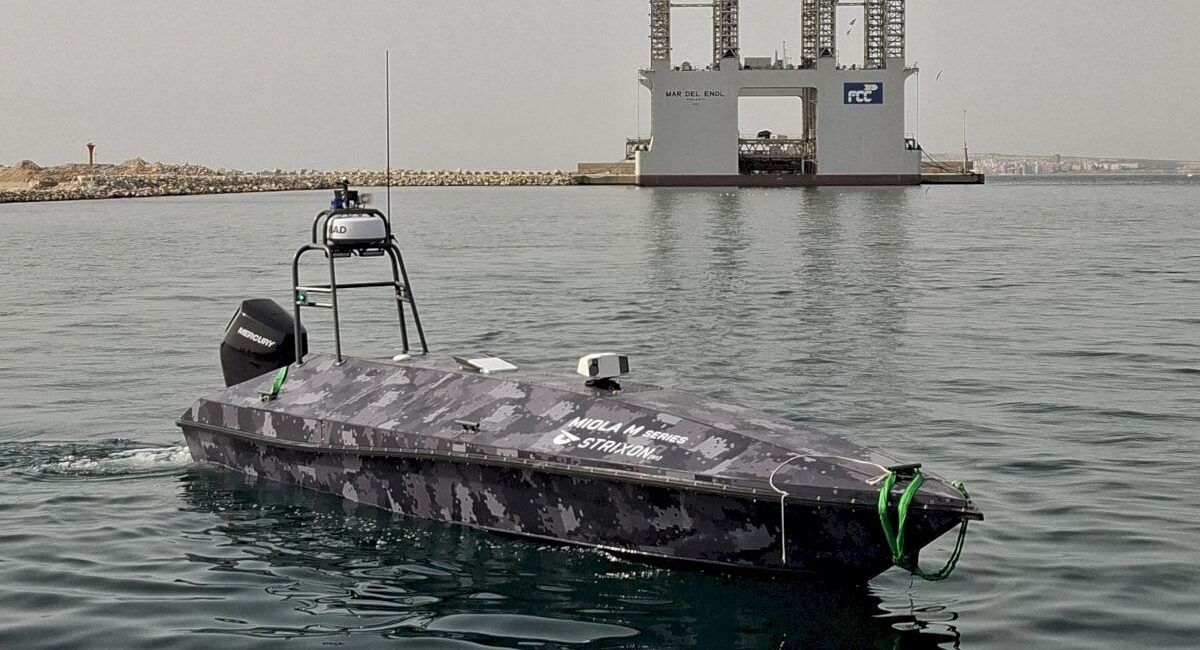
The Port of Alicante yesterday, Tuesday 21st July, hosted sea trials and a live demonstration of a state-of-the-art unmanned surface vessel (USV). The project positions the city as a benchmark for testing advanced technologies applied to maritime security and surveillance.

Promoted by CYBERDATACONTROL SL, the initiative allowed for testing the capabilities of the BNK M Series Patrol Version in a real operational environment. The autonomous vessel was developed to carry out coastal surveillance, reconnaissance, and maritime support missions using intelligent navigation systems and artificial intelligence. It can reach speeds of 53 knots, which is equivalent to approximately 100 km/h.
During the workday, tests were carried out at dock 19 of the Port of Alicante, where precision manoeuvres, as well as assisted and autonomous navigation, were evaluated.
The technologies incorporated into the system include autonomous navigation using programmed routes, state-of-the-art radar, thermal imaging, and artificial intelligence for identifying vessels, people, and floating objects. It also features redundant communications via mobile and satellite networks. Additionally, the system is capable of executing automatic safety protocols in the event of a loss of communications, ensuring the controlled apprehension of the vessel and the remote regaining of control by the operator.
The project does not include permanent facilities in the port area, as the vessel will be transported by tow truck, launched for testing, and removed once the demonstrations are complete. The entire operation is being carried out in coordination with the Port Authority and Maritime Authority, following current regulations to ensure navigational safety.
The demonstration showcased the potential of this technology for civil and security applications, including the surveillance of critical infrastructure, port protection, maritime traffic control, environmental monitoring, and support for search and rescue operations.
The autonomous vessel test coincides with the publication in the Official Gazette of the Province (BOP) of the ordinance regulating a controlled testing environment for innovative technologies within the port area. The text will be submitted for approval at the next Board of Directors meeting of the Port Authority. It aims to reconcile the promotion of innovation with the protection of the safety of people, facilities, and public property. Furthermore, the regulation seeks to foster open innovation to improve the efficiency, sustainability, and competitiveness of the port logistics system, attract talent and entrepreneurship to the sector, and encourage collaboration between public and private entities.
Other Articles