



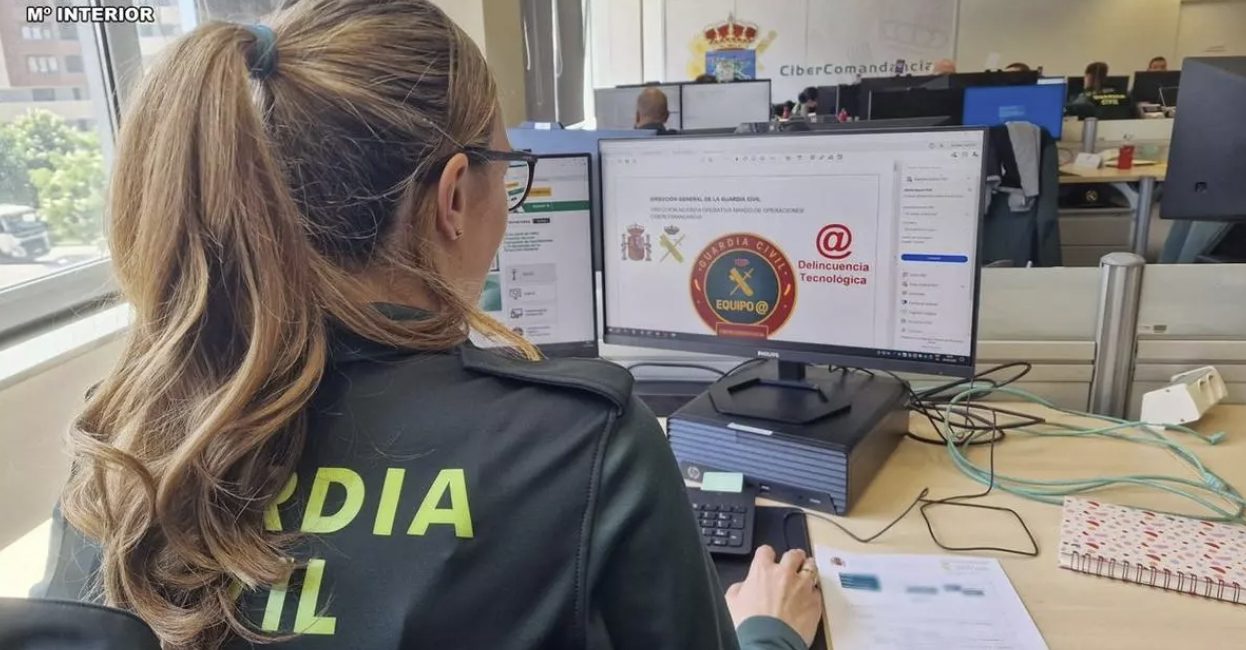
The Guardia Civil has investigated a 71-year-old man, a resident of Guardamar del Segura, as the alleged perpetrator of a cyber scam in which a corporate email was impersonated to divert 5,000 euro corresponding to the payroll and severance pay of a worker from a Valencian company in Puçol.

The operation began after a company reported a fraudulent transfer electronically. The case was taken over by the Cyber Command’s Team @, whose agents determined that the scam was a type of fraud known as “Business Email Compromise”, which involves impersonating corporate email accounts.
According to the investigation, the perpetrator registered an email address virtually identical to the employee’s, with only one letter changed, making it difficult to detect at first glance. From this account, he sent a message to the Human Resources department reporting a supposed change of bank account and requesting that both the outstanding salary and severance pay be deposited into the new account provided.
The recent termination of the employee’s contract lent credibility to the request. The company, convinced that the message and supporting documentation were genuine, updated the bank details and transferred the 5,000 euro to the indicated account.
The fraud was discovered days later when the employee contacted the company after realising he hadn’t received the money. Upon reviewing the exchange of messages, both parties confirmed that the email used to request the bank transfer came from a fraudulent domain, almost indistinguishable from the real one.
After receiving the complaint through the National Electronic Complaints Office, the Guardia Civil officers requested the immediate blocking of the transfer. Analysis of the money’s traceability and the receiving account allowed them to identify the beneficiary of the funds.
The investigation attributes to the suspect an alleged crime of computer fraud and another of money laundering. The case has been handed over to the courts in Torrevieja.
The Guardia Civil points out that this type of fraud causes a double loss: the company loses the transferred money, but remains obliged to pay the employee’s salary and severance pay, who also suffers a delay in receiving payment.
To prevent these scams, it is recommended to confirm any bank account changes through a second channel, carefully check the sender’s address, and establish internal verification protocols before authorising payments or transfers.
Other Articles