



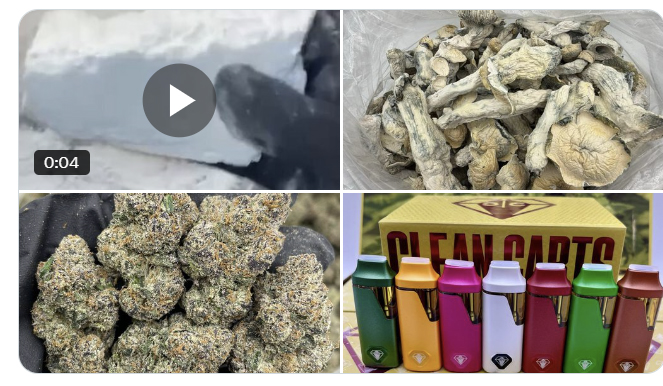
Advertisements openly offering illegal drugs on the social network X (formerly Twitter) feature Alicante and Elche on a long list of Spanish cities. The posts use language typical of the black market, promise “premium” products, and encourage users to leave the platform to finalise the supposed purchase via messaging apps, phone numbers, or email addresses.

A review of numerous publications shows an almost identical structure: a succession of terms related to different substances, followed by names of cities such as Madrid, Barcelona, Valencia, Zaragoza, Seville, Malaga, Murcia, Palma, Alicante, Las Palmas, Bilbao, Cordoba, Vigo, Valladolid, Gijon, Granada, Elche, Oviedo or Leganes.
In some cases, the messages include images and even videos of marijuana buds, bags, hallucinogenic mushrooms, pills, white powder, or vape cartridges. Others simply repeat keywords and cities, a formula seemingly designed to appear in searches related to drugs and specific locations. Several accounts publish virtually identical texts and lead to external channels where, they claim, orders are processed.
Alicante as a draw in mass advertising
The advertisements simultaneously mention numerous Spanish cities and, occasionally, locations in different countries, without providing verifiable information about sellers or delivery points.
Everything suggests that geographical names are being used as bait to attract people searching for phrases like “cannabis Alicante,” “cocaine Alicante,” or “weed Elche.” A single post promises deliveries to more than twenty cities, indicating either a national or even international network, or a scam.
It is not possible to confirm that all the profiles belong to drug dealers. Some tweets may be linked to real distribution networks, but others could simply be aimed at collecting advance payments, obtaining personal data, or redirecting the victim to channels where it is more difficult to seize their money.
What do “plug”, “ZAZA”, “snowflake” or “vape carts” mean?
The ads mix familiar names with Anglo-Saxon slang expressions. One of the most frequently used is “plug,” which refers to the seller, supplier, or contact who provides drugs. When an account presents itself as a “weed plug” or “legit plug,” it is trying to convey that it is a trustworthy dealer.
Words like “weed,” “bud,” “ZAZA,” “loud,” “dank,” or “sativa” are used to describe cannabis. “Bud” means bud, while “ZAZA,” “loud,” and “dank” are often used as marketing terms to present marijuana as particularly potent or high-quality.
The terms “coke” and “snowflake” commonly refer to cocaine. “Snow,” “flake,” or “snowflake” play on its appearance as a white powder and allow it to be advertised without always using its direct name.
“Vape carts” are cartridges for electronic cigarettes, while “THC liquid” refers to liquids that supposedly contain tetrahydrocannabinol, the main psychoactive component of cannabis. The term “edibles” identifies foods made with cannabis, such as gummies, chocolates, or cookies.
Also appearing are “hash,” equivalent to hashish; “shrooms,” used for hallucinogenic mushrooms; “ket,” short for ketamine; and the acronyms MDMA and DMT, corresponding to psychoactive substances. “Whips” is a more ambiguous term, although in this context it is usually associated with nitrous oxide capsules or containers.
CBD, on the other hand, is not automatically an illegal substance. It is a compound of cannabis without the intoxicating effects of THC, although in these messages it appears included in catalogues that also offer cocaine, ketamine, and other controlled substances.
From an open social network to private channels
The observed dynamic uses X as a public showcase. The advertisement is disseminated on a platform where it can be located through searches, keywords, or city names, but the conversation then moves to private or encrypted applications.
This platform exit serves several purposes. It prevents entire conversations about prices and delivery from appearing in the public listing, allows for quick contact changes when an account is closed, and makes it harder for other users to see potential complaints from buyers who have not received the product.
The analysed posts include invitations to contact customers via messaging channels, call specific phone numbers, or send emails to receive a supposed menu, find out prices, or arrange delivery. The frequent use of terms like “premium,” “legit,” “fast delivery,” and “trusted” attempts to create a sense of professionalism and reliability within an operation that remains completely opaque.
The ads violate X’s rules
X’s own policy states that the platform cannot be used to sell, buy, or facilitate transactions of illegal goods and services. Drugs and controlled substances are expressly included among the prohibited items.
The company states that it may suspend an account even on the first review if it determines that this rule has been violated. It also maintains that it proactively seeks out potential violations for human review, in addition to taking action on content reported by users.
The continued presence of posts of this nature raises doubts about the effectiveness of detection systems, especially when the messages contain explicit names of substances, images, and direct calls to place orders.
The use of abbreviations and slang can hinder automatic moderation, but many ads combine this vocabulary with easily recognisable terms like “coke,” “MDMA,” “DMT,” “hash,” or “THC.” This is compounded by the massive repetition of messages and cities, a behaviour bordering on spam that is also addressed by the social network’s internal policies.
The online sale of drugs is not a theoretical phenomenon
Spanish security forces have dismantled several organisations in recent years that used social networks and messaging applications to sell narcotics.
In 2024, the National Police dismantled a group in Granada that was promoting marijuana through social media and subsequently shipping it via courier companies. The operation resulted in the seizure of 115 kilos of buds, 148 plants, nearly 35,000 euro, and a firearm.
The Guardia Civil and the French Gendarmerie also arrested 22 people linked to an organisation that sold drugs via Telegram, accepted payments in cryptocurrency, and used postal services to distribute orders. The raids resulted in the seizure of cocaine, marijuana, weapons, and cash.
Another joint operation by the Guardia Civil and the National Police uncovered a network dedicated to selling gummy candies and snacks laced with synthetic drugs online. Among the seized items were vape pens containing cannabis liquids and packets of cocaine.
These precedents do not allow us to affirm that the accounts now detected are part of similar organisations, but they do demonstrate that social networks, private messaging, cryptocurrencies and parcel delivery have become tools used by groups dedicated to drug trafficking.
A possible crime against public health
Article 368 of the Penal Code punishes those who cultivate, produce, or traffic drugs, as well as those who promote, encourage, or facilitate their illegal consumption. Penalties vary depending on the substance, its dangerousness, the quantities involved, and the circumstances surrounding the offence.
Posting an advertisement does not, in itself, reveal whether drugs are present, if sales have occurred, or who is behind the account. That determination falls to law enforcement and, if necessary, the courts. However, the public offering of cocaine, ketamine, MDMA, or other substances, along with contact information for placing orders, constitutes evidence that can be reported to both the platform and the police or Guardia Civil.
Meanwhile, Alicante continues to appear as just another word in clandestine catalogues promising to deliver everything, anywhere. It is a digital marketplace where it is difficult to distinguish between real traffickers, automated profiles, and scammers, but it remains visible to any user who simply searches for Alicante or Elche on X.