



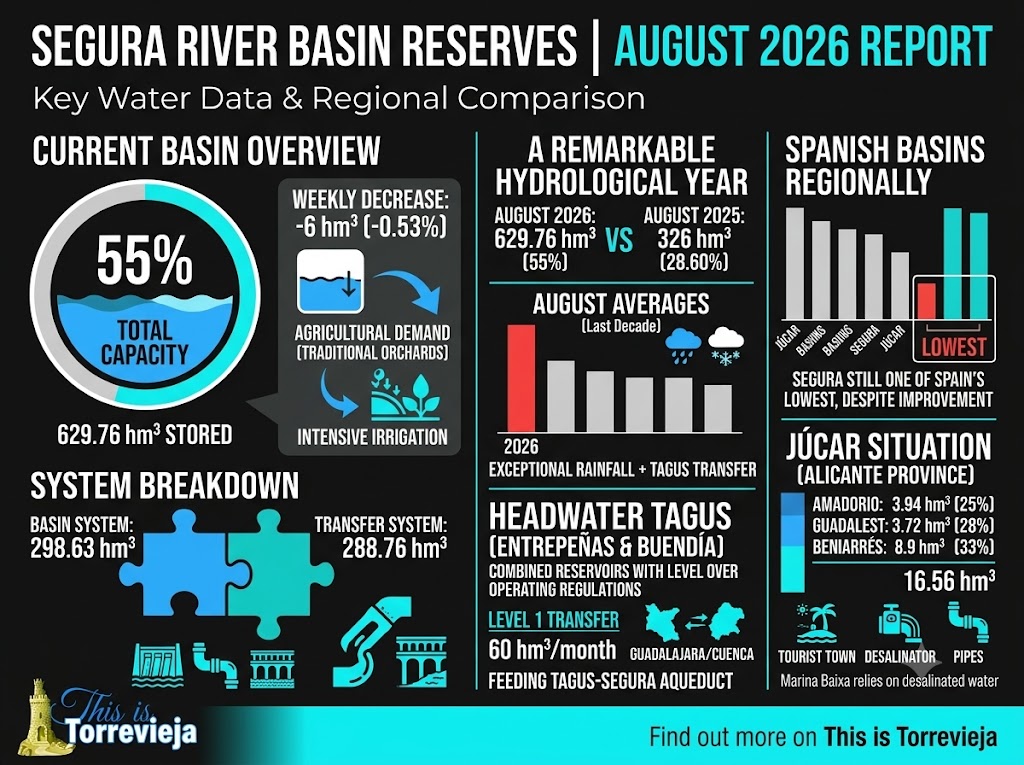
The reservoirs in the Segura River Basin are entering August with reserves of 629.76 cubic hectometres, nearing 630 hm³, an amount that represents 55 per cent of their total capacity of 1,140 hm³. Stored water levels have decreased slightly in the last week, dropping by 6 hm³ as demand for agricultural use in the traditional orchards of the Upper, Middle, and Lower Segura begins to take its toll on reserves, alongside intensive irrigation using the water transfer system. This represents a decrease of 0.53 per cent compared to the previous week, but the level remains significantly higher than in recent years.

Although this 55 per cent figure still places the Segura River Basin at the bottom of all Spanish river basin management organisations — with only the neighbouring Júcar basin recording lower levels below 60 per cent — it is a very positive figure. It represents a level not seen in August since the 2014 hydrological year, according to statistics from the Segura River Basin Authority. At this time of year, the typical percentage in the historical record barely exceeds 30 per cent.
The difference compared to last year and the average of recent years is significant and reflects an exceptional hydrological year across the basin. This recovery is explained by significant rainfall both in the headwaters of the Segura and in the headwaters of the Tagus, from which it receives transfers for agricultural irrigation and public supply. During the same week in 2025, reservoirs held 326 hm³, representing 28.60 per cent of their capacity. This year, there are 303.76 hm³ more than at the same point last year, marking a 93.18 per cent increase. The comparison is also favourable against the average of the last decade, which stood at 358 hm³ and 31.45 per cent of capacity. Current reserves exceed that ten-year average by 271.76 hm³, according to the water balance report from the Ministry for Ecological Transition and updated data from the river basins themselves. Official data from the Segura River Basin Authority does not include the reserves of the Taibilla reservoir, which are always destined for urban supply and currently hold about ten cubic hectometres.
By system, the stored water is divided almost equally between the basin itself and the transfer system. The basin system stores 298.63 hm³, while the transfer system holds 288.76 hm³. For the past 46 years, since the Tagus-Segura transfer began operating, water shipments from the aqueduct have been distributed through reservoirs built or adapted specifically for this purpose, including Tálave, Camarillas, La Pedrera, and Crevillent.
The water demand in Campo de Cartagena, which has the most important irrigation community among the users of the Alicante, Murcia, and Almería transfer, has been noticeable in the reserves of La Pedrera, in Orihuela. La Pedrera exceeded 50 per cent of its capacity in June, but has been gradually releasing water to the post-transfer and is now at 43 per cent of its capacity with 107 hectometres.
The remaining reservoirs contribute another 42.37 hm³. This consists of water stored in reservoirs designed to mitigate floods, such as the Santomera reservoir, whose resources cannot be used because they remain stagnant, sit below the discharge limit, or are salinised. Overall, the Segura reaches the central part of summer with reserves well above last year and higher than the ten-year average.
Water levels in the Entrepeñas and Buendía reservoirs, the headwaters of the Tagus River, are also showing positive signs, with combined reserves exceeding 1,408 cubic hectometres. Located in the provinces of Guadalajara and Cuenca, these reservoirs feed the Tagus-Segura Water Transfer system. Their reserve threshold is more than 100 cubic hectometres above Level 1 of the operating regulations, which authorizes the maximum transfer of 60 cubic hectometres per month. Technical reports indicate that at the start of the hydrological year in October, the transfer will return to Level 2 if it does not rain.
A tighter situation is found in the reservoirs of the Júcar River basin in the province of Alicante. These include the Amadorio and Guadalest reservoirs, which supply water to the Marina Baixa system, and the Beniarrés reservoir inland, close to the neighbouring province of Valencia, which regulates the Serpis River. Amadorio, in Villajoyosa, holds 3.94 hm³, barely a quarter of its capacity; Guadalest reaches 3.72 hm³, or 28 per cent; and Beniarrés holds 8.9 hm³, or 33 per cent. Together, the three reservoirs hold 16.56 hm³. Although scarce, reserves at Amadorio and Guadalest remain vital for supplying the Marina Baixa region, which relies on desalinated water from the Mutxamel plant via the Fenollar pipeline to meet tourist and irrigation demands.
Meanwhile, water supply and irrigation in the Vinalopó valleys, from Villena to Agost, passing through Elda, depends on underground aquifers and the Júcar River transfer rather than reservoir reserves. In the Marina Alta region, wells provide sufficient water for supply and irrigation during a typical hydrological year.
Other Articles