




Alicante has gained 10,272 inhabitants in three months following an increase driven by the arrival of immigrants, bringing the total population of the province close to 2.1 million, specifically reaching 2,099,866. According to the latest Continuous Population Statistics from the National Institute of Statistics released yesterday, Thursday 6th August, these provisional figures correspond to 1st July, 2026, and reflect the impact of the extraordinary regularisation process promoted by the government of Pedro Sánchez, with Venezuela, Colombia, and Morocco as the main countries of origin.

By gender, 1,005,674, or 49 percent, are men, and 1,027,892, or 51 percent, are women. Of the new inhabitants gained by the province in the last quarter, 9,366 were born abroad and 901 were born in Spain, accounting for 43 percent of the population increase in the Valencian Community, which experienced the greatest growth in the country. The regional population rose from 5,551,160 in April to 5,574,958 at the beginning of summer, an increase of 23,887 new residents, or 0.43 percent. The province of Valencia increased by 9,912 inhabitants and Castellón by 3,703.
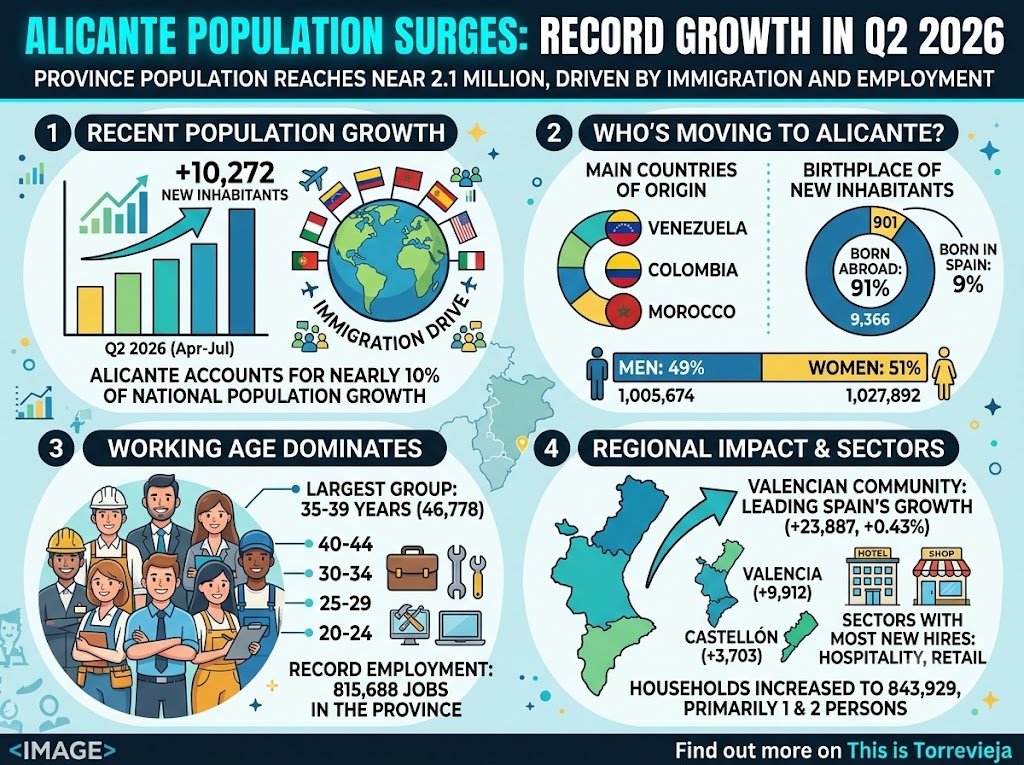
The age group with the largest immigrant population in Alicante is 35 to 39 years old, with 46,778 people, split almost evenly between men and women. This is followed by the 40-44, 45-49, 30-34, 25-29, and 20-24 age groups, representing the working-age population. The province has reached a record of 815,688 jobs, driven by tourism and regularisation, as 1,568 of the 9,722 new social security contributors are foreign nationals. Hospitality and retail sectors recorded the most new hires.
Across the country, Spain’s population increased by 104,178 people, reaching 49,801,559 inhabitants as of July 1, marking an all-time high. The Alicante province accounts for almost 10 percent of the national population growth. INE historical series indicates Spain surpassed 35 million residents in 1974, 40 million in 1997, and 45 million in 2007. Between July 2025 and July 2026, annual population growth nationwide was 444,205 people.
Nationwide growth was largely attributed to an increase in people born abroad, reaching 10,291,807, a figure higher than the number of foreign nationals due to citizens acquiring Spanish nationality. The number of foreigners increased by 87,197 to reach 7,437,543, while the population of Spanish nationality grew by 16,981. Main immigrant nationalities arriving in Spain included Colombians, Venezuelans, and Moroccans, while departures were also led by Colombians, Moroccans, and Venezuelans.
Population growth occurred across all autonomous communities and cities. Following the Valencian Community, the Balearic Islands and Asturias saw the largest relative increases. Total households nationwide reached 19,874,860, with Alicante recording 843,929 households compared to 839,830 in April, mostly comprising two-person and single-person households.
Other Articles