




Complaints are mounting as August progresses. In May, the Ministry of Transport launched a pioneering artificial intelligence system to regulate traffic at the Rocío del Mar-Punta Prima roundabout in Torrevieja, near the Orihuela municipal boundary. This is one of the most congested points on the N-332 highway in the Vega Baja region. An average of nearly 40,000 vehicles pass through this roundabout daily, where traffic from the national highway, Orihuela Costa, southern Torrevieja, and the residential areas of Punta Prima, Rocío del Mar, and Señorío de Gomendio converge. The idea was to reduce queues at a roundabout that has been saturated for years. On paper, it sounded promising. However, in the middle of summer and with no data from the Ministry to prove otherwise, the results are far from convincing those who suffer through it daily.

The feeling among many drivers is that the system protects the flow of traffic on the N-332, which still experiences significant queues, while penalising those trying to merge from Avenida Escorpiones or Avenida de Las Olas. Traffic jams on both roads already existed, but they have worsened since the intelligent traffic management system has been more fully implemented. The problem is particularly acute on Avenida de Las Olas. For residents of Rocío del Mar, the TM towers, and Señorío de Gomendio, this access road is not an alternative: it is the only way to reach the national highway.
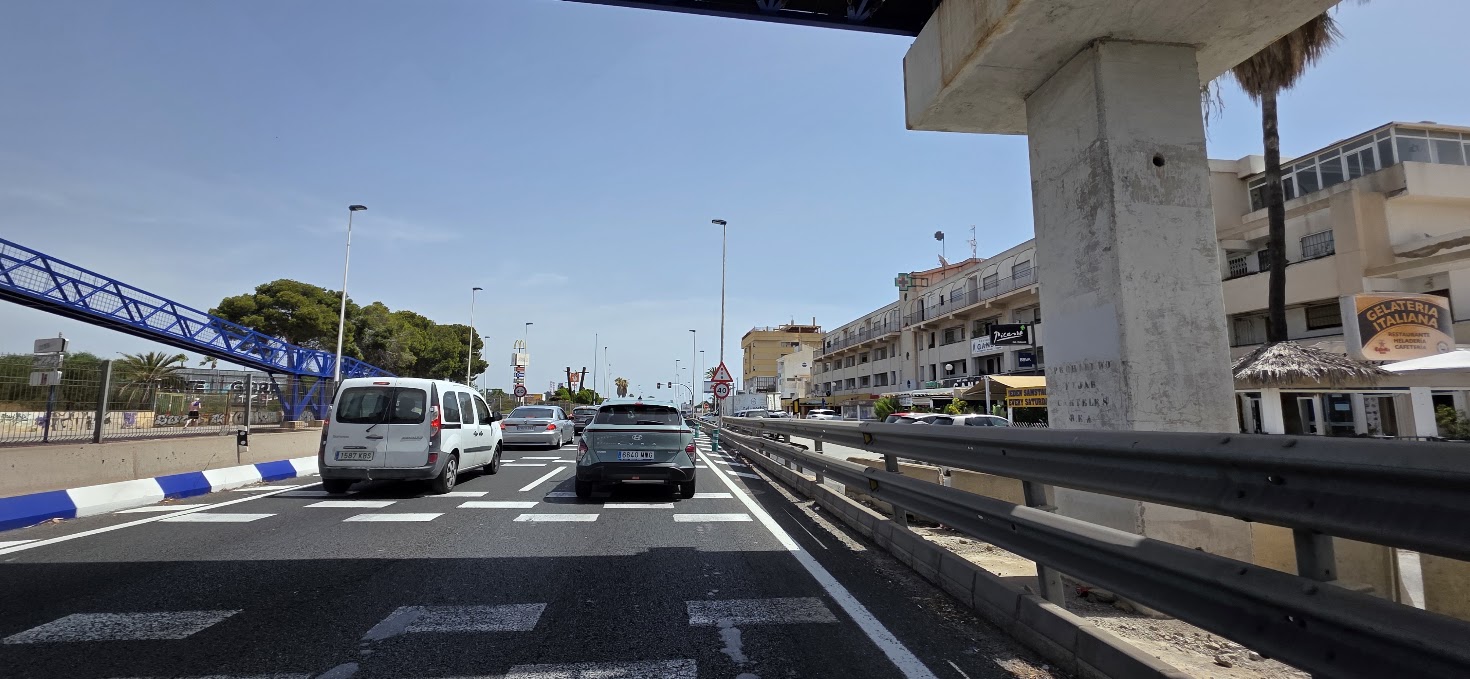
The scene repeats itself throughout the day. The traffic lights at the entrance to the roundabout do not function like a conventional intersection, with a clear sequence of red, amber, and green. They flash amber or turn red as the system decides. Drivers, accustomed to the basic logic of any traffic light, rush to enter when they see amber. Desperation does the rest. More and more vehicles are seen running the red light. And when someone does obey, the response from the queue is immediate: a series of beeps that seem anything but AI-like. Where there used to be waits, now there is noise, idling engines, and fed-up residents on Avenida Las Olas.
The traffic lights are installed on both sides of the N-332 and at the access points from Avenidas Las Olas and Escorpiones. These are two high-capacity roads, but they experience enormous congestion in the summer. Las Olas bears the brunt of the load because it carries traffic from residential areas that have grown significantly in recent years, with hundreds of new homes and a parking shortage that is already noticeable throughout the Punta Prima area. The traffic lights are not only overloading Avenida Las Olas, but also the shortcut along Calle Arrecife and Pleamar, which connects to the roundabout sooner and is now gridlocked at certain times of day.
The system incorporates traffic lights, detection cameras, and data collection devices. According to the project, this information feeds an AI-based control system capable of adapting traffic light cycles to actual traffic volume. Initially, the video surveillance was not signposted, although signs warning of its presence have now appeared. Currently, the system does not include a licence plate reader or equipment for automatic ticketing, something that should be explicitly indicated.
The worst traffic jams, due to waiting times rather than the number of vehicles, occur on Avenida de Las Olas, although only in one lane. These are followed by queues on the N-332 towards Torrevieja, which at times stretch for more than a kilometre to the Alameda del Mar roundabout. Next come the traffic jams on Avenida Escorpiones and, to a lesser extent, the congestion of traffic coming from Torrevieja towards Orihuela Costa and Pilar de la Horadada. The Ministry of Transport argued that the intelligent traffic light monitoring and management system is based on machine learning and reinforcement learning techniques. The goal is for the system to learn from user experience and collected data. The system combines neural networks, big data analytics, traffic modelling, and traditional road engineering methods to select the most efficient solution for all users at any given time.
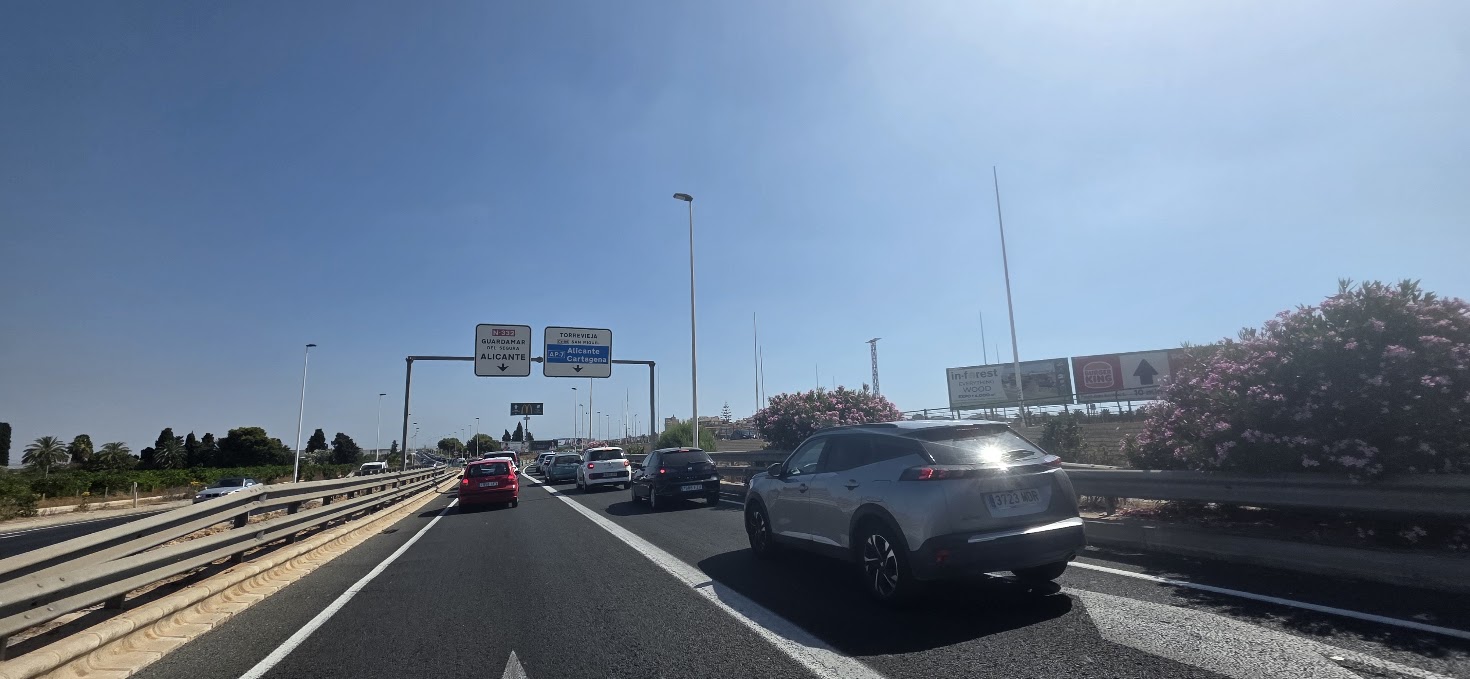
The theory clashes with the reality on the street. At a normal roundabout, drivers generally know what to expect. Not here. The traffic light turns red when the system decides, and that decision is unpredictable for someone who has been stopped for several minutes. Many users interpret the artificial intelligence as merely preventing the traffic jam on the N-332 from reaching kilometre-long proportions, at the expense of shifting the problem onto the access roads to residential areas.
The project cost 409,369 euro and is financed with European funds from the EU’s Recovery, Transformation and Resilience Plan. The tender specifications themselves acknowledge the experimental nature of the measure. It is the first roundabout in Spain with this type of technology applied to traffic regulation on the national road network. They also admit that, although similar projects exist, this technique is not routinely included in the regulatory framework for the National Road Network due to its sensitivity to certain factors. That nuance explains some of the residents’ anger. Punta Prima has become a kind of testing ground for a system that seeks to optimise traffic flow and learn from real-world traffic. Drivers, however, interpret it differently: longer queues to leave their homes, more honking outside their windows, and a roundabout that now seems less predictable than before.
AI has not been able to solve the traffic jam. Because it stems from a difficult-to-rectify root in urban planning over the last forty years focused on approving tens of thousands of tourist apartments without providing residents with greater capacity or alternative mobility options. While level roundabouts at intersections prioritised safety, they simply do not allow enough space for cars. Drivers residing in Torrevieja and Orihuela Costa, the main users of the N-332, are waiting for the road to be widened as it passes through Torrevieja—a project decades in the making—and they would be happy with a conventional widening: one with earth embankments, concrete, and asphalt. But there has been no news of the widening project for over a year, since the ministry indicated that it had passed the environmental assessment.

