


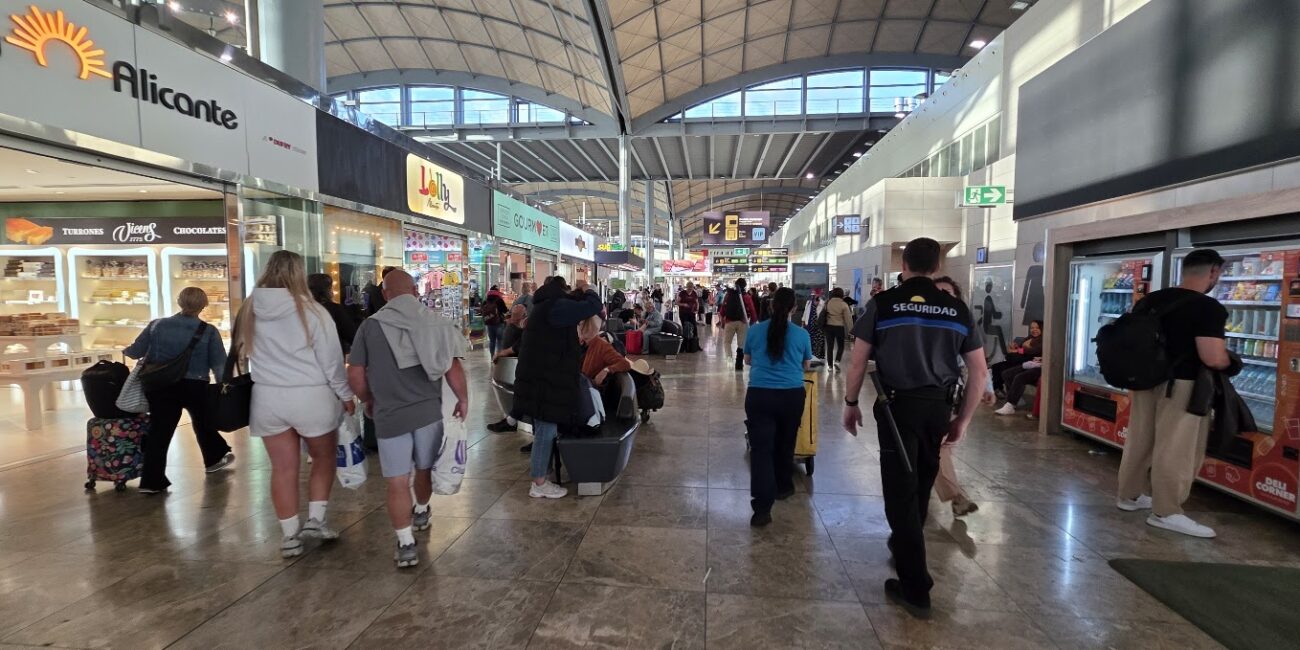
August did not disappoint in terms of passenger numbers at Alicante-Elche Miguel Hernández Airport, confirming another record for what continues to be the quintessential holiday month. The main gateway for tourists visiting the Costa Blanca exceeded 2.3 million passengers that month (2,337,378), representing an 11.4% increase compared to the same month in 2015.

With this figure, the provincial airport located in Elche has already surpassed 14.7 million passengers (14,739,523) in the first eight months of the year, confirming an upward trend towards achieving a new record once the full year is completed next December (the overall figures will not be available until mid-January, when the complete data for December is released). The 14.7 million passengers represent a 9.9% increase between January and August, just over five million shy of the airport’s all-time high of 19.9 million, which was reached in 2015, with passenger traffic for September, October, November, and December still to be tallied.
For now, the figure of one million passengers per month has already been exceeded in the last four months of the year, at least since 2024. In 2025, this figure was comfortably surpassed, suggesting that, if this trend continues, more than 20 million passengers will be exceeded by the end of 2026. In fact, another indicator pointing in this direction is the number of flights operated in the first eight months of the year: a total of 92,328 movements, representing a 10.1% increase compared to the same period in 2025, according to Aena sources. As for flights operated during the month of August, a total of 14,069 movements were handled, representing an 11.7% increase compared to the same month in 2025.
Regarding the origin of visitors, as is usually the case, the majority of this traffic is from abroad. Moreover, this international traffic continues its upward trend, growing by 12.3% in August, with 2,085,186 passengers registered. Once again, British tourists lead the way in this area. The United Kingdom topped the August statistics with no fewer than 800,000 travellers, followed by Germany with around 152,000, the Netherlands with around 125,000, and Poland with around 124,000, according to Aena statistics. Meanwhile, domestic traffic registered 251,109 passengers, also representing a 4.6% increase compared to August 2015.
The growth rate at Miguel Hernández Airport is higher than the average for all airports managed by Aena in Spain. In August, Aena’s network of airports across Spain handled 34,890,784 passengers, representing a 4.7% increase compared to the same month in 2025 (the provincial airport’s figure is 11.4%). According to Aena, 273,292 aircraft movements were managed, 4.3% more than in August 2025, and 104,356 tonnes of cargo were transported, 5.2% less than in August of last year.
The truth is that the provincial airport is once again the fastest growing among the top five busiest airports. Madrid Adolfo Suárez Airport handled 6,544,815 visitors, representing a 4.8% increase; Barcelona El Prat Airport registered 5,933,007, a 4.6% rise; Palma de Mallorca Airport saw 4,808,295 passengers, a 2.3% increase; and Málaga Costa del Sol Airport recorded 3,050,841 passengers, a 6.6% rise, according to Aena statistics.
Furthermore, in the cumulative figures from January to August 2026, Aena’s network of airports in Spain registered 225,543,599 passengers, representing a 4.1% increase compared to 2025. This means that Alicante-Elche Airport also exceeded the average growth rate for all airports, with a cumulative growth now standing at 9.9%. Similarly, Aena sources specify that its terminals across Spain handled 1,890,414 aircraft movements (+4.4%) and moved 878,168 tonnes of cargo, 1.8% more than in the same period of 2025.
The release of the statistics for August coincides with the approval of Aena’s third Airport Regulation Document (DORA III), following its ratification by the Council of Ministers this Tuesday. This document outlines a plan that includes an initial allocation of €868 million for the expansion of the terminal located in the El Altet district of Elche, a project with a total estimated investment of €1.154 billion.
The Government approves an investment of 868 million euro in the Alicante-Elche airport and a 0.33% increase in fares.
The airport infrastructure improvement project’s main feature is the construction of a new boarding pier, following the demolition of the old Terminal 1 (now disused). This project will also require the demolition of the smaller General Aviation terminal building, allowing for the development of the new pier, planned as an extension of Terminal 2, running parallel to the runway.
Its implementation should allow the airport to reach a capacity of at least 26 million passengers annually, according to initial estimates, although its true potential will depend on the final details of the planned actions. For now, Aena has already awarded the contract for drafting the expansion project to the joint venture comprised of Sener Mobility, Cemosa, and Fairbanks Arquitectos, for a sum of €15.7 million, as previously reported. This alliance of architectural firms has a total of five years (60 months, according to the tender specifications) to complete the project, although this is an overall timeframe in which specific projects will be developed in stages for each of the individual actions envisioned by Aena.
In any case, institutional representatives such as the Minister of Innovation, Industry, Trade and Tourism, Marián Cano, reiterated their demand this Tuesday from the Central Government for “less talk and more action,” following the Council of Ministers’ approval of the Airport Regulation Document 2027-2031. Cano emphasised that the Valencian Community “needs not just headlines, but real planning, tenders, construction projects and firm deadlines” to address the growth in air travel demand and the strategic importance of the Alicante-Elche Miguel Hernández and Valencia airports for tourism, mobility and the economy of the Valencian Community as a whole.
The Minister of Tourism welcomed the Government’s “final recognition of a need that the Generalitat has been demanding for years,” but warned that “the announcement is too late if it is not accompanied by immediate action.” “The Valencian Community cannot continue waiting while its airports break passenger records and operate at full capacity,” she concluded.
Other Articles

Torrevieja Hospital invests 212,000 euro in ten new respiratory support devices
Alicante considers urban planning changes for tourist luggage storage