

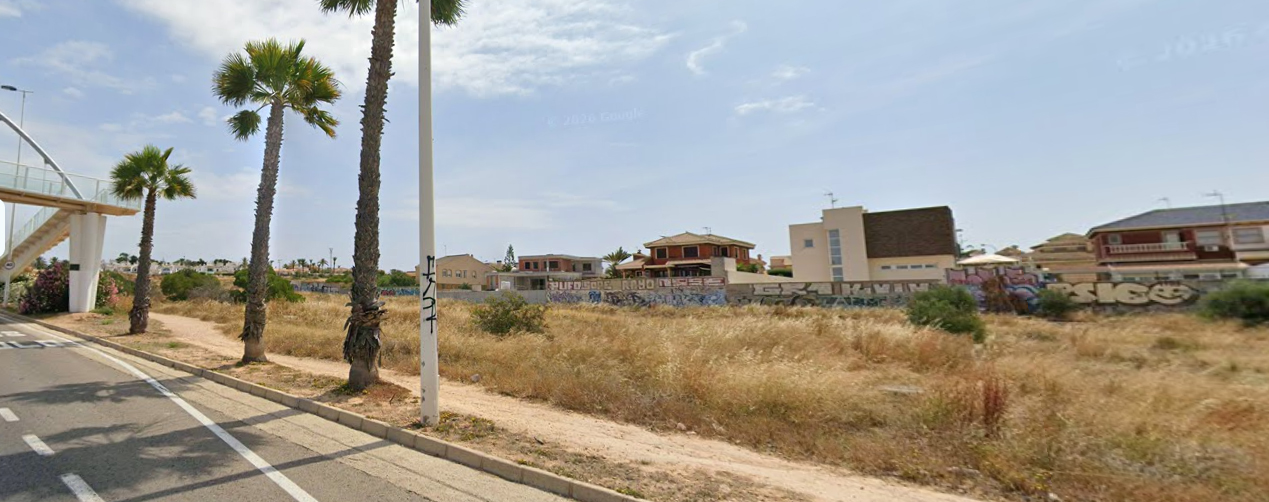
Heavy machinery has moved into the area of the PRI Enclave 3-Montecarlo, situated in the north of Torrevieja next to Avenida de las Cortes Valencianas. Initial fencing work on the ground marks the end of a long administrative wait dating back to the 1990s for a small-scale urban development plan. The project will now fill a parcel of land awaiting development in the middle of a large residential area that was established decades ago.

Montecarlo is not La Hoya or La Ceñuela, as it does not foresee thousands of homes. Its scope is much smaller, covering just over 61,000 square metres of land and a maximum of 104 homes, with an estimated population of 260 residents. However, its importance lies in its location. Positioned in the north of the city to the east of Avenida de las Cortes Valencianas, between Aguas Nuevas and other previously developed residential sectors, its urbanisation will allow the completion of the road network, services, and open spaces in an environment that has surrounded it for decades.
Private Reparcellation
The reparcellation transforms the old structure of small plots, inherited from a private division in the 1970s, into estates adapted to current planning rules. This structure was the primary cause of its delay. There were originally 48 estates with over twenty owners, alongside a plot of unknown ownership measuring 14,434 square metres. As a result, the reparcellation was processed as compulsory because a voluntary agreement could not be reached, partly due to the existence of that unregistered estate.
In this instance, the rights were registered in favour of the local council on a fiduciary basis, meaning provisionally and on behalf of whoever might prove a “better right” in the future. Companies and individuals, formerly linked to the local administration, are competing for that better right, having supposedly received information at the time that it lacked registration. To add further confusion to the planning, that surface area of 14,434 metres corresponds exactly to the layout of public roads in the cadastral register.
Additionally, the council has obtained a further 400 metres through another registration of an unregistered plot. Despite the uncertainty surrounding the ownership of a property representing 23 per cent of the total plan and who will secure the urban building plots, the development project has commenced.
Small Scale but 27 Million Euro Sales Value
The urban planning documentation itself describes the project as an action of “minor surface entity” and outlines its development in a single execution unit. The layout includes four residential plots, a central green space, and a longitudinal road connecting with the surrounding area. By comparison, Sector 20 La Hoya under execution exceeds 1.8 million square metres with a maximum of 7,490 homes planned, whilst Sector 29 La Ceñuela, which is still awaiting approval, proposes 1,347 homes across an area of 291,644 square metres. Against those figures, Montecarlo is a minor project in volume, but significant for closing the residential continuum of Aguas Nuevas. It represents infill urban development with the simple goal of erecting more homes for the tourism market, using land with acquired residential rights that cannot be offered alternative uses due to its private nature and surrounding urban layout.
Protected Housing
The reparcellation establishes a real surface area for the sector of 61,161 square metres. Of this total, 34,596 square metres correspond to net residential land, whilst the remainder is allocated for public facilities, open spaces, and roads. The division allocates 24,217 square metres of residential space for free-market housing and 10,378 square metres for protected housing, which includes 4,000 square metres under municipal ownership. This 30 per cent land reserve for protected housing went completely unnoticed during the processing and public dissemination of the plan.
Green Area
Furthermore, the layout incorporates 17,030 square metres of roadways, a main green zone of 8,531 square metres, and just over 1,000 additional square metres of non-computable open spaces situated next to Avenida de las Cortes Valencianas. Taken together, the transfers of roads and green areas represent around 43.4 per cent of the plan. However, this development will not execute the large pending green area on the strip of land between Aguas Nuevas and Cortes Valencianas that extends to the junction with Avenida de Castilla-La Mancha. Residents of Aguas Nuevas, the sector responsible for its execution, will once again have to settle for periodic land clearing by the council and the dozen trees planted in recent decades.
Fixed urbanisation charges, which represent the cost of constructing infrastructure before selling urban plots, amount to around 3.25 million euro including VAT. This sum includes the actual urbanisation works such as pavements, roads, sanitation, drainage, and street lighting, alongside the sanitation fee, technical fees, and management expenses. The reparcellation documentation also includes an estimated valuation of the residential sector once urbanised. It is a small but profitable sector within the usual scope of secondary holiday housing in Torrevieja, offering views of the salt lagoon. The overall sales value of the complex is calculated at 27.77 million euro, of which 21.40 million euro corresponds to open-market housing and 6.37 million euro to protected housing.
Initial Agreements
The plan has undergone an administrative process lasting over three decades. The first municipal approval agreements in the plenary session date back to 1992, followed by provisional approvals in 1993 and 1995. The Territorial Urban Planning Commission definitively approved the PERI in January 1998, subject to the submission of a revised text. Effective publication arrived years later in 2005, and the council approved a modification of the PRI in 2008 to adapt the layout to the road network and physical reality of the surroundings. Management was equally non-linear; in 2009, a procedure was opened to develop the area via indirect management, and in 2013, the PAI was approved, appointing Cauce Actividades Urbanísticas, S.L. as developer before the company eventually resigned.
In 2019, the plenary session accepted the resignation and cancelled the programme. The current phase began in 2020 on the initiative of Marcos y Bañuls, S.L., a company owned by an Orihuela businessman known for car dealerships, which assumed the status of urbanising agent under a property owner management regime. The Local Government Board approved the Integrated Action Programme and the urbanisation project on 13 October 2023, assigning the status of developer to Marcos y Bañuls.
The final administrative unblocking occurred in February this year, when the Local Government Board granted final approval to the Revised Text of the Reparcellation Project for Enclave 3-PRI Montecarlo. That agreement, dated 6th February 2026, ordered its publication and subsequent registry entry once firm, whilst requiring the developer to complete the final guarantee up to 5 per cent of the urbanisation charges, amounting to 81,439.60 euro.
Other Articles

Growing pains could be warning signs in children who play sport
Torrevieja barracks renovation project tendered with 96,080 euro budget