

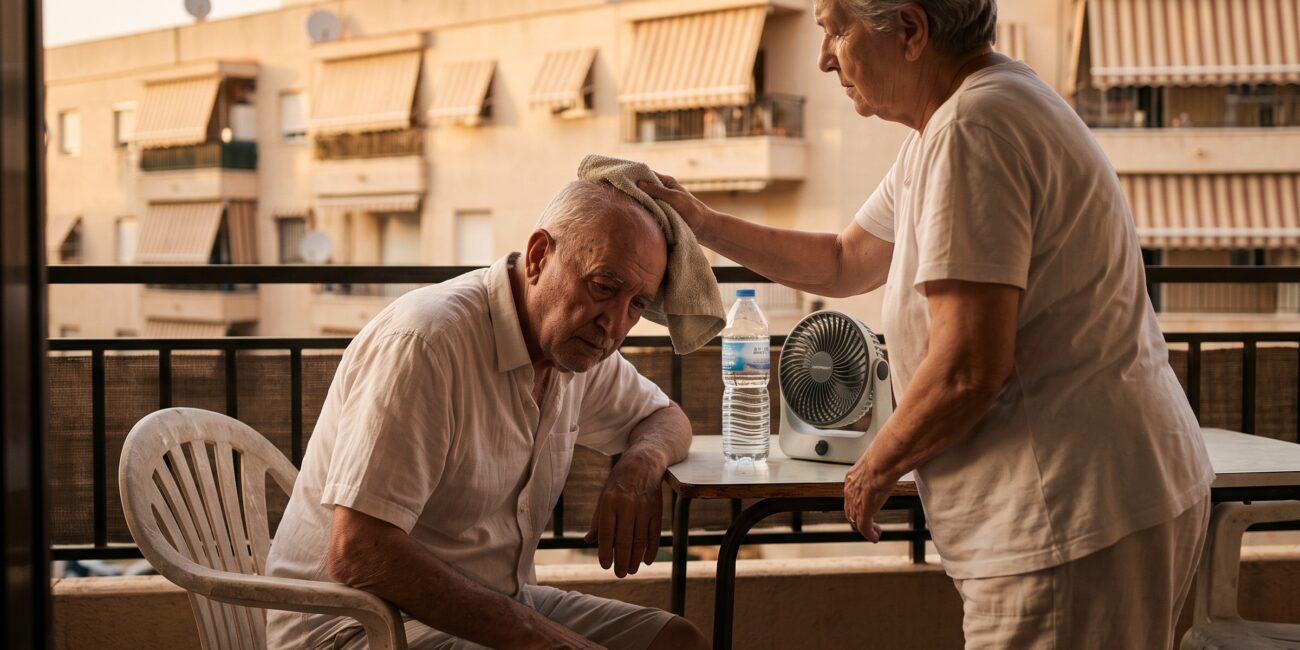
The summer of 2026 has resulted in 586 deaths attributable to extreme heat across the Comunitat Valenciana, marking the highest figure recorded since 2015, according to data from the Daily Mortality Monitoring System (MoMo) operated by the Instituto de Salud Carlos III.

The official report covers fatalities linked to high temperatures between 21 June, the beginning of the astronomical summer, and the early hours of Wednesday, when autumn officially arrived. Throughout that span, Spain as a whole registered 5,428 heat-related fatalities, meaning more than one in ten deaths occurred within the Comunitat Valenciana.
Across the region, Alicante proved to be the most severely impacted province, accounting for 279 deaths linked to soaring temperatures. Valencia recorded 179 fatalities, while 128 deaths were registered in Castellón over the same timeframe.
Figures from MoMo reveal that the vast majority of victims were aged over 65. The impact was also higher among men, who accounted for 310 deaths compared to the total number of female fatalities.
From a meteorological perspective, the climatological summer (June, July, and August) ranked as both the warmest and the tenth driest in the Comunitat Valenciana since 1950. The territory endured three distinct heatwaves and broke previous records for torrid nights, enduring 65 dates where overnight temperatures never fell below 25 degrees.
July proved to be the deadliest month of the season, seeing 235 heat-linked deaths. August followed closely with 228 fatalities. Between 21 and 30 June, 57 deaths were reported, whilst a further 65 took place between 1 and 21 September.
A weekly breakdown indicates that week 28, from 5 to 11 July, saw the highest single surge with 105 deaths, closely followed by week 34, from 16 to 22 August, with 100 fatalities. Week 29, between 12 and 18 July, also registered a high toll with 63 deaths.
Regarding single days, 10 July saw 22 heat-related deaths, whilst 20 occurred on 9 July. On both 21 July and 20 August, 19 deaths were recorded, with 18 on 22 August, 17 on 12 July, 16 on 20 August, and 15 on 13 July.
These numbers establish 2026 as the deadliest summer for heat in the Comunitat Valenciana since MoMo began keeping records in 2015. Previously, the summer of 2025 held the record with 431 fatalities, followed by 2015 with 348 deaths, 2022 with 329, 2023 with 306, 2019 with 277, and 2024 with 261.
The MoMo monitoring system calculates excess mortality by comparing registered deaths against expected statistical averages for a specific time and area, estimating the proportion linked to extreme temperatures. It does not establish individual causes of death, but rather identifies overarching mortality spikes connected to climatic events. Because notifications are continuously submitted with procedural delays, figures are routinely adjusted and are only consolidated after several weeks by the Instituto de Salud Carlos III.
Other Articles