
The project to transform Alicante’s rail network and create a direct train connection to Alicante-Elche Miguel Hernández Airport has just passed one of its major administrative milestones. The Ministry of Transport and Sustainable Mobility has given final approval to the feasibility study and the public consultation process for the Torrellano bypass.

The decision marks the end of the planning phase for this infrastructure project and will pave the way for the start of construction, the Ministry announced yesterday, Monday, October 5th. The resolution will be published shortly in the Official State Gazette (BOE).
The project is part of the remodeling of the Alicante Railway Arterial Network (RAF) and its main objectives include improving the city’s railway connections, facilitating direct access to the airport and making it possible to eliminate the current railway line that runs along the coast.
A direct rail connection to Alicante-Elche Airport
One of the most significant changes included in the Torrellano variant is the creation of a direct rail connection with the Alicante-Elche Miguel Hernández airport.
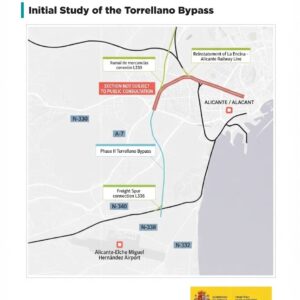
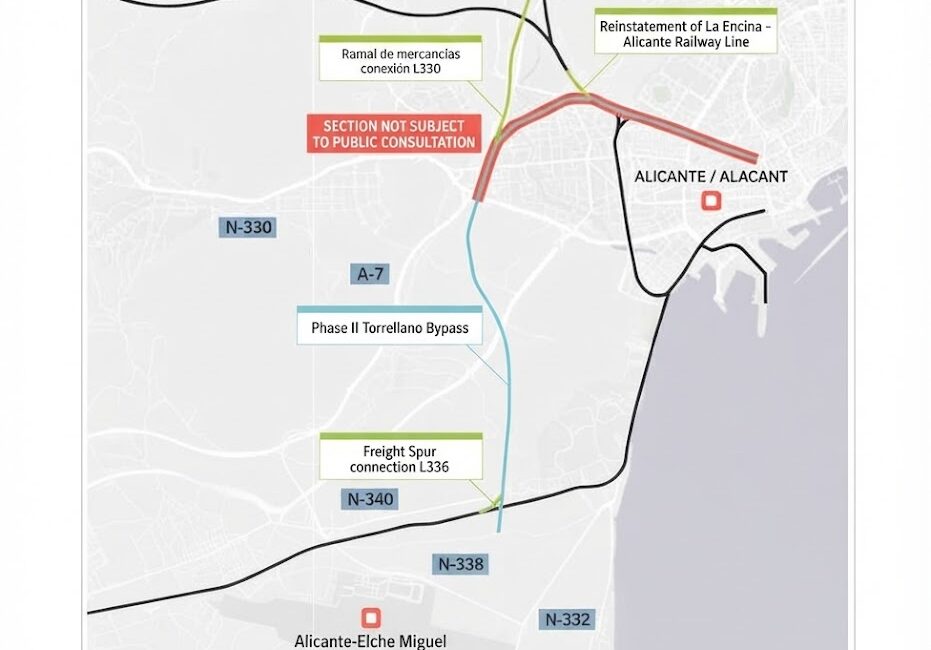
The project has been organised in two phases. Phase I is specifically designed to serve the airport and includes the construction of a station within the airport grounds. This phase is currently in the design phase.
Phase II, for its part, will continue this first section until reaching the Alacant-Terminal station, thus completing the route planned in the railway planning.
With the final approval of the study, the Ministry of Transport is promoting the work aimed at putting the entire section of the bypass into service up to the Alicante station.
The coastal railway line will be dismantled
The progress of the bypass will also have a significant impact on Alicante’s existing railway line. Its construction will allow for the dismantling of the coastal track between San Gabriel station and the Agua Amarga area.
The removal of this infrastructure is precisely one of the objectives expressly included in the project. The Ministry proposes eliminating this urban barrier in order to open the city of Alicante to the sea.
Transport has also confirmed with this resolution its decision to rule out electrification and gauge change of the coastal section as a provisional solution to route freight rail traffic during the construction of the bypass.
Instead, freight traffic will be diverted via the Murcia-El Reguerón high-speed line, a measure that, as the Ministry recalls, was promised by Minister Óscar Puente during one of his visits to Alicante.
Improvements for the commuter rail network and the Mediterranean Corridor
The connection to the airport and the removal of the coastal railway line are not the only objectives of the project. The Torrellano bypass also aims to improve the services provided by the C1 Alicante-Terminal-Murcia del Carmen commuter rail line.
Likewise, the project aims to increase the operational capacity and functionality of the Alicante Railway Arterial Network and promote its integration into the Mediterranean Corridor.
Thus, the project is structured around four main objectives: improving the commuter rail service, increasing the capacity of the Alicante railway network, directly connecting the airport by rail, and making it possible to dismantle the section located next to the coast.
The project already has a favourable environmental statement
The final approval comes after another important step for the future of the infrastructure. On May 29th, 2026, the Ministry for Ecological Transition and the Demographic Challenge issued the resolution from the Directorate General for Environmental Quality and Assessment, which formulated the environmental impact statement favourable to the project.
The variant is also framed within the objectives of the Sustainable, Safe and Connected Mobility Strategy 2030, aimed, among other aspects, at improving social cohesion, promoting economic growth and providing answers to mobility needs.
In this regard, the Ministry of Transport highlights the role of rail as an alternative to private vehicles and its contribution to sustainable mobility from social, economic and environmental perspectives.
With the final approval of the preliminary study for the Torrellano variant, the project thus completes its planning phase and moves towards a new stage to make the future direct rail connection with the Alicante-Elche airport and the transformation of the city’s railway line a reality.
Other Articles

Eviction of 95-year-old man in Benidorm postponed for one month
Woman arrested in Alicante over bank scam