
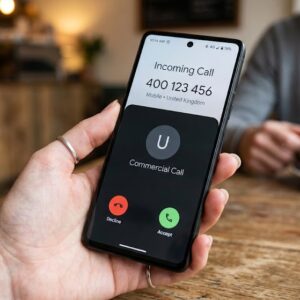
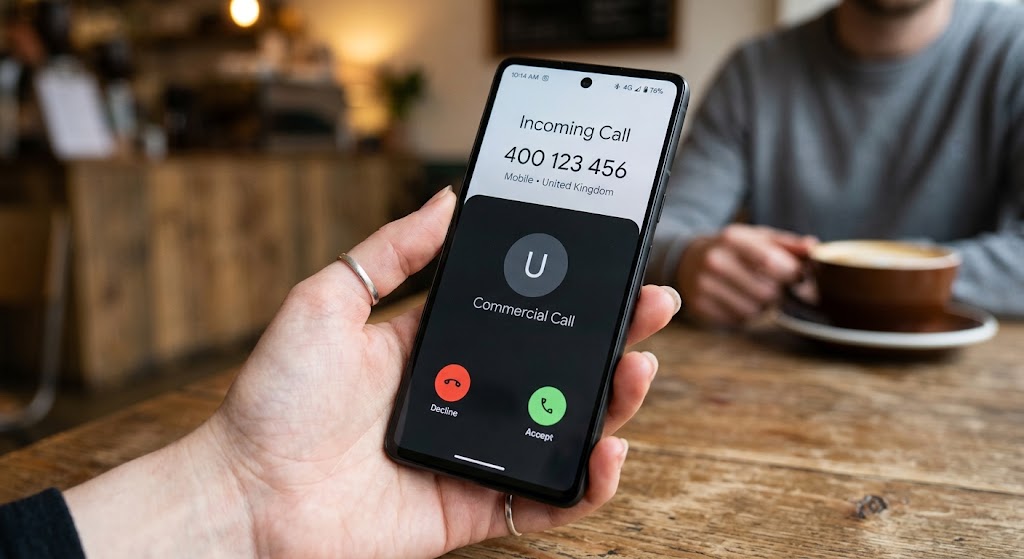
Receiving a call from an unknown number and discovering, upon answering, that it is a company trying to sell a product or service is a common situation for many people. However, starting this Saturday, October 17th, 2026, identifying these types of calls will be much easier thanks to a change in telephone numbering.

The government has mandated that commercial calls must be made from numbers beginning with 400, so that consumers can recognise their purpose before answering. The measure affects companies covered by the regulations, with certain legal exceptions, and aims to reduce confusion between advertising calls and those related to personal matters or contracted services.
The modification is included in a resolution of the State Secretariat for Telecommunications and Digital Infrastructures, published in the Official State Gazette on April 16, 2026, which established a period of six months to put the new numbering into operation.
What does it mean when a number starts with 400?
The main change is that companies subject to this obligation must use nine-digit numbers starting with 400 when making business calls.
For example, if a consumer receives a call from a phone number that begins with those three digits, they will be able to identify it as an advertising call without having to answer.
The National Commission for Markets and Competition explains that the objective is for citizens to be able to clearly distinguish when a company intends to offer them a product or service and when it calls them for another reason.
Until now, these types of calls could cause confusion because they used numbers that users associated with other types of calls. With the new system, the area code will allow users to immediately recognise their commercial nature.
What if my phone or electricity company calls me?
One of the most important aspects of the change is the difference between a sales call and a customer service call.
If a company contacts a consumer to offer a new rate or try to sell a service, that communication may be subject to the obligation to use 400 numbers.
However, a call related to a breakdown, a complaint, an inquiry or the management of a contracted service does not necessarily have to be made from that area code.
In fact, the new regulation states that 400 numbers cannot be used to provide customer service, precisely to prevent users from confusing an advertising call with a communication related to their contracts.
The regulations include certain exceptions, among them some related to electricity, gas and telephone service providers depending on their size and market share.
Can you return calls that begin with 400?
No. This is another peculiarity of the new numbering system. According to the Official State Gazette, numbers beginning with 400 can only be used for outgoing calls. In other words, businesses can make calls from these numbers, but users cannot call them back.
This restriction aims to prevent confusion and ensure that business phone numbers are not used for other purposes. Therefore, if a missed call appears from a number beginning with 400, it will not be possible to contact the company by directly returning that call.
Can I block all marketing calls?
The new regulations also include an interesting option for those who do not wish to receive these types of communications. The Official State Gazette establishes that telephone operators may offer their customers, upon request, the option to disconnect calls originating from the 400 range. This means that consumers can check with their telephone company to see if they offer this service to block receiving commercial calls from these numbers.
However, the regulations do not stipulate that all operators must automatically activate this blocking, nor that its availability is identical across all companies.
Furthermore, the new area code does not mean that commercial calls are prohibited. Companies must continue to respect the rules governing when they can contact consumers and under what circumstances they need their consent.
What happens if a company keeps calling from another number?
Once the adaptation period provided for in the resolution has elapsed, commercial calls subject to this regulation must be made using the specific numbering.
The National Commission for Markets and Competition will be responsible for monitoring compliance with the terms of use for the 400 prefix, while the competent authorities may take action against any violations. This does not mean that every call received from another number is necessarily fraudulent. It could be a legitimate call that is not advertising or that falls under one of the legal exceptions.
Nor should a call from a 400 number be assumed to be safe simply because it displays that prefix. Consumers should maintain normal precautions and avoid giving passwords, verification codes, or bank details to callers whose identity they have not been able to verify.
Since when does the new measure apply?
The key date is Saturday, October 17, 2026. The resolution regulating the 400 prefix was published on April 16 and came into effect the following day. Since then, companies and operators have had six months to adapt their systems and implement the new numbering.
The initiative is part of a series of measures aimed at improving the identification of commercial calls and strengthening consumer protection against unwanted communications and potential scams. Starting Saturday, seeing a number beginning with 400 on your phone screen will be a clear indication that the call is for commercial purposes, allowing you to decide whether to answer it or ignore it.

Line-up for the 6th Benidorm Fest revealed
Injured hiker rescued by helicopter