


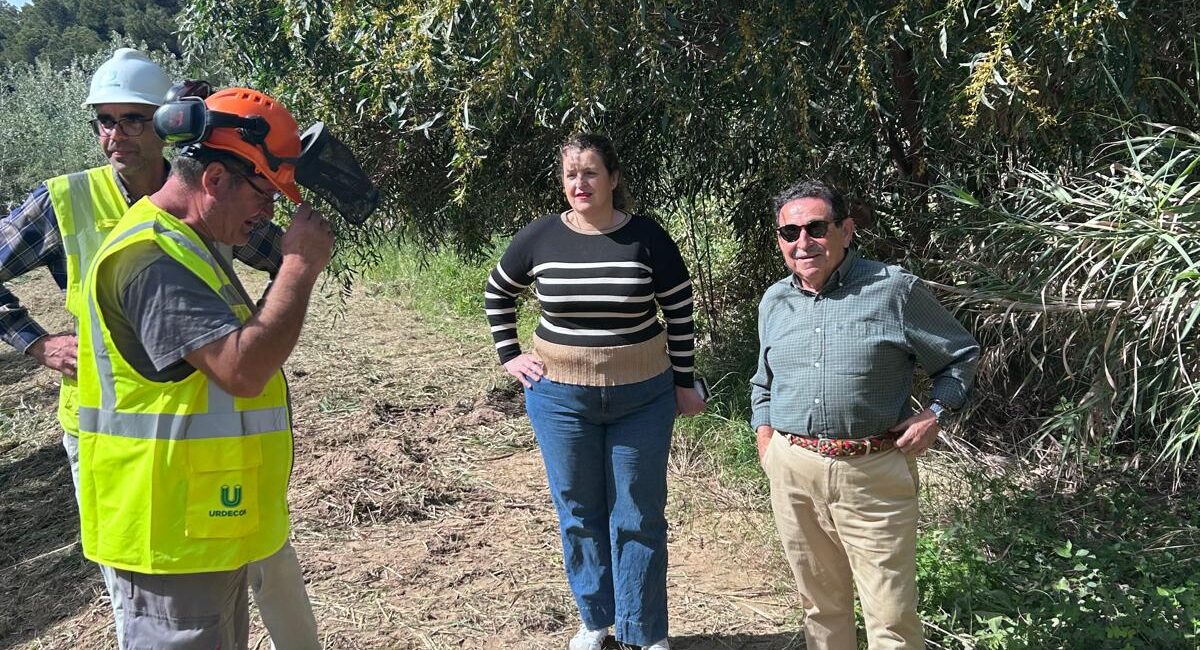
The Orihuela City Council has initiated new cleaning and maintenance efforts on urban waterways within the municipality, with a particular emphasis on the coastal strip. This initiative is part of a comprehensive project that is designed to enhance the environmental and landscape condition of these areas, prevent flooding, and restore drainage capacity. Manuel Mestre, the Councillor for Coastal Areas, and Noelia Grao, the Councillor for the Environment, visited a site where work has already commenced to monitor its advancement. These actions are being implemented in response to a request from the City Council to the Segura River Basin Authority.

These works are a continuation of those that have already been completed in the urban area, where the City Council has previously intervened in various inland waterways. They now enable progress to be made on the coastal sections, which are particularly susceptible to episodes of intense rainfall.
The Nacimiento River, the Rambla de las Estacas, and the Barranco Rubio are the three primary channels for the evacuation of rainfall in the coastal area. The current construction is underway in these areas.
In the vicinity of Campoamor, the Nacimiento River has exhibited a substantial increase in the growth of invasive vegetation, as well as the accumulation of urban refuse, sediment, and plant debris. This can result in flooding or overflows during periods of intense rainfall, as it reduces the river’s drainage capacity. The actions implemented include the removal and management of refuse, the cleaning of the riverbed, and mechanised clearing.
The Rambla de las Estacas, a major drainage channel in the southern region of the municipality, is currently undergoing repairs to the dense vegetation and accumulated washed materials. This work is expected to reduce the hydraulic section of the channel and increase the likelihood of obstructions.
In the Barranco Rubio ravine, which is also located in Campoamor, the objective is to restore the ravine’s functionality and reduce the danger of flooding by removing accumulations of plant material and debris that obstruct the flow of water.
These interventions are in addition to the cleansing and maintenance efforts that the City Council has already implemented in a variety of waterways within the municipality. invasive vegetation was eradicated and the riverbed was cleansed in the vicinity of the Twin Waterwheels, thereby enhancing the conservation status of this historical and scenic area and its hydraulic capacity. Work has also been conducted in the Sanes, Los Muertos, Los Calderones, and Bonanza ravines.
The objectives are to restore the drainage capacity of the waterways by means of the following: the removal of sediments and plant debris, the manual and mechanical cleaning of the waterways, the removal and management of refuse at authorised landfills, and the mechanised and selective clearing of invasive vegetation. The environmental impact of these works is minimised while respecting the native riparian vegetation.
The risk of flooding is exacerbated in areas near populated centers as a result of the accumulation of detritus and vegetation in waterways, which reduces their drainage capacity. Subsequently, these initiatives are characterised by a robust preventative approach, which enables the municipality to anticipate potential incidents and enhances safety generally.
The project is being executed in accordance with the agreement between the Orihuela City Council and the CHS, with the City Council contributing 60%.
Noelia Grao, the Councillor for the Environment, emphasised that this is “a critical action to enhance the safety and condition of the municipality’s waterways.” She also emphasised that “this work enables us to predict potential issues and guarantee improved performance during periods of heavy rainfall.”