


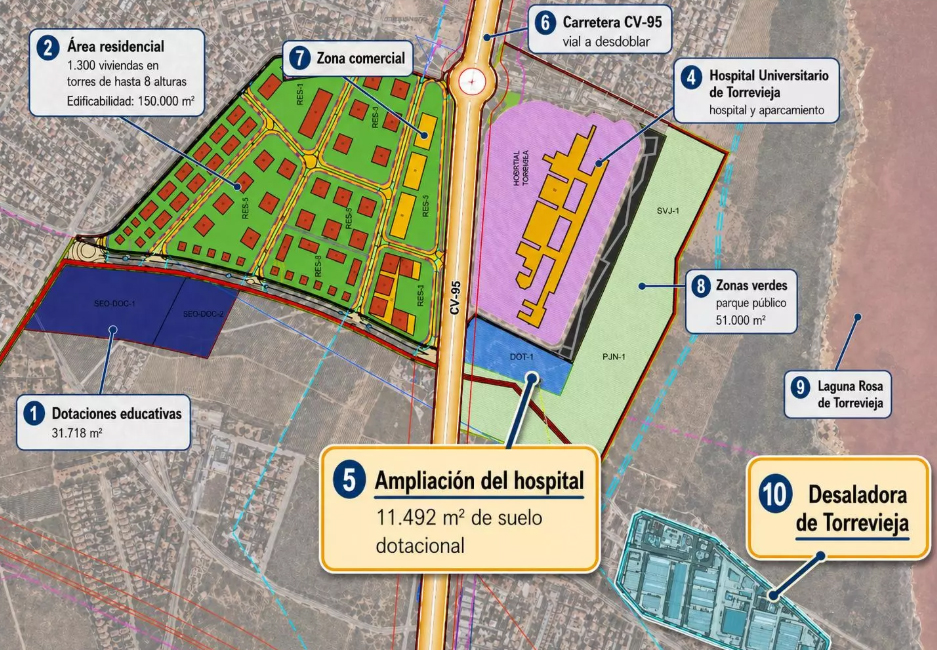
The expansion of the CV-95 highway between the roundabout that gives access to the Torrevieja Hospital in Los Balcones and the roundabout of the desalination plant, which has been paralysed since 2003, will be paid and executed mainly by the promoter of Sector 29 La Ceñuela, as part of the costs of the residential and commercial development, which involves 1,300 homes and is in the planning phase. The part to be widened is around 870 linear metres, but the Generalitat, the regional government responsible for drawing up the project, has integrated certain major alterations that will be assumed by the developer, according to the governing team of the Popular Party.

Auxiliary lane
This comprises the construction of a lane that will connect the N-332 bypass with the Torrevieja University Hospital, and will allow access to the medical centre directly. Towards Los Balcones-Torrevieja the route will have two lanes and towards Torrevieja-Los Balcones three. The third lane will be an independent auxiliary lane, separated from the other two, so that traffic from Torrevieja to the hospital can utilise this route.
Also, the City Council wants to take over the approximately 200-meter stretch between the desalination plant and La Veleta that is not the responsibility of the developer. All this is subject clarity from the Ministry of Transport of how the access would be obtained to the N-332 bypass from that location, which will be a dual carriageway. This option is not yet taken into account in the final designs of the construction project finalised by the Generalitat (Valencian regional administration).
Sources inside the government team explained that the idea, which affects the whole road widening project, is not yet definitive from a technical point of view and may be changed. Consequently, the schedule for starting the on-site work is yet undetermined.
Cycleway
The project also includes a bicycle lane that will connect with the existing one along the N-332 parkway on the other side of the hospital, avoiding what is now the La Ceñuela estate, where the urban development plan provides for the construction of homes. The City Council’s original plans for a pathway and bike lane to link the cemetery to the hospital are now unviable, as there is no accessible property near to the desalination plant and the hospital could be expanded.
This plan ought to be the last. The road widening has been delayed since 2005 when this urban development project started to be reviewed. It was suspended in 2015 when the Generalitat (Valencian regional government) protected 70% of the zone to be reclassified. It was a must for the developer of the urban development area. However, the road widening, which is part of the sector’s commitments, has also not been carried out, as the land reclassification in exchange for providing 100,000 square metres of the sector to build the hospital, which began in 2006, has not materialised. The widening was first included as an element of the unique plan designed for the hospital. Since then, the average daily traffic flow has climbed to around 20,000 cars, resulting in chronic traffic bottlenecks both entering Torrevieja and accessing the hospital.
Now the promoter, once the Generalitat
Since taking office, the mayor of Torrevieja, Eduardo Dolón, has credited the Valencian regional government (Generalitat) alone for financing and executing the road widening project. “But now he has altered his tune saying that the majority of the work would be carried out by the developer of Sector 29 La Ceñuela once the project has final clearance. Thus, the infrastructure’s future depends on adoption of an urban growth plan. This project, which occupies 350,000 square meters and comprises more than 1,300 residences, largely in eight-storey towers, was first approved on Monday, in the ordinary plenary session, for the special modification of the General Plan that will provide it a legal foundation.
Still a long way to go
There are going to be many months, maybe years, before any work can ever be done on the site to develop the neighbourhood or to widen the road. The change, number 116 of the 1986 Torrevieja General Urban Development Plan (PGOU), must be definitively approved after the public consultation process, a decision that ultimately lies with the Generalitat (Valencian regional authority). And the partial plan, which is being processed in parallel by the developer, also needs definitive approval, pending municipal permission.
This solely applies to the CV-95 widening in this segment. The portion between Los Balcones and Orihuela, which includes the road that goes across the entire Torrevieja development, is dependent on a concession proposal pushed by the Generalitat (regional government of Valencia), the drafting of which has yet to be awarded.
Other Articles

