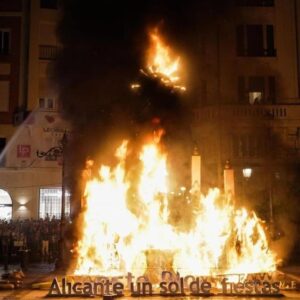



The Councillor for Beaches, Antonio Vidal, has announced that the city of Torrevieja will celebrate the traditional Bonfires of San Juan on its beaches this coming Tuesday, 23rd June. Vidal reported that many Torrevieja residents enjoy this popular festival on the beaches and that it “serves as the kickoff to summer, becoming a special celebration enjoyed by both young and old,” as the councillor noted.

There will be four beaches where this tradition can be celebrated – La Mata, El Cura, Los Locos and Los Náufragos – and they will be controlled by members of the Local Police, Guardia Civil and Civil Protection.
Wood distribution for the festivities
The City Council will provide wood for this popular festival. A total of approximately 30,000 kilos of pine and mimosa wood will be distributed — which the Beaches Department assures leaves no residue — and no other types of wood or materials that could be used to make bonfires on the beaches will be permitted.
The firewood distribution points will be: Los Náufragos beach at the entrance to the Poniente pier; Los Locos beach (central area); and El Cura beach (northern area). On La Mata beach, there will be three distribution points: Avenida del Agua (next to the pumping station), Avenida de los Europeos next to the lifeguard station, and in La Mata town, opposite Plaza de Encarnación Pucho. The Beaches Department recommends that bonfires do not exceed one metre in height for safety reasons.
The bonfire celebrations for San Juan’s Eve on Torrevieja’s four beaches will take place from 20:00 to 02:00, at which time residents will be encouraged to end the festivities, as beach cleaning will begin afterward. The Department of Urban Cleaning will have additional staff on duty that night to clean these four beaches.
Food, bathing, and rituals
The control exercised by the City Council in distributing the limited amount of wood and clearing the beaches has considerably reduced the size of the bonfires — they have been much smaller for some time now — and their number on the beaches. In reality, the San Juan festival has become more of a night for sharing dinner — there are now almost more barbecues than bonfires — pagan rituals more or less adapted to the occasion, music, and nighttime dips in the sea. Some sections of these beaches attract more young people, such as Los Náufragos beach, where drinking in public is more common.
The main beach excluded from this list is Acequión. This stretch of coastline, located within the bay of Torrevieja, is managed by the City Council through an agreement with the Generalitat. Also excluded are the natural pools along the seafront promenade, Cabo Cervera, and Cala Piteras, although bonfires are still permitted at these locations.
In total, around 60 people will make up the security detail, including local police, civil guards and Civil Protection volunteers, in addition to four ambulances for any incidents that may occur during the night and early morning, as well as a lifeguard station on Los Náufragos beach with stretchers to attend to any possible incidents.
A night of popular celebration
Vidal indicated that the City Council hopes it will be “a night of popular celebration” and “enjoyment for all attendees” at the beaches and asks for responsibility so that when they leave they collect all the belongings and waste they may have accumulated and put them next to the bins.
The provincial Coastal Service generally does not authorise bonfires on beaches. However, if the local council that approves them does not explicitly request that they be held, it turns a blind eye. While the central government is responsible for enforcing the Coastal Law and preventing damage to public property, the responsibility for its maintenance lies with the local councils. In the case of Torrevieja, beach cleaning is carried out 365 days a year.
In fact, all the coastal municipalities of the Vega Baja region, with the exception of Torrevieja, restrict this use in accordance with their own ordinances. In Pilar de la Horadada, access to the beaches for bonfires and drinking in public is expressly prohibited on that night — a municipal decree usually reminds residents that what is prohibited year-round is not an exception on San Juan either.
Guardamar del Segura concentrates the festivities on a single stretch of the central beach, with a bonfire and a performance by the Grup Foguerer “Els Milotxes” for all residents and visitors, and prohibits bonfires — most of its beach is located next to a large pine forest. Orihuela leaves its decision until the last minute, but usually prohibits the use of the beaches for bonfires, as do many towns and cities in the province.