



The extraordinary regularisation of migrants has left Alicante with a dual image. On the one hand, it shows a province that has once again become one of the main centres of demand for this process in Spain. On the other, it shows thousands of people who have spent years working, caring for others, waiting tables, harvesting crops, or supporting households without fully recognised legal status and who now seek to transform that established life into one with legal documentation, rights, and stability.

The data confirms the significant role of Alicante in the procedure implemented by the central government. According to figures released this Thursday by the Government Delegation, the province has registered 73,245 applications, practically the same as Valencia, where 74,951 have been recorded. The difference between the two is a mere 1,706 applications. Overall, the Valencian Community has received 167,286 applications, making it the third autonomous community with the most requests, behind only Catalonia and Madrid, and ahead of Andalusia.
The provincial breakdown shows that Alicante is a primary territory in this process. Valencia accounts for approximately 44.8% of Valencian applications, while Alicante accounts for roughly 43.8%. Castellón lags considerably behind, with 19,090 applications, representing around 11.4%. This statistical snapshot reflects a reality that has been evident for years in sectors such as care work, agriculture, hospitality, and domestic work: a significant portion of the migrant population is integrated into the economic and social fabric of the province, although often in precarious or administratively invisible circumstances.
Spain already underwent a mass regularisation process in 2005, during the government of José Luis Rodríguez Zapatero. That process, then called normalisation, benefited 576,506 undocumented immigrants and profoundly transformed the labour market. Two decades later, the country is facing a new extraordinary regularisation process promoted by the government of Pedro Sánchez, with more than 1.17 million applications registered nationwide by the deadline of 30th June. Of these, more than 608,000 have already started processing, representing almost 52% of the total.
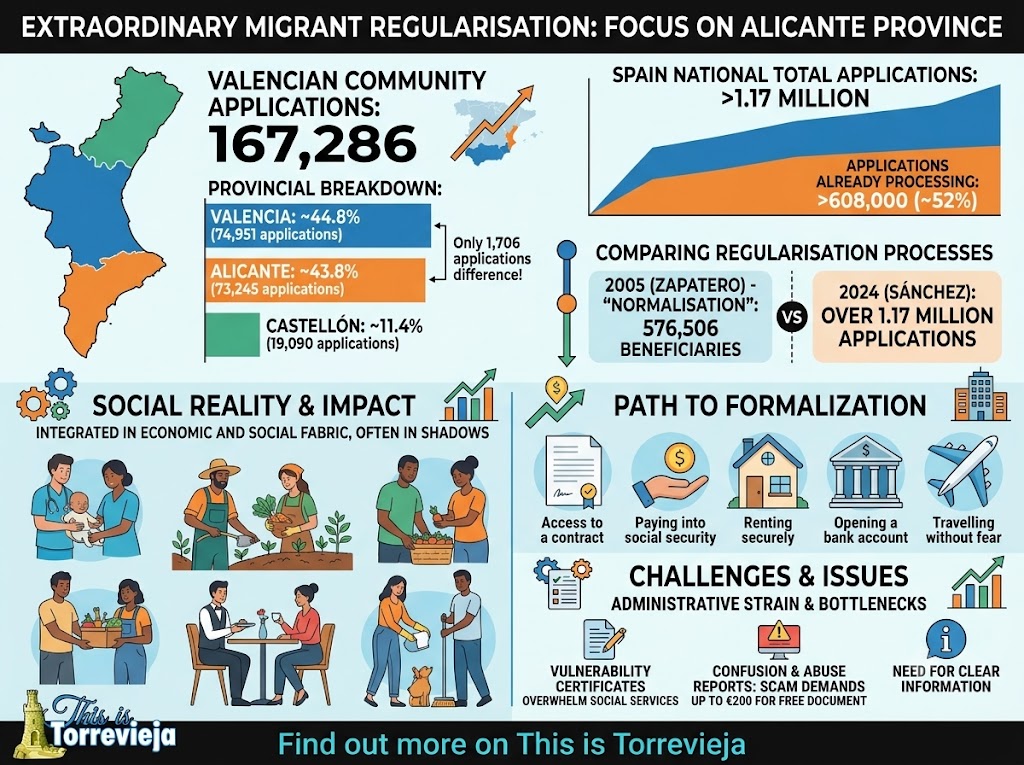
For those involved in the process, regularisation is not just a number or another bureaucratic hurdle. Immigrants who have already gone through previous processes, whether before Zapatero, during that normalisation period, through social or family ties, or via visa, all agree on one thing: having legal status makes the difference between living outside the system and truly integrating. It means access to a contract, paying into social security, renting with greater security, opening a bank account, travelling, not depending on intermediaries, and no longer living in fear of any ordinary procedure.
The procedure, however, has once again highlighted the difficulties faced by an administration strained by the avalanche of applications. In the province of Alicante, one of the main bottlenecks has been the vulnerability certificate, a key document in certain cases to prove the situation of those seeking extraordinary residency. Demand has overwhelmed social service centres, especially in the larger municipalities, coinciding with the start of in-person application submissions at the Post Office, Social Security, and the Immigration Office.
The measure, approved by the Government as a royal decree, stemmed from a citizens’ legislative initiative (ILP) that reached Congress with over 600,000 signatures but was blocked in the Lower House due to a lack of parliamentary agreement. All migrants who had been living irregularly in Spain before 1st January and had resided in the country for at least five months, as well as anyone who had applied for asylum before that date, were eligible to apply, provided they had no criminal record.
In the city of Alicante, the initial lack of clear instructions led some social service centres to simply record the names and phone numbers of applicants in order to notify them when there were defined criteria for processing the report. In just two centres located in neighbourhoods with a high concentration of migrants, more than a thousand people had registered. Other municipalities, such as Alcoy, established specific procedures to try to expedite the process.
The confusion surrounding the certificate has also opened the door to abuses. Some applicants have reported being asked for up to 200 euro in Alicante to process a document that is free. “Everyone is scrambling to find a piece of paper they’re being asked for. It’s all very confusing and complicated,” one of those affected explained. According to his testimony, some people are taking advantage of the lack of knowledge and the urgency of those who don’t want to miss the opportunity to regularise their situation: “Out of desperation, many pay it to avoid going back and forth.”
The Ministry of Inclusion, Social Security and Migration provides a template for a certificate of vulnerability on its dedicated regularisation portal, which is available for download. However, a combination of lack of awareness, fear of making a mistake, and difficulty accessing information has turned a free process into fertile ground for intermediaries and potential scams.
The process, therefore, offers a perspective that goes beyond the sheer volume of applications. Alicante is nearly as numerous as Valencia in terms of the number of requests, accounting for almost 44% of all applications in the Valencian Community. Behind this figure are thousands of people who are already part of the province and are now trying to leave the informal economy and access a normalised administrative life. Regularisation is thus once again presented as a turning point, the transition from sustaining part of the system in the shadows to being able to do so with recognised rights.
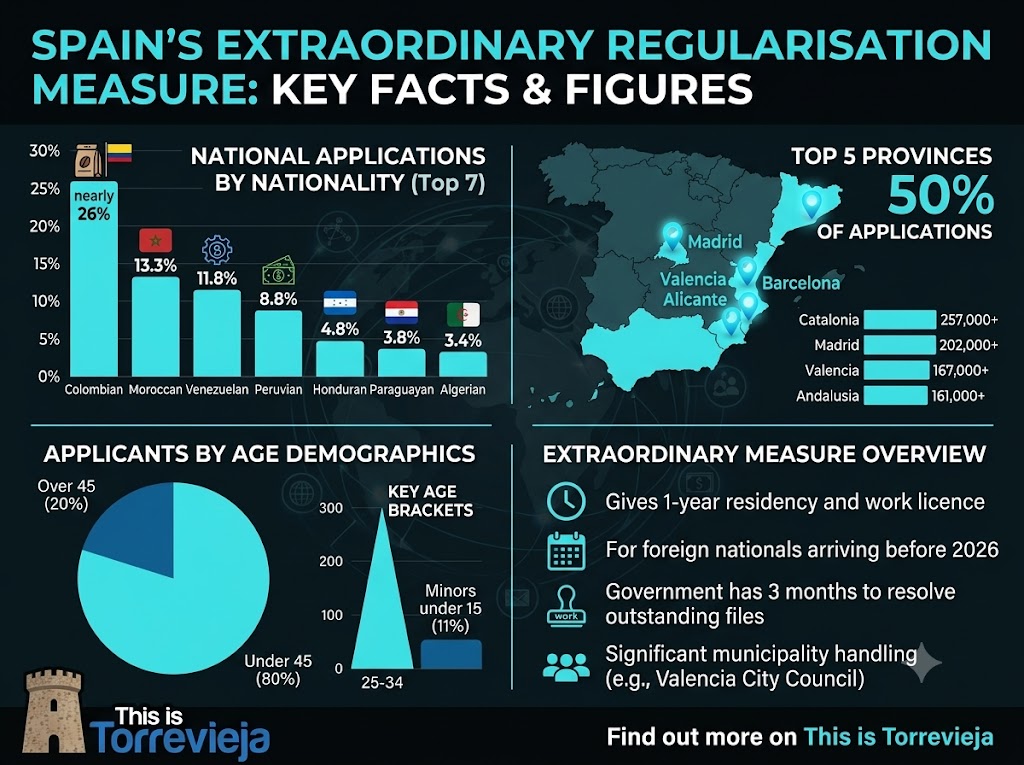
Nationally, the vast majority of applications have come from individuals originating from Latin America and Africa, with 80% of applicants aged under 45. The largest specific nationality group is Colombian, accounting for nearly 26% of all requests, followed by Moroccan citizens at 13.3%, Venezuelans at 11.8%, Peruvians at 8.8%, Hondurans at 4.8%, Paraguayans at 3.8% and Algerian nationals at 3.4%. By age demographics, the 25 to 34 age bracket submitted the highest number of petitions, whilst 11% of all applicants are minors under the age of 15.
Geographically, half of all regularisation applications were concentrated within just five provinces: Madrid, Barcelona, Valencia, Alicante and Murcia. Catalonia recorded the highest volume of files overall with more than 257,000 applications, followed by Madrid with 202,000, Valencia with 167,000 and Andalusia with 161,000. In terms of local municipalities, significant numbers of applications were handled by local offices, including queues of applicants at the Valencia City Council offices. The extraordinary measure grants a one-year residency and work licence to foreign nationals who arrived in Spain prior to 2026, and the government now has three months to resolve the vast majority of the remaining outstanding files.
Other Articles

Registration opens for the 54th Elche Half Marathon
Alicante to Madrid rail passenger numbers drop by 6%