



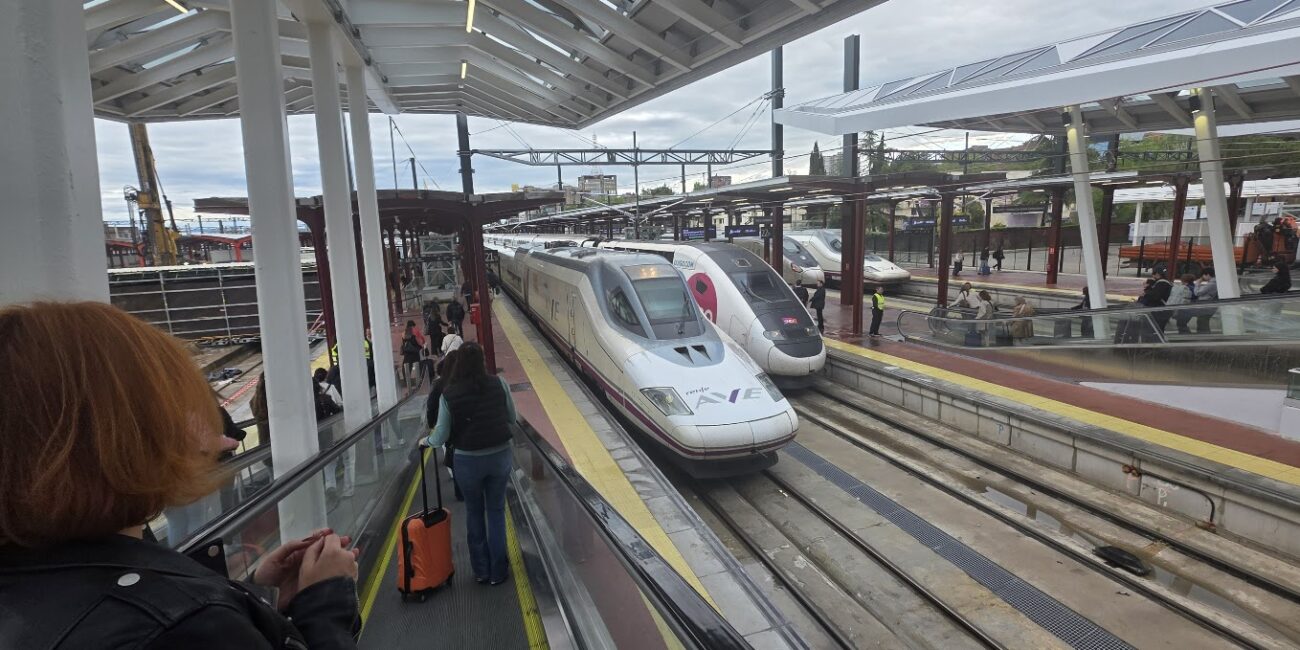
Not all that glitters is gold on the high speed rail corridor connecting Alicante and Madrid, at least according to the line’s performance at the start of this year. Specifically, between January and March, there was a 6% reduction in the number of passengers compared to the same period in 2025, according to the latest study by the National Markets and Competition Commission (CNMC) published on Tuesday, 30th June.

This decline is significant given that the corridor had been recording moderate but steady growth almost constantly since the liberalisation of the railway sector. This growth followed the introduction of new connections offered by Ouigo and iryo, alongside Renfe’s low-cost line, Avlo, between the spring and summer of 2023. In fact, Avlo was the first to provide this connection, debuting on 27th March 2023. Ouigo followed on 27th April, and iryo’s turn arrived on 2nd June.
Indeed, the CNMC report for the first quarter of 2025 showed a 3.8% increase in passenger numbers compared to the same period in 2024. Nevertheless, the connection between the two capital cities is the one resisting best across the national network, in a context where long-distance train travel contracted across all high speed corridors, according to the report. In the second-best position amidst the widespread decline is the connection between Valencia and Madrid, which lost 8% of its traffic.
The reduction of passengers in the remaining corridors resulted in double-digit percentages. The Madrid to Barcelona link lost 17%, Madrid to Seville dropped by 27%, and Madrid to Malaga and Granada fell by no less than 67%. In the global balance, according to the report, long-distance high speed lines recorded a 21% year-on-year drop in passenger numbers.
This data is confirmed by figures compiled by the INE up to April and published at the beginning of June, which reflected that long-distance rail transport fell by 13.7% year-on-year up to that month, with 3.86 million passengers. In that context, high speed services (AVE, Avlo, Ouigo and iryo) plummeted by 15%, with 3.1 million users, affected by the suspension of services on some routes and traffic disruptions.
The main cause of this general decline is no secret. It relates precisely to service cuts recorded on the southern corridor due to the rail accident in Adamuz, Cordoba, on 18 February, which forced the interruption of Madrid to Seville and Madrid to Malaga services and a reduction in frequencies. The same occurred regarding the Madrid to Barcelona connection, where, virtually in parallel, there were several days of temporary speed limitations and significant service delays. This situation was further aggravated by a 25-minute increase in journey times introduced on 5th February, according to the CNMC.
In principle, these circumstances should not have influenced the two Levante corridors, although a certain contagion effect may have occurred due to increased concern—technically unjustified—regarding the maintenance of railway infrastructure. Added to this were several episodes of adverse weather that discouraged travel during a period of the year when mobility for tourism and leisure reasons is typically at its lowest.
For the time being, ticket prices have not posed an additional obstacle to justify the reduction in travel. The CNMC report notes that the average price for a journey between Alicante and Madrid stood at 27 euro (excluding taxes). This figure is practically equivalent to the 28.86 euro recorded in the first quarter of 2025. Furthermore, it represents the second cheapest price recorded in the same quarter of this year across all corridors, sitting just one euro above the ticket prices on the Valencia to Madrid corridor. The average price excluding VAT for the Madrid to Barcelona line was 46 euro, the Madrid to Seville link was 33 euro, and Madrid to Malaga was 32 euro.
In any case, it is also noteworthy that the performance of the connection between Alicante and Madrid already showed signs of slowing down in the final quarter of 2025, according to the balance offered by the CNMC for that period. Specifically, during that timeframe, the line grew by only 0.4% in the number of users.