

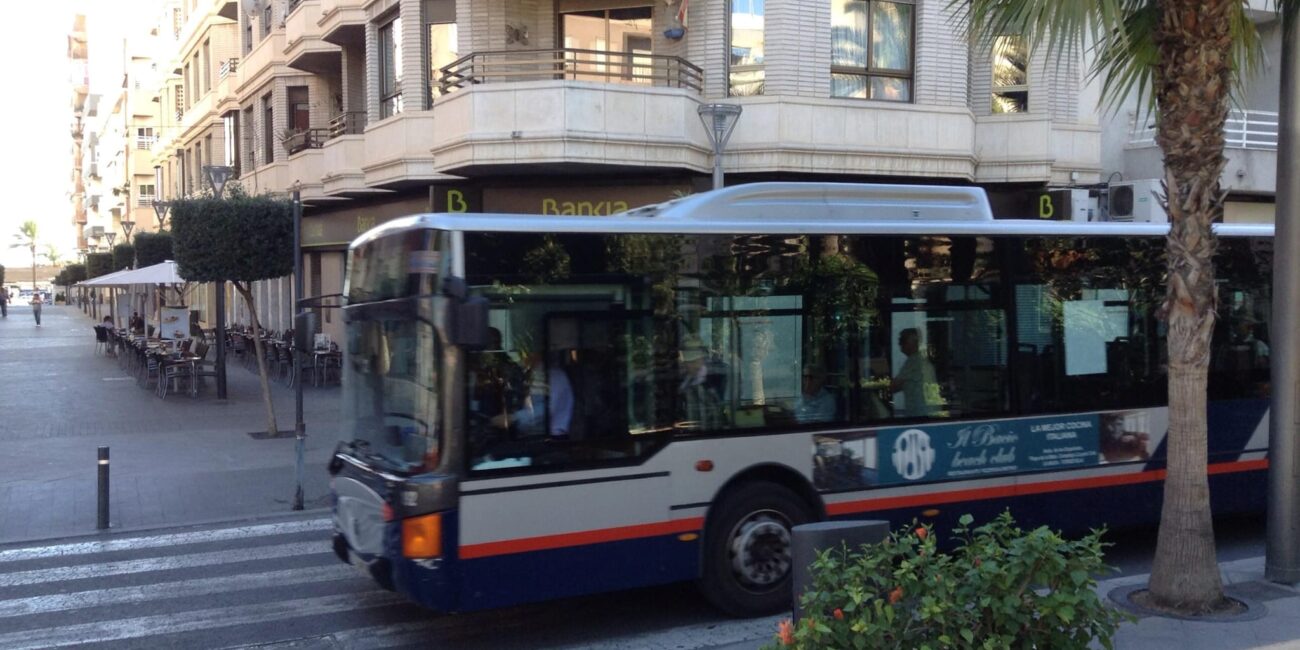
At the beginning of the month, Torrevieja City Council marked 27th July on the calendar as the date to launch the new urban bus service. Just days before the new network of lines begins, user criticism is focused on some of the routes, with many arguing that far from improving transportation, they worsen it.

The map, with its main stops and various connections, has stirred controversy because in some cases the routes are fragmented. The most complex contract ever processed in the municipality’s history, according to the City Council itself, with a cost of 67 million euro, aims to expand coverage to better connect neighbourhoods and residential areas, and strengthen links to the University Hospital, health centres, schools, high schools, beaches, markets, and La Mata.
However, even before its deployment, there are already doubts about whether its implementation through the winning bidder Avanza, the same company that has provided the service until now, with new lines, more frequencies, technology, different rates – the free service for registered residents ends – and 32 low-emission buses, will be able to end the numerous deficiencies recognised by everyone and suffered by users.
The criticism now focuses on the fact that residents will have to take two buses when previously they could get there with just one. The most striking example is the Rocío del Mar-Punta Prima route. What was previously a single route connecting the residential area with the town centre will now require two journeys for a distance of only 5 kilometres, forcing a transfer at the hospital.
The current Torrevieja-Los Altos-Rocío del Mar bus route, with a frequency of 40 minutes (at best), used to take at least 30 minutes for a relatively short journey due to its detours. Now it is shorter, but it does not reach the city centre.
The new Line 1 runs from Rocío del Mar, through Los Altos, to the hospital centre and vice versa. A single line covers a distance of just 3 kilometres. To continue to the town centre or vice versa, you will need to transfer to Line 3, which connects Avenida Doctor Gregorio Marañón with Desiderio Rodríguez, Mar Azul, and the hospital.
“All they have done is worsen the stops and routes,” laments one of the affected users, adding, “We are going to have to pay for two trips to get to Torrevieja. They are ripping us off; this is highway robbery,” referring to the cost of a single ticket – 1.35 euro each way. To avoid paying for a transfer, it is necessary to purchase one of the offered passes.
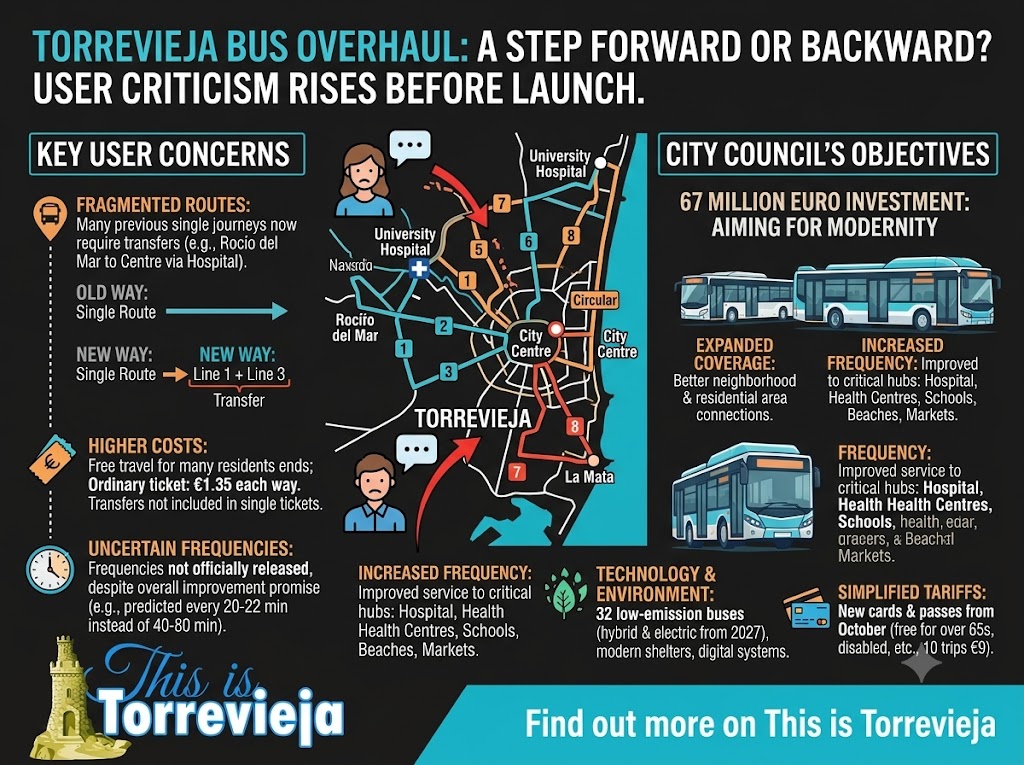
The network is structured around a main axis located on Avenida Doctor Gregorio Marañón, from where most routes to different areas of Torrevieja depart. The new system has 12 lines (nine daytime and three nighttime) and includes an on-demand transport service for certain areas.
New lines:
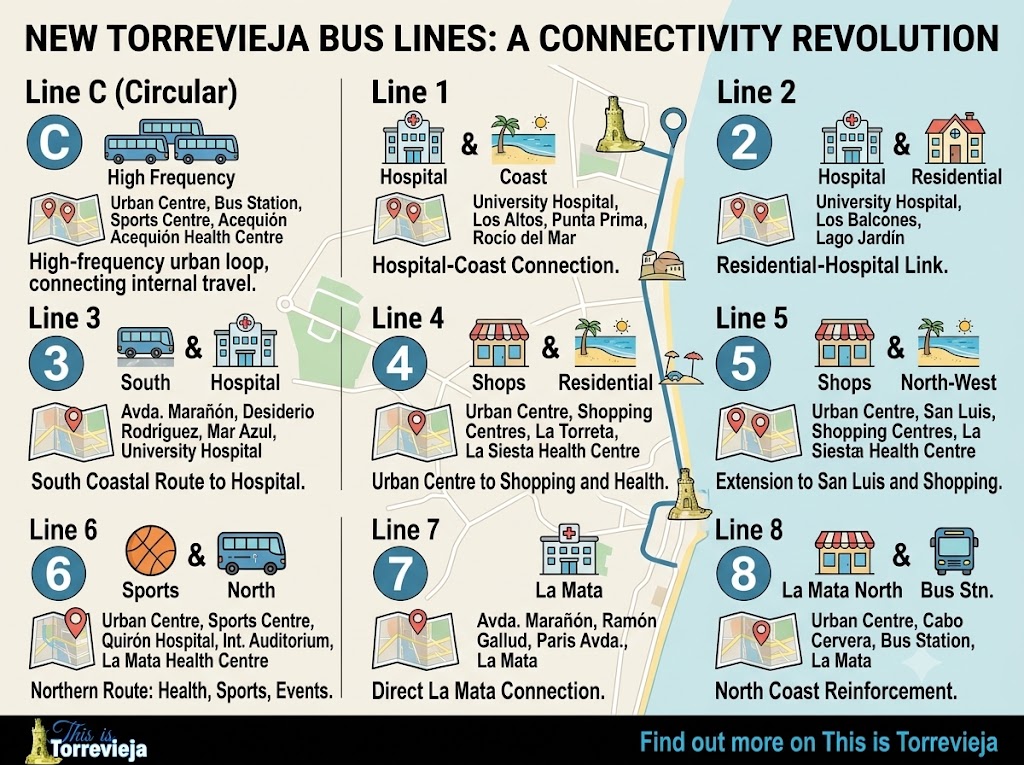
- Line C (Circular): will run through the urban centre, connecting Doctor Gregorio Marañón Avenue with the bus station, the municipal sports centre and the Acequión Health Centre, becoming the line with the highest frequency for internal travel.
- Line 1: will connect the University Hospital of Torrevieja with Los Altos, Punta Prima and Rocío del Mar.
- Line 2: will link the hospital with Los Balcones and Lago Jardín.
- Line 3: will connect Doctor Gregorio Marañón Avenue with Desiderio Rodríguez, Mar Azul and the University Hospital.
- Line 4: will connect the urban centre with the shopping centres, La Torreta and the La Siesta health centre.
- Line 5: will extend the service from the centre to San Luis, also passing through the shopping centres and the La Siesta health centre.
- Line 6: Will link the centre with the municipal sports centre, the Quirón Hospital, the International Auditorium and the La Mata health centre, also incorporating a special service to the market and the Auditorium during the celebration of events.
- Line 7: will connect Doctor Gregorio Marañón Avenue with Ramón Gallud, Paris Avenue and La Mata.
- Line 8: will connect the centre of Torrevieja with Cabo Cervera, the bus station and La Mata, reinforcing the connection of the northern coast.
The official announcement of the service frequencies, which was scheduled for last Monday, has not yet been made. What is known so far, unofficially, is that it will reduce waiting times by almost half compared to the previous service. Currently, there are minimum frequencies of 40 minutes on weekdays and between 60 and even 80 minutes on weekends and holidays. Now, the frequency will be between 20 and 22 minutes from Monday to Sunday.
The month of change The implementation of the service will follow a phased schedule culminating in 2027 with a renewed fleet. This first phase, dubbed the “month of change,” aims to allow residents to learn about and familiarise themselves with the new service before it becomes operational, according to the City Council.
However, only the route map has been published from the initial roadmap, without the frequencies being disseminated, nor the activation of the service’s website – planned for yesterday, Friday 24th July – with access via QR codes installed on bus shelters and buses.
As for the new bus shelters – 181 in total – with a separate investment of 1.5 million, deployment will begin in the first quarter of next year.
Second phase: tariffs For the time being, the service will operate with current fares until the second phase of implementation, scheduled for October. During this phase, the new transport cards and passes will be introduced, coexisting with the existing ones until the end of the year to facilitate the transition between the two systems. This effectively means the end of free travel for 80% of users – it was previously free for registered residents upon application.
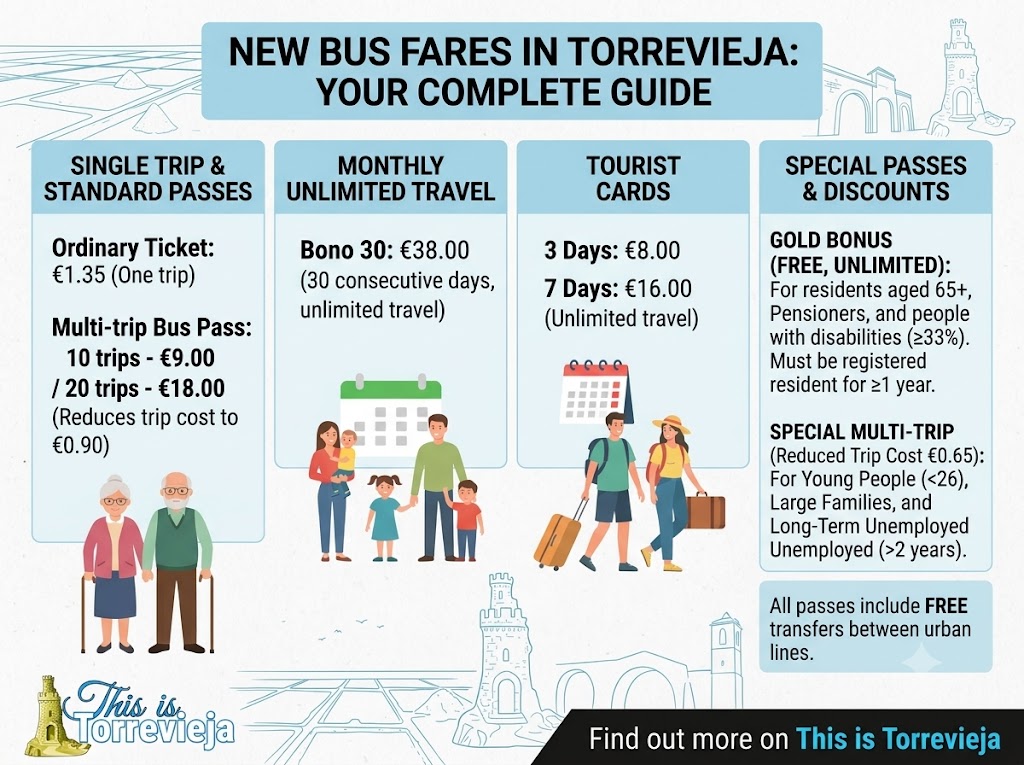
There will be a free pass for seniors (over 65), pensioners, and people with disabilities of 33% or less. Another special pass will be available for large families, the long-term unemployed, and young people under 26. A separate pass for tourists will cost 8 euro for three days or 16 euro for a week. A monthly pass will cost 38 euro. All passes include free transfers.
Rates: Ordinary ticket: Price: 1.35 euro Valid for a single trip on any of the urban lines.
Multi-trip Bus Pass: 10 trips: 9 euro 20 trips: 18 euro The actual cost of the trip is reduced to 0.90 euro.
Special Multi-Trip Bus Pass: Intended for groups with special mobility needs. Price per trip: 0.65 euro It will be available to young people under 26 years of age, large families and long-term unemployed people (more than two years).
Bono 30: Price: 38 euro Unlimited travel for 30 consecutive days on all urban transport lines. Aimed at any regular user of the service.
Tourist Card: Designed especially for tourists and visitors. Types: 3 days: 8 euro 7 days: 16 euro It allows unlimited travel during the contracted period.
Gold Bonus: The most socially oriented option in the new system. Completely free and unlimited travel all year round. Eligible applicants include residents of Torrevieja aged 65 and over for at least one year, pensioners registered for at least one year, and people with a disability of 33% or more registered for at least one year.
In addition, the traffic light priority system for buses will be put into operation, a technological improvement that will reduce travel times, improve punctuality and increase the regularity of the service, in addition to exclusive or priority bus lanes in Gregorio Marañón, Ramón Gallud, Apolo and Orihuela.
At the same time, work will continue on adapting the facilities for the future incorporation of the electric fleet.
Third phase: fleet renewal The final phase of the project will take place during 2027, with the goal of achieving complete modernisation by next summer. Between March and June, the new, permanent fleet of 32 low-emission buses will be progressively incorporated, including six electric and 26 hybrid vehicles, permanently replacing the temporary fleet. The new service will practically double the current capacity, increasing from 17 vehicles (14 in service and three in reserve) to a total of 32, which will significantly improve service frequency and expand coverage.
Also, during this phase, new onboard digital systems will be implemented that will allow users to consult information, validate tickets using mobile devices, pay directly with a bank card, and have a fully digitalised transport system.
The new service facilities will also be completed, which will include garages, workshops, offices, an operational base and charging infrastructure for the new electric fleet – the drafting of the project is now beginning and the execution of the works should be completed in 10 months.
Fire breaks out in Orihuela house
Man injured in head-on crash on CV-95 in Jacarilla
