



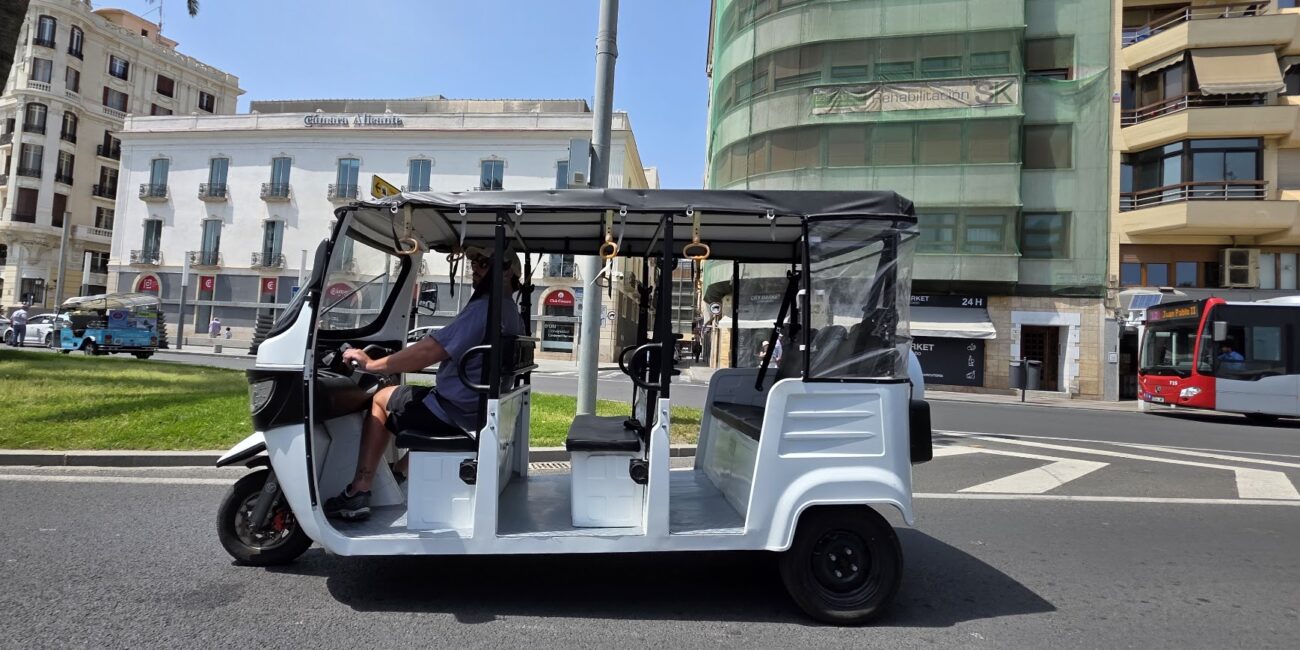
Alicante is facing another summer with tuk-tuks circulating through its streets without specific regulations governing their operation. These tourist vehicles have become a common sight during the peak season, with drivers reporting that a single vehicle can complete up to nine tours in a day when cruise ships dock. However, the city is still waiting for an ordinance that establishes where they can operate, where they can stop, and under what conditions they can provide services.

This August, the scene is repeated across various parts of the city. Tuk-tuks can be seen parked next to hotels on Postiguet beach, in Plaça del Mar, or in unauthorised areas while waiting for tourists. They also venture into restricted zones, and despite the city council’s announced ban, some continue to reach Santa Bárbara Castle. All of this occurs while the regulations intended to govern the activity remain unapproved.
In June 2025, the PP (People’s Party) governing team announced plans to modify the Vehicle Circulation Ordinance to establish limitations and conditions of use for tuk-tuks. The Councillor for Urban Mobility, Carlos de Juan, explained at a plenary session that the modification would serve to curb these tourist vehicles. However, official procedures did not begin until January 2026, when a 20-day consultation period was opened for citizens and organisations to submit input.
That deadline passed at the end of January, and seven months later, the amendment remains pending. The city thus faces another summer without a specific framework to regulate an industry that has grown in recent years, involving an increasing number of vehicles and operators. The primary measure adopted so far was banning tuk-tuks from driving through the Old Town via the Low Emission Zone. The City Council implemented this regulation in November 2025 after acknowledging that tuk-tuks were operating with municipal permits that violated Low Emission Zone restrictions.

Lack of control is particularly evident at Santa Bárbara Castle. Vehicles have been prohibited from entering the fortress since 4th June, yet they continue to reach the vicinity of the Benacantil hillside, even passing the access point designated exclusively for public transport and taxis.
Tuk-tuk driver Javier García explains that the castle remains part of the tours offered to visitors. He acknowledges taking passengers up to the fortress, though he notes it is more complicated now. He states that drivers normally go up with reservations, drop passengers off at the top, go back down to wait, and then return to pick them up. He adds that they usually wait around fifteen minutes downstairs, parked informally, before picking up clients to continue the city tour. During this wait, they often pick up additional tourists wanting to walk up the hill to the fortress entrance. He offers private city tours lasting between one and a half and two hours.
The volume of work increases significantly during summer, especially when cruise ships dock in Alicante. Driver Hernán Ortega, currently in his third summer working in the city, notes that on a normal day he completes two or three morning tours and another two or three in the afternoon. When cruise ships arrive, he easily does six or seven tours daily, and has completed as many as nine in a single day.
Another driver, Aiman Sambali, describes a system based on directly soliciting clients, completing up to eight tours a day paid on commission. He notes that when a cruise ship arrives, drivers head straight to the ship’s dock to pick up passengers directly.
This situation is causing frustration among local taxi drivers, who raise concerns over unfair competition and the absence of clear sector regulations. Taxi driver José Espí states that tuk-tuks perform services resembling taxis, parking anywhere without designated stops and obstructing traffic. Fellow taxi driver Jesús García notes that tuk-tuks routinely station themselves at the stand in front of Postiguet hotels, insisting that the City Council must step in to regulate the sector.