

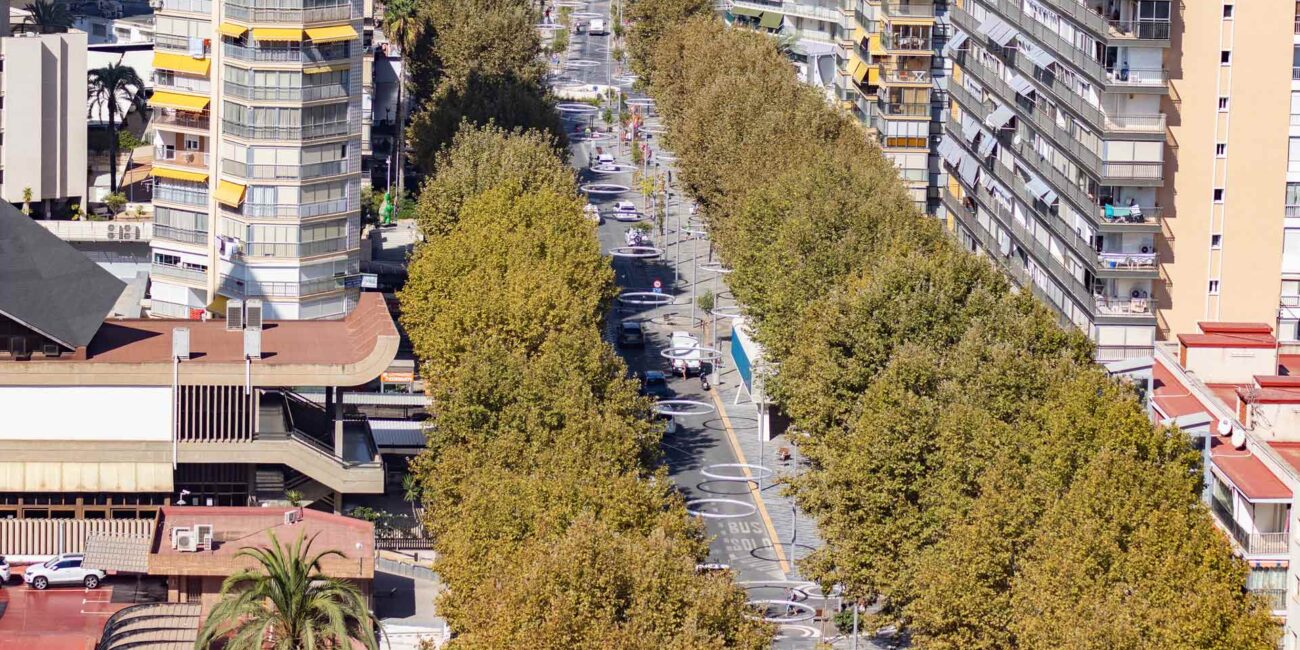
Benidorm Town Council is set to reinforce its urban tree cover by planting around 400 new trees during the final quarter of the year. The initiative aims to expand shaded areas and reduce the “heat island” effect linked to high temperatures. The project will involve an investment of more than 100,000 euro, spread across several contracts scheduled for approval starting next week.

The new plantings will be distributed across streets, squares, landscaped areas and school grounds. The selected species are mulberry trees (Morus alba), pride of Bolivia (Tipuana tipu) and Persian lilac (Melia azedarach). These leafy varieties have been chosen to generate a larger shaded surface area for both local neighbours and visitors.
The Councillor for Parks and Gardens, José Ramón González de Zárate, pointed out that the action responds to the municipal commitment to increase tree cover wherever possible and help tackle extreme temperatures. The aim is for tree shade to allow people to enjoy public spaces with greater comfort while reducing heat-related risks.
The councillor also highlighted the results achieved in streets where multiple lines of trees have already been added. According to González de Zárate, these areas have recorded drops of up to four and five degrees in temperature. He noted that planting trees, alongside supplementing them with artificial shade where tree planting is not possible, makes it possible to move towards a more comfortable city adapted to the effects of climate change.
Shade as a commercial ally
The expansion of shaded areas is not being framed purely as an environmental measure. The Town Council also links urban trees to commercial and economic activity, considering that a cooler and more pleasant public space can encourage people to spend more time in the streets.
The logic, according to González de Zárate, is simple: anyone walking down a street exposed to the heat tends to move quickly, whereas a shaded route with better comfort levels invites people to walk, stop in front of shop windows, enter businesses or sit at an outdoor terrace.
This increased presence on the streets can particularly benefit activities such as retail trade, catering, cafes, outdoor terraces, tourism, leisure and services, which are key sectors in Benidorm.
In this regard, the municipal leader considers that shade should be understood as an indirect economic asset for urban space as well as an environmental service. A greater presence of trees can enhance the attractiveness of the streets, the comfort of neighbours and tourists, and the vitality of commercial areas.
The Town Council is thus committed to incorporating trees as a core component of urban infrastructure. According to González de Zárate, the planning of new streets and public spaces should treat plant shade with the same importance as other elements like paving, lighting, drainage or street furniture.