
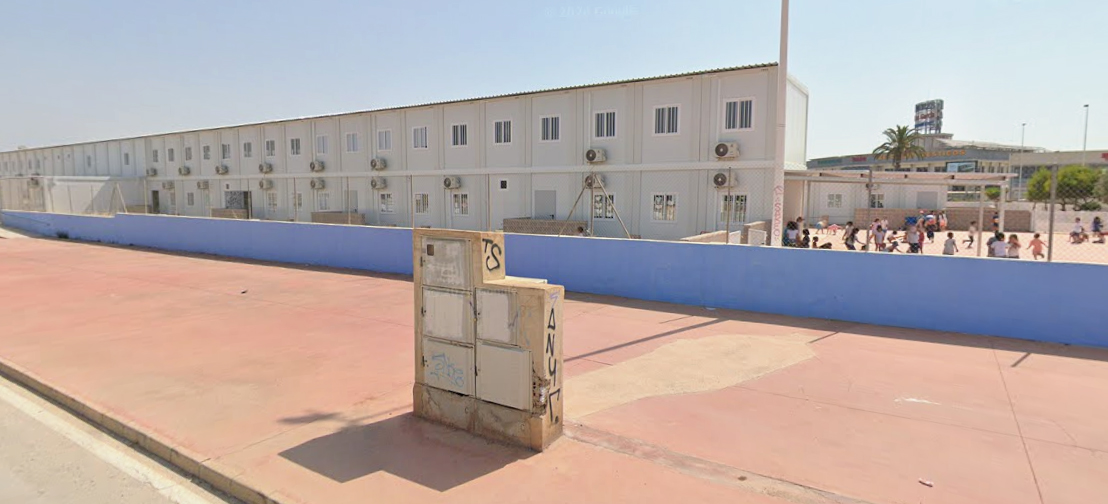
Prefabricated classrooms allow for a rapid increase in school places, but they are costly for the administration. The use of these modules has made it possible to respond to the rapidly growing demand for school places in Torrevieja and to open schools without waiting for permanent buildings. Currently, schools number 14, 15 and 16, the Eras de la Sal Secondary School number 6 and the extension of the Mare Nostrum Secondary School operate exclusively in temporary classrooms—new, air-conditioned and modern, but temporary nonetheless.

Without the temporary classrooms, it would be impossible to guarantee the right to education for new students in a municipality that, by maintaining the tourist housing construction industry at full capacity in what remains of its developable land, has added 10,000 inhabitants to its census in just two years. But this temporary arrangement could last for several school years and entails the limitations inherent in carrying out educational activities in this type of facility, which is no longer like the old barracks, but cannot be converted into makeshift gyms or auditoriums within walls of sheet steel and polyurethane insulation.
These inconveniences for students and teachers are compounded by a hefty public expenditure spread across various contracts, expansions and several years of rent. The cost of building a new secondary school is exorbitant. Three-year contracts alone represent an average cost exceeding 1.87 million euro per year, more than 5,100 euro per day.

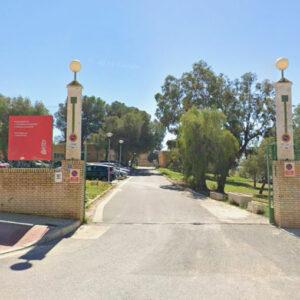
The amount corresponds to regional government contracts related to the modular classrooms and does not include the work the City Council must undertake to prepare the plots, install utilities or level the land. As just one example, the municipality had to spend over 140,000 euro to prepare the site for school number 16 in Mar Azul, which had previously housed the temporary classrooms of the Amanecer school for 17 years. Nor does it include the purchase of the buildings. The agreements primarily cover the assembly, rental for the contracted period and subsequent dismantling of facilities designed as temporary structures.
One of the most significant cases is the CEIP Maestro Ricardo Lafuente school, number 14. In 2022, the Generalitat awarded a contract for the construction and rental of the school until 2026 for 1,109,423 euro. The school opened with 20 classrooms: two for two-year-olds, six for preschool and twelve for primary school, in addition to a cafeteria, library, staff room, offices and other spaces necessary to function as a complete school. The facility was expanded in 2024 with another contract for 399,576 euro, which allowed for the addition of another grade level. Between both contracts, the total cost of the Maestro Ricardo Lafuente school reaches 1.51 million euro. With the expansion, the complex now has 29 classrooms, including the two for two-year-olds.
The situation is different at CEIP number 15. This school occupies entirely the prefabricated facilities that CEIP Inmaculada Concepción used while its new building was under construction. After Inmaculada relocated, the modules were retained to create the new school due to increased enrolment. The two contracts associated with these facilities total approximately 1.45 million euro, including taxes. CEIP 15 has 27 classrooms: nine for preschool and 18 for primary school.
The largest individual contract is for CEIP number 16. The Generalitat awarded its installation for 2,211,820 euro including VAT for 36 months. The average cost exceeds 737,000 euro per year, or approximately 2,020 euro per day. It comprises 27 regular classrooms, nine for preschool and 18 for primary school, as well as support classrooms, a music room, a computer lab, a library, a cafeteria, a staff room, administrative offices and other spaces for 675 students. The temporary installation for IES Eras de la Sal number 6 also exceeds two million euro. The main contract amounts to approximately 1.59 million euro including VAT, and a subsequent extension adds another 450,000 euro. In total, this amounts to 2.04 million euro, equivalent to approximately 679,000 euro per year or nearly 1,860 euro per day over 36 months.
The modular expansion of the IES Mare Nostrum has a smaller financial impact, although it follows the same model. Its six new classrooms, a staff room, restrooms and circulation areas were awarded for approximately 264,000 euro, including taxes, over three years. The average cost is around 88,000 euro annually and 240 euro daily. The size of the facilities demonstrates the extent to which this temporary solution has spread throughout Torrevieja’s education system, with more than 80 classrooms used daily by students and teachers.
The area occupied also reflects the scale of these facilities, with more than 9,500 square metres of prefabricated buildings alone, according to public information from the Generalitat regarding these contracts. In this respect, the administration is indeed proactive, given its extensive experience, awarding them through a streamlined framework agreement process between a group of approved companies and backed by a multi-million euro budget to cover all eventualities.
However, speed alone is not enough. Plots of land and their adaptation are needed, and these are not always available. Beyond the infrastructure, there is the logistical challenge of providing transportation, which the administration must guarantee for students living furthest from schools always located on the outskirts. Furthermore, there is the difficulty of establishing schools and institutes that accommodate a migrant student body exceeding 60%, with a significant number of temporary teachers.
Other Articles