

The action in Alicante took place shortly after a major phase of the operation executed on 10th April 2026. On that date, officers searched residential properties and a workshop across Malaga, Estepona, Marbella, and Churriana. These raids yielded 1,434 kilos of cocaine, 800 grams of tusi, two short firearms, four cars, and two motorcycles.

Concurrently, officers raided a villa used as a storage warehouse in Sant Just Desvern, Barcelona, finding 1,351 kilos of cocaine concealed inside a garage.
In the days following these raids, officers arrested three further members of the network in Pilar de la Horadada, all linked to the transportation of the seized drugs.
A network specialised in road transport
According to the National Police, the organisation comprised mainly Albanian nationals based on the Costa del Sol who specialised in storing and moving large quantities of cocaine by road.
The narcotics originated from Colombian trafficking organisations and entered Spain via Campo de Gibraltar and Algeciras. The network was tasked with storing the drugs and moving them to northern Spain, with the final objective of crossing the border into France to supply distribution networks across the European Union.
Journeys between the Costa del Sol, Levante, and Catalonia
Investigators tracked frequent trips across Spain, primarily connecting the Costa del Sol, Campo de Gibraltar, Levante, Catalonia, and Madrid. Members of the group often travelled hundreds of kilometres only to stay at a destination for a few minutes. Observing these patterns enabled officers to map out the internal hierarchy and roles of each individual.
In April 2026, police tracked a convoy of high-end vehicles covering a round trip to Huelva exceeding 2,000 kilometres in a single day, with vehicles travelling at speeds above 200 kilometres per hour.
Vehicle firms and front men used for cover
The network used sophisticated security tactics to evade detection. They established companies dedicated to buying and selling high-end vehicles and utilised rental cars bearing temporary licence plates that were not listed in standard police databases.
The group also arranged sham contracts using front men and recruited low-income Albanian nationals to obscure ownership of the properties where drugs were stored. Police described the organisation as highly specialised and dangerous, noting that members used up to six vehicles at a time for counter-surveillance during movements.
High-end vehicles and assets seized
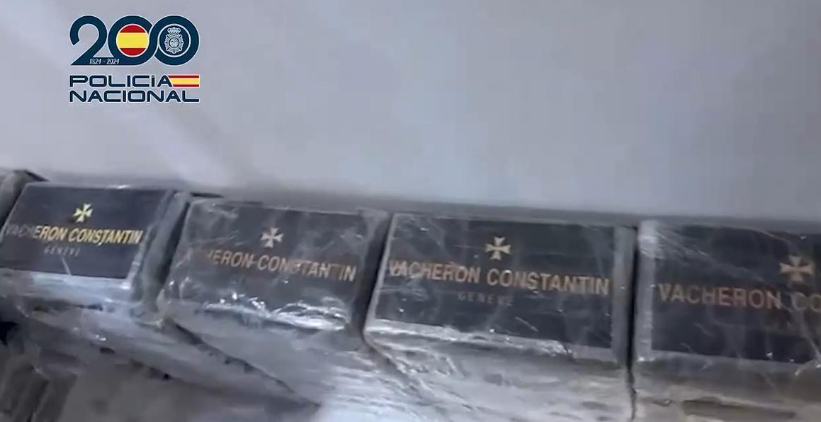
Across the whole operation, police confiscated two short firearms, 29 high-end vehicles, and eight additional vehicles. Officers also seized more than 13,800 euro in cash, high-value jewellery, luxury watches, crypto assets, bank accounts, and various financial products tied to the illegal activity.
The operation extended through the summer as police tracked down and arrested network members who had fled Spain or gone into hiding. Following judicial appearances, 12 of the 15 detainees were remanded in custody.
Other Articles

Guardia Civil investigate possible poisoning of a minor after drinking in Javea