


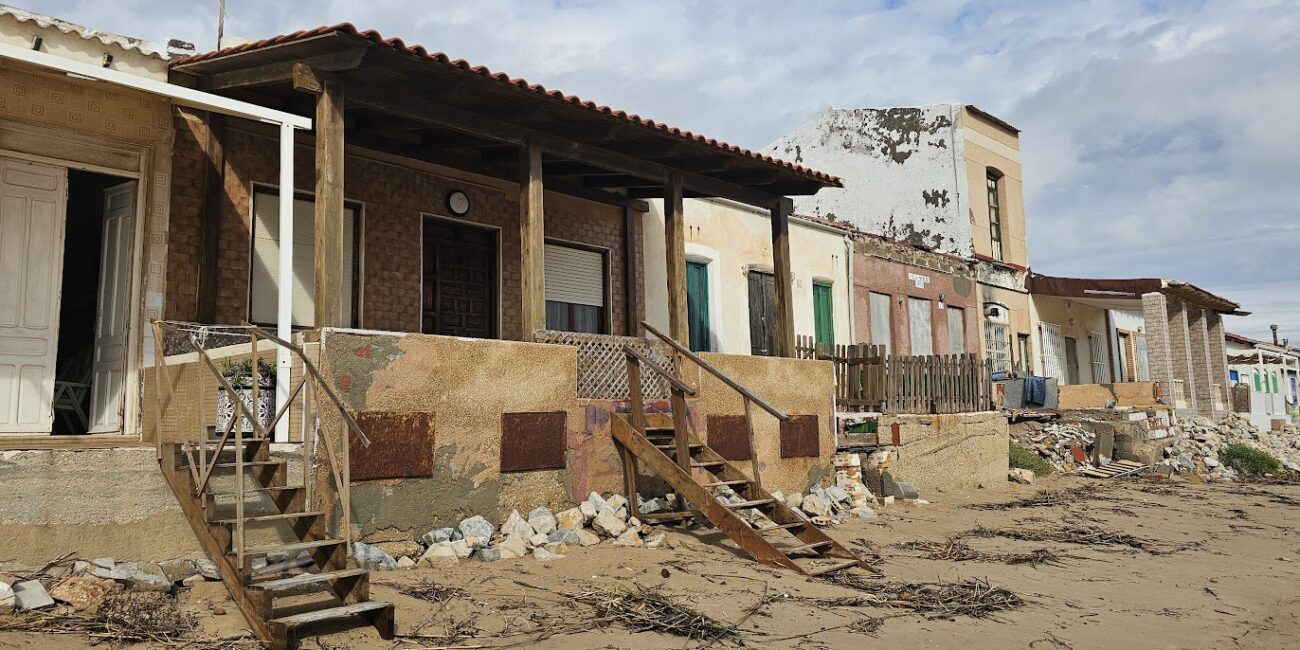
The Generalitat Valenciana has prepared a decree law to implement the legal framework for settlements of ethnological value, aiming to safeguard historic seafront communities such as the Babilonia beach properties in Guardamar del Segura as soon as the Tribunal Constitucional lifts its suspension on this portion of the regional coastal regulations.

The announcement was made by the third vice president and regional minister for the Environment, Infrastructure, Territory and Recovery, Vicente Martínez Mus, during an official visit to Guardamar del Segura. There, he met local residents affected by coastal boundary determinations and toured several affected properties.
The regional official stated that the Consell would not wait for a definitive ruling from the Tribunal Constitucional if the court first agrees to lift the precautionary suspension. “We already have a decree law drafted so we do not have to wait for that final resolution, allowing us to enforce this status of settlements of ethnological value,” Martínez Mus explained, reiterating that the regional administration intends to deploy all legal mechanisms at its disposal to stop these coastal settlements from disappearing.
The visit formed part of a schedule of meetings with coastal residents impacted by shoreline boundaries, which also took in Serra Grossa and Albufereta in Alicante. The minister framed all three cases within ongoing disagreements between the regional government and the central administration regarding coastal management and protection policies.
Addressing concerns over whether the central Ministry for the Ecological Transition could act against the properties before the Tribunal Constitucional issues its final decision, Martínez Mus expressed confidence that the ministry will show caution. He noted that while the legal challenge brought by the central government currently suspends the application of the ethnological protection clause, the remainder of the regional coastal law remains fully valid.
“I trust and believe the ministry’s current conduct indicates it will respect that prudence, which means at least waiting for the resolution of the Constitucional,” he stated.
Martínez Mus maintained that preserving the Babilonia dwellings is entirely compatible with environmental values and the public use of beaches. He emphasised that the regional framework was not conceived solely for Guardamar del Segura, but as a broader policy intended to address similar disputes throughout the Comunitat Valenciana where homeowners are facing boundary reclassifications rather than protection.
During the meeting, the regional minister also outlined formal objections submitted by the Generalitat Valenciana against proposed central modifications to national coastal regulations, which are being introduced via an anti-flooding decree. Martínez Mus criticised the draft criteria, arguing they could permit homes reached by sea water during storms to be absorbed into the public maritime-terrestrial domain. He noted that the regional government has joined forces with other coastal autonomous communities to call for a comprehensive reform of state coastal legislation.
Beyond legislative initiatives, Martínez Mus identified coastal regeneration as the primary long-term remedy to prevent beach regression across the Comunitat Valenciana. He accused the central government of failing to carry out planned coastal defence works and missing opportunities to secure European funding.
“It is technically possible to carry out regeneration and protection works so that we do not lose our beaches,” he said, warning that a lack of protective intervention is accelerating the loss of coastal territory, culture, and natural heritage.