



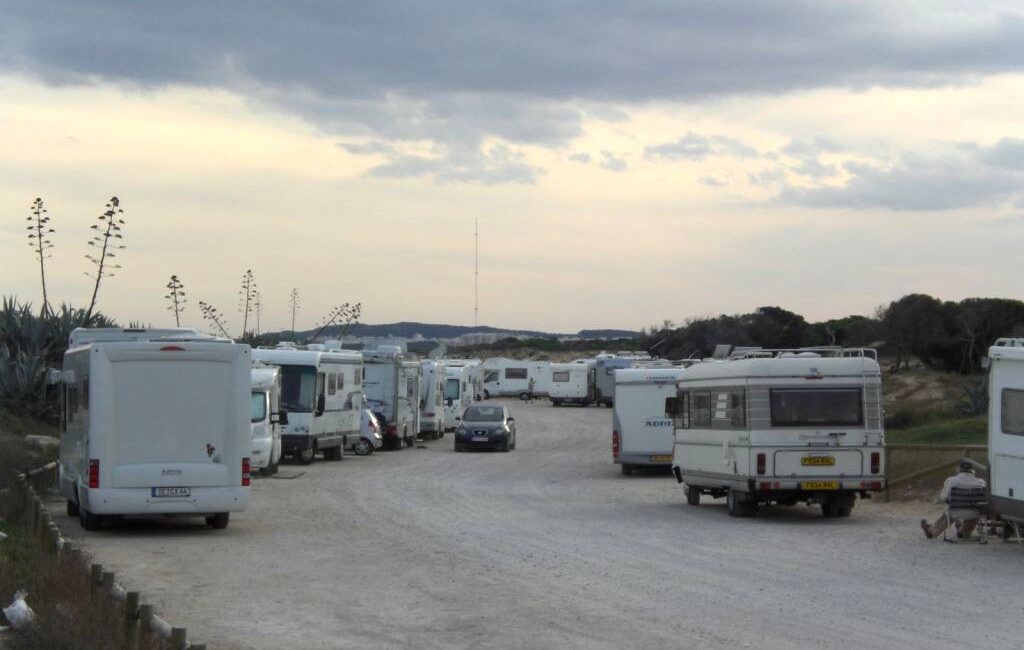
In the province of Alicante, including the Vega Baja region, the peak season for motorhome tourism has resumed in full effect. These vehicles are currently occupying prime locations in Torrevieja, particularly on avenues and streets with parking areas designated for residents. These locations include the lanes in the green area of the La Manguilla residential complex on La Mata beach, Calle La Veleta on the southern coast of the town centre, the area around Cala de Ferrís, and the Torrevieja and La Mata lagoons natural park grounds. This final area is situated between the visitor centre of the natural park and the cemetery. The municipal parking area adjacent to Zenia Boulevard in Orihuela Costa has been occupied by dozens of motorhomes, occupying over 20,000 square metres.

Signals
The Torrevieja City Council has implemented signage that prohibits the parking of motorhomes that are wider than 2.2 metres in order to manage and regulate the substantial volume of vehicles that enter the municipality. The cues have a deterrent effect; however, their efficacy is severely restricted.
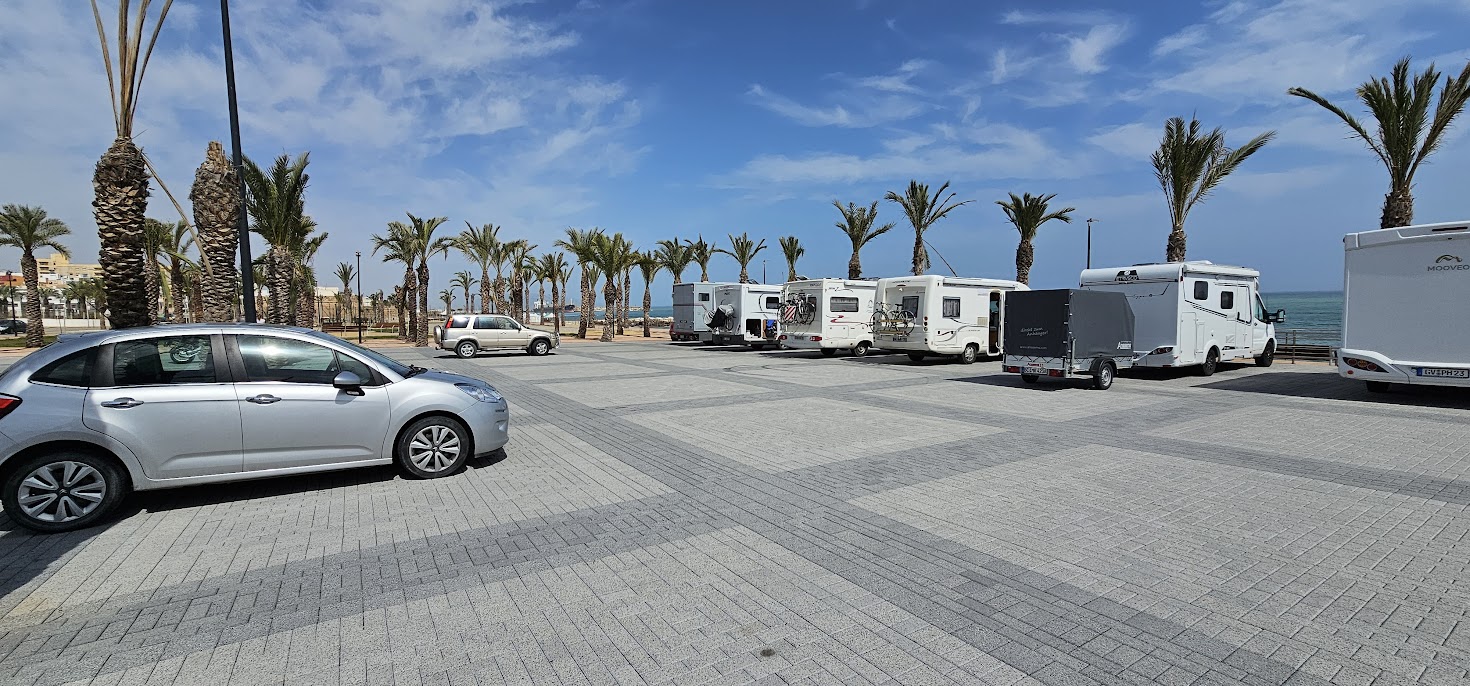
These regulations may be enforced by the local police on the streets and avenues where the sign has been erected, as they are considered public lands. Nevertheless, they are unable to do so in the natural park, as the land on which the caravans are located is privately owned. Consequently, the local police are unable to intervene. Additionally, this is a trivial incident in comparison to the dozens of services that Torrevieja’s officers are responsible for, as their primary responsibilities are to respond to traffic accidents and support public safety.
The encroachment on the natural park’s environs has the most detrimental effects. These are not regions that are included in the most protected zone. Rather, they are land parcels that are impacted by the Natural Resources Management Plan (PORN) and serve as a buffer zone. Motorhome parking is in no way permitted in this area.
The main road leading to the visitor area and parking lot of Lo Albentosa Park (Eduardo Gil Rebollo) is the route by which caravans approach the park from the N-332 roundabout. Nevertheless, caravans frequently deviate from the designated pathways towards former vineyard plots, where they encounter regenerated clumps of kermes oak and mastic trees, which are protected vegetation in this protected habitat area.
The impacts on natural areas are substantial when this type of tourism occurs, in contrast to the image of civilised, high-spending tourism. For instance, the site retains a portion of the solid waste and, most importantly, the effluent produced by campervans.
The unrestricted green space on the beachfront in La Manguilla is currently occupied by vehicles. The residents are experiencing some issues as a result of the overpopulation. Although parking is permissible, it does not permit the placement of objects outside the vehicle, such as tables and chairs, which is a frequent occurrence in municipal parking areas. A few weeks ago, the campervans that were occupying the parking areas on the western breakwater in Torrevieja were removed due to the impact they were having on the pontoons and the nearby residents.
Two hectares
In recent weeks, the public parking lot adjacent to La Zenia Boulevard in Orihuela Costa has been occupied by motorhomes. The shopping center utilises this parking area, which the City Council had previously rejected for the construction of a new school, at no cost to provide additional parking for its retail space, without remunerating the Orihuela City Council. And it is currently allocated for these motorhomes. The tourism sector’s specialised channels are utilised to advertise the most popular destinations, which are those with minimal enforcement and fewer sanctions.
Applications for mobile devices
Users share precise GPS coordinates, decibel levels, access point photos, and, most significantly, the presence or absence of police surveillance through online forums and dedicated mobile applications. The saturation of locations that were essentially unknown as parking areas just five years ago has been accelerated by the digitalisation of mobile tourism.
The Zenia Boulevard parking lot in Orihuela is characterised by the absence of an overnight charge and a rigorous, systematically enforced time limit, which results in the extension of stays indefinitely. Semi-permanent encampments that can persist for weeks or even months during the summer season have evolved from 24-hour rest stops before proceeding south or towards the Almería coast. Despite the fact that some local businesses have reported an increase in sales of basic goods, food, and supplies to motorhome travellers, the parking lot, which is intended to accommodate the influx of consumers during peak hours, is currently overrun by vehicles that do not rotate.
What the DGT has to say
According to the Spanish Directorate General of Traffic (DGT), a motorhome is deemed to be parked if it is parked in a permitted location and does not exceed the road markings that delimit the parking area, nor the time limit, if any. “In this instance, it is irrelevant whether the occupants of the vehicle are present; it is sufficient that any activity occurring within the vehicle does not extend beyond the perimeter through the deployment of elements such as tents, awnings, levelling devices, stabilising supports, etc.” The same national regulations stipulate that camping is only permitted in designated areas (campsites or parking grounds, as determined by the regulations of each autonomous community).