



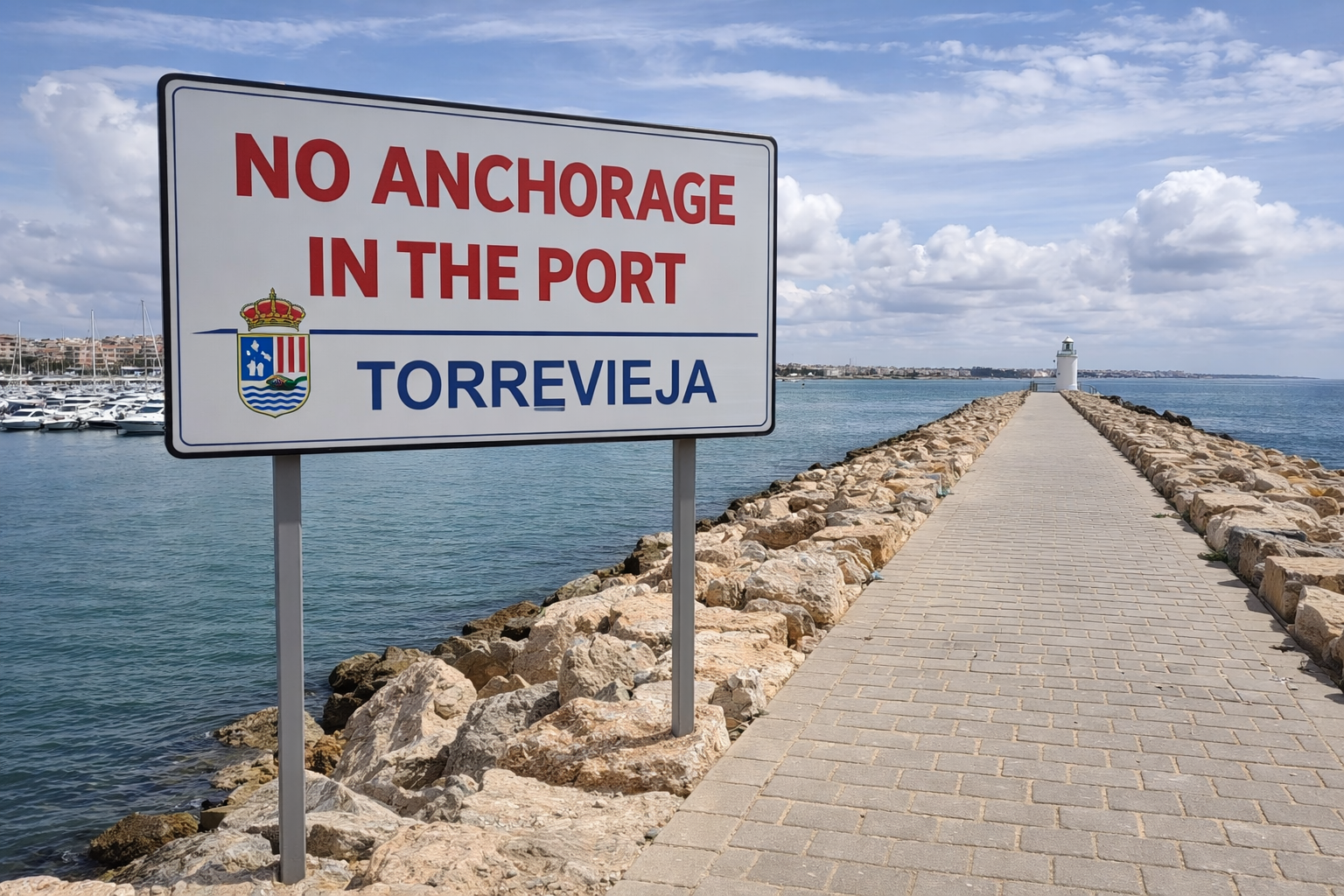
People who own leisure boats, yachts, sailboats, or fish for sport will have no justification to defy the anchoring ban in Torrevieja Bay. This law is often broken, especially when there are a lot of tourists. The Port Authority of the Valencian Regional Government has just put up three big signs at the entrance to the port, one on the starboard side and one on the port side, to warn everyone that anchoring is not allowed. The signs are mostly for boats that are coming into the port from the entrance. The signs were put up near the lighthouse at the same time as the Levante breakwater reopened. There is another sign with the same warning on the Poniente dock, across from these signs that show the prohibition statement in both Spanish and English.

Three docks
The port basin, which is one of the biggest in the Valencian Community even though three marinas are on its sea surface, has experienced a rise in the number of yachts and leisure boats docking there in recent years. These boats dock in the bay, which is protected from the wind. This makes it a peaceful place to swim in the middle of the high season or to spend one or more days on a private or rented boat.
There are three marinas in the port area, which have more than 2,500 berths. There is also a docking area for the purse seine fishing fleet, an industrial pier for loading salt on the western breakwater where ships over 120 metres long and carrying ten thousand tonnes of cargo arrive, and two other small piers owned by sports clubs with fishing and recreational boats. There are also a lot of jet ski and recreational boat rental enterprises at the marinas. The busiest times for these businesses are during the spring and summer holidays. All of this leads to a lot of maritime traffic during the day, especially from these light vehicles that don’t have much control. There are also paddleboards and kayaks, which have become more popular in recent years. Other types of watercraft, such jet skis, motorboats and small boats, don’t need a licence or driving expertise. recreational activities, including kayaking and paddle surfing, that cross paths with the rest.

Tradition and economic activity
Free anchoring in the bay also brings in business for nautical companies that rent out small boats that can hold up to six people without the need for a skipper’s licence or “titulín.” Most people who use these services don’t want to leave the safety of the port, but there are also other recreational options, like swimming in the dock (which is also against the law) and even eating and drinking on small boats.
Face on the outside
The boats gather along the outer face of the Marina Salinas barrier, where they don’t get in the way of boats coming in or going out of the marinas or the boats in the artisanal purse seine fleet. On some warm days, as many as 40 boats come together in the same place. There is some friction because the boats are so close to each other and individuals are swimming or fishing for fun or starting outboard motors while people are in the water nearby. This anchoring happens once in a while and lasts for only one day. This kind of limited anchoring is common in the port of Torrevieja and is done by many people who live in the city and have moorings in the marinas. It doesn’t put maritime traffic at risk because it is maintained away from passages. But it has gotten more common in the last few years. It got worse during the epidemic as a simple means to get over mobility constraints, even if gatherings on recreational boats became more popular. Boat rental businesses also keep it going.
During the holidays, you can see that more ships are anchored in the bay. This puts more demand on port space, especially during peak season. Because of all the people, there is less room to anchor, and ships are now in places that make it harder for other ships to move around.

Off the coast of Acequión beach is another place where this kind of mooring is common. Boats anchor extremely near to the beach, which is frequented by hundreds of people every day in the summer, even though swimming is not allowed in the harbour. This is a long-term anchoring problem that is mostly happening near Marina Internacional, where you can even see several big, half-abandoned ships.
The City Council pays the Generalitat a public fee to keep up coastal areas that the Consell doesn’t think are beaches but do have foot showers and are cleaned every day by the City Council. There are no lifeguards there.
Alerts
Last summer, the maritime agency stepped up its alert and surveillance work on recreational boats that were anchored in Torrevieja Bay. The M-61 “Río Oja” fast patrol boat, which is more over 20 metres long and part of the Alicante marine service, did a warning mission. Sanctions are only used in certain situations, depending on the sort of crime.
Room
Sailboats, leisure boats, and jet skis can all come together within a few meters of people swimming or starting the outboard motors on smaller boats. Bay users mostly welcomed the extra checks with common sense, but some didn’t understand why they couldn’t do something they’d always done. The number of boats and the usage of a marine space that has gotten smaller during the previous thirty years, on the other hand, have altered.
Problems
The anchored yachts in the marinas of Marina Salinas, Real Club Náutico, and Marina Internacional make it hard for other boats to get there. They also make it hard for the purse seine fishing fleet based in Torrevieja to get through. This fleet leaves at 11:00 PM and comes back at 8:00 AM. Also, they make it harder to get to the places where water sports are allowed, which the marinas have asked for so that people can do things like rowing.
The Administration has not hired a maritime captain in more than ten years. This person might help keep an eye on current nautical traffic, which is now the job of Alicante or Santa Pola.