
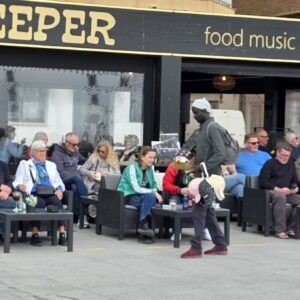

Torrevieja City Council has rejected an appeal lodged by the owner of a well-known seafront promenade restaurant against the refusal of its permit to install terraces on public land. The municipal resolution turns down the establishment’s request to keep its large, fixed, covered and glass-enclosed terrace located on Calle del Mar at its intersection with the seafront promenade, demanding its removal for safety reasons. The document upholds a previous decree, dated 4th March 2016, which rejected the occupation of public space and required the removal of structures installed without authorisation. The company has not yet complied with the order.

Fire safety and resident complaints
The appeal was filed on 31st March, and the company, which declined to comment when contacted, also requested a stay of execution regarding the denial. The City Council rejected this request, arguing that the requirements for halting the removal of the permit and the terrace were not met. The resolution states that the denial is based on unfavourable technical reports due to non-compliance with the building code, specifically the section concerning safe evacuation in the event of a fire. The fixed and rigid structure of the terrace on this section of the street—along with tables and chairs that are never put away—permanently obstructs the roadway at its intersection with the popular Paseo de las Rocas, a promenade frequented by thousands of people during the summer months. This situation has been denounced by residents of adjacent buildings through numerous complaints filed with the City Council for over five years.
Urban planning violation
What distinguishes this decree from similar ones issued recently by the same municipal department—which many restaurant and bar owners have resolved by paying fees or submitting projects—is that it includes a file for non-compliance with urban planning regulations. An ongoing procedure to protect urban planning legality was initiated on 21 January 2026, following a complaint received in October 2025 by the municipal Urban Planning department. This procedure directly affects the rigid, fixed structure. The file states that fire engines cannot fit, and the construction is illegal, lacking both a major works permit and an occupancy permit. The administration maintains that this urban planning situation has not been invalidated by the appeal and that no new elements have been presented to contradict the technical reports.
The Public Works and Business Licensing Department added that the unauthorised occupation of public land affects the general interest, the common use of public space and safety conditions. Therefore, the City Council confirmed the denial of the terrace permit, rejected the requested suspension and maintained the obligation to immediately remove the elements installed on public land.
Legal options and current situation
The company may appeal this decision, which is final at the administrative level, to the Administrative Court of Elche within two months of notification. Should it pursue legal action, it could also request a preliminary injunction to suspend the order.
On the ground, the facilities remain unchanged. The only modification made by the establishment in recent months is compliance with regulations requiring a pedestrian walkway between the restaurant’s facade and the terrace itself. For the past few years, the restaurant had placed furniture there, effectively occupying public space and obstructing pedestrians. Now, however, the walkway is open. An area of chairs and tables adjacent to the permanent terrace on Calle del Mar has also been removed, but the glass structure itself, which is the subject of the urban planning violation, remains and is used daily as an outdoor dining area.
Council reaction and tightening controls
Despite the forceful nature of the municipal resolution ordering the immediate removal of all elements, the Councillor for Public Space Occupation and Police, Federico Alarcón, downplayed the establishment’s non-compliance and asserted that meetings had been held to ensure the terrace complied with regulations. He also stated that the company had begun taking corrective measures. Alarcón framed this action within the context of the Torrevieja City Council’s intensified controls on the occupation of public land following the pandemic, during which controls were relaxed. With the suspension of fee collection, the municipal ordinance itself ceased to be enforced as intended, leading to abuses with excessive expansions and a lack of control over pedestrian walkways.
The city was one of the last in Spain to reinstate the fee, at which point Alarcón’s department decided to reinterpret the ordinance to start from scratch across more than 600 establishments. With a reinforcement of police officers assigned to the Occupation Unit, authorisations must now be validated by submitting projects from qualified professionals alongside a plan showing the exact location and number of tables and chairs. This increased municipal oversight has led to a cascade of licence suspensions in recent months due to outstanding tax debts or missing documentation. Most initial rejections have been resolved after paperwork was submitted, but in some cases, the City Council has intervened to remove furniture and issue fines.
A change of criteria
In the case of the restaurant on Paseo de las Rocas, the local police team responsible for monitoring public space has changed its stance. When residents previously complained about the terrace and the alleged obstruction at the end of Calle del Mar, Alarcón pointed out that the report from the officer then responsible stated the enclosed awning with glass panels was removable, complied with safety regulations and was approved. Using the same regulations, but with different eyes observing what was obvious to residents and competing restaurant owners, the opinion has changed.
It is not the only case. Along the entire seafront promenade and up to Punta Margalla, the popular Columns, several examples can be found of public space occupied by robust, permanent terraces, some of which have even incorporated municipal palm trees into their design.
An illegal installation invisible for five years
The municipal technical report considers the construction unsuitable for legalisation. The structure has been in place for over five years, though the file was only initiated following a complaint in October 2025. It occupies public property and lacks a major works permit, authorisation for construction on public land and authorisation for occupying public space.
The report describes a large structure measuring 15 by 6.3 metres, approximately 94.5 square metres, with a rigid roof, rigid walls, lighting and climate control systems. Technicians maintain these characteristics exceed what is permitted for terraces, where the municipal ordinance only allows elements such as awnings, parasols or windbreaks. Furthermore, the structure is classified as a permanent enclosure, as it cannot be removed during an inspection.
The report also highlights fire safety violations, warning that the construction eliminates the access road for fire engines and the required manoeuvring space next to adjacent buildings with evacuation heights exceeding nine metres. It notes that the permissible materials for a terrace would not comply with the Technical Building Code for a structure located at that distance from other buildings. The Urban Planning Department concludes that the project violates the General Urban Development Plan (PGOU) because it is a work requiring a permit but carried out without one. The economic value of the work is set at 26,932 euro, a figure that can serve as the basis for the sanctioning procedure or for restoring urban planning legality.

