

The Torrevieja local government board approved last Friday, 12th June, the second modification to the contract for the renovation works on the fishing pier’s quayside and the urbanisation of the area surrounding the Míguez Wharf, awarded to the company González Soto. The firm won the bid for five million euro with an improvement that guaranteed it could reduce the execution period from five to four months. The City Council awarded the contract in November 2025. The contract’s formalisation date, which is the date used to officially start the timeframe, is not included in the public documentation of the file.

With this decision, the planned completion date is now 15th August 2026. This is not the first extension. The file shows that the governing board already approved a previous extension on 30th March 2026, which at that time set the final date for the project as 15th June 2026.
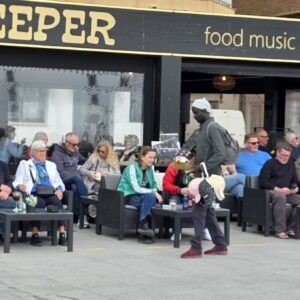
Most of the promenade, where the paving with white natural stone has been completed, was open to the public this past weekend for the inauguration of the Paseo del Mar leisure centre, albeit in a precarious state and people complaining about the lack of shade and trees. The works include the redevelopment of the quayside of the old fishing pier, where the original bollards have been preserved. The lighting is not working. The most delayed phase of these works is the one affecting the area around the Customs building, where a fountain and a space to relocate some of the hippie craft stalls are planned.
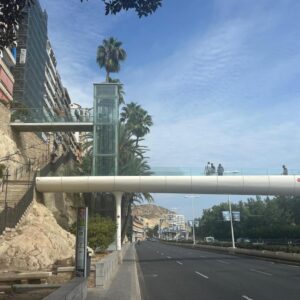
These works are in addition to the rehabilitation of the Mínguez dock, valued at 2.1 million euro after an almost 40% increase in its initial budget. This project has been significantly impacted by the authorisation granted by the city council and the regional government (Consell) for the construction of a parking lot for the Royal Yacht Club on the water’s western side and the enormous pedestrian ramp for the shopping centre on the wall now exposed by these works, to the east. The deadline for completing these works was already extended a few weeks ago.
The new extension is justified by causes that the technical report considers unforeseen, unavoidable, and not attributable to the winning bidder. The document states that the delays are not due to any breach of contract by the contractor, but rather to changes that arose during the execution of the work.
One of the main reasons is the change in criteria established by the Directorate General of Ports, Airports and Coasts of the Valencian Regional Government regarding various aspects of the original project. These observations affected, among other things, accessibility, paving, facilities, affected services, street furniture, landscaping, and coordination with the Leisure Centre.
The report explains that these recommendations necessitate adapting solutions already planned in the project to the physical reality of the construction and the future operation of the port area. Therefore, the City Council maintains that this is not simply a reconsideration of the initial design, but rather adjustments resulting from the technical oversight of the port authority.
The second reason is related to the changes made to the Paseo del Mar Leisure Centre, located next to the project area. According to the file, this construction modified the drainage of the access ramp, some pillars, and the final levels of the paving, which necessitates adapting the landscaping of the cliff face as well.
As a result of these changes, part of the pavement is redesigned, smaller pieces are used to adapt to the new slopes, planters not initially planned are incorporated, and a new stormwater drainage network is implemented to facilitate water evacuation.
Regarding the budget, the certificate consulted does not include a specific figure nor does it detail an increase in the contract cost. The document mentions the budget within the technical observations and project adjustments, but the approved modification refers to the execution timeframe, not a new monetary amount. This does not preclude, as has occurred in previous contract extensions for all port-related works, the possibility of a subsequent request for an extension.
While the legal report is favourable to the extension, it notes that it has not been sufficiently proven that the procedure was carried out within the maximum period of fifteen days from the cause of the delay. Even so, it considers it appropriate to grant the extension in the public interest and to guarantee the proper completion of the contract.
To date, none of the repeated delays in the port area redevelopment works, representing an investment of over 40 million euro, have resulted in any penalties for the contractors. In most cases, these delays have been accompanied by budget increases. This has been the case with the Mínguez Wharf, the construction of the pedestrian esplanade replacing the old Paseo de La Libertad (where the amusement park will be located), and the construction of the access to the Levante dock and its connection to the Leisure Centre. The renovation of the Levante dock promenade was also delayed by more than six months, although without a budget increase. These delays were resolved with reports from municipal technicians confirming that they were justified for various reasons.
The changes mentioned in the concession granted by the Generalitat’s Directorate General of Ports have not been explained by the City Council. The Generalitat is the competent authority for regulating the use of the port’s public domain, which it directly manages, and its surrounding area, the first urban line adjacent to the port. The Generalitat granted the concession to the City Council so that it could carry out the works. However, neither the conditions under which it was granted nor the modifications that have been incorporated during the works have been made public by either administration.