

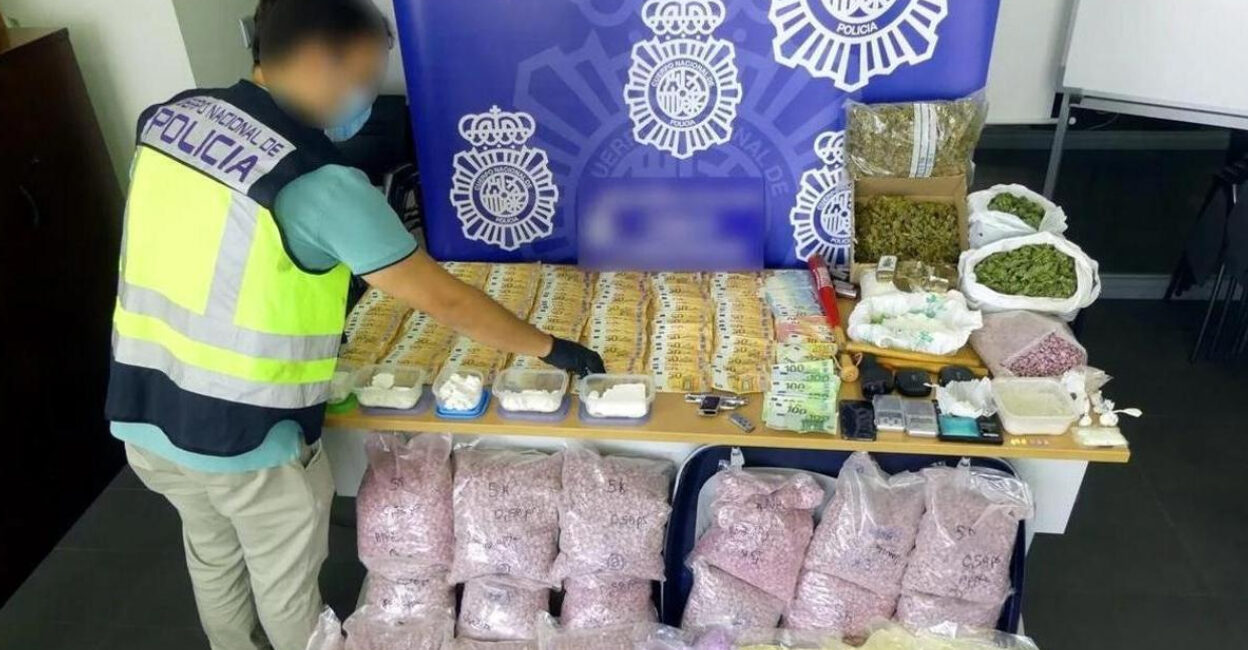
A court in Torrevieja has released five individuals arrested during a National Police operation after identifying a potential procedural flaw involving the use of undercover agents. The operation had led to the seizure of 199,600 MDMA (ecstasy) pills, valued at more than 2.7 million euro. The presiding magistrate acknowledged that the suspects’ release was likely due to doubts surrounding the legality of the evidence.

The decision was handed down on 31st July by the presiding magistrate of Court Number 4 of the Torrevieja Court of First Instance. The five detainees, two of whom were represented by defence lawyer Aitor Esteban Gallastegui, were brought before the court on suspected offences against public health and membership of a criminal organisation. Although the Public Prosecutor’s Office requested pretrial detention without bail, the defence successfully opposed the measure.
The duty judge accepted the existence of the physical drug seizure, noting that the suspects were apprehended after exchanging nearly 200,000 ecstasy pills worth over 2.7 million euro at a hotel in Torrevieja. However, questions were raised over the legal validity of key evidence.
The investigation originated from information supplied by Dutch police to the General Police Headquarters for Judicial Investigations regarding a resident of Ponferrada allegedly involved in synthetic drug trafficking. Officers from the Central Drug and Organised Crime Unit (UDYCO Central) conducted surveillance before requesting permission from the Madrid Anti-Drug Prosecutor’s Office to deploy undercover officers.
The Anti-Drug Prosecutor’s Office opened preliminary proceedings and issued a decree authorising the undercover operation on 21st May 2026. These officers helped identify the suspects and uncover their logistics, ultimately leading to the planned drug transaction at a Torrevieja hotel on 29 July, where the arrests were made.
Under Spanish Criminal Procedure Law, the Public Prosecutor’s Office can authorise undercover agents for organised crime inquiries but must inform the court “immediately”. When the suspects appeared before the Torrevieja court, no record existed showing that the Anti-Drug Prosecutor’s Office had notified any judicial body.
The judge highlighted that while jurisprudence allows some flexibility regarding when notification takes place during pre-trial proceedings, there was no documentation showing any communication to any court even after the operation concluded and arrests were made.
The magistrate noted that evidence gathered by undercover agents might be declared legally inadmissible due to failure to comply with mandatory procedural rules. The judge stated that remanding the five individuals into custody based on potentially flawed evidence would infringe upon their fundamental rights.
The duty judge did not formally annul the investigation or the evidence, clarifying that the decision only addressed the immediate custody status of the suspects. The trial court or the court handling the ongoing investigation will ultimately determine whether the proceedings are invalid.
In the meantime, precautionary measures have been imposed. The five individuals must appear in court three times a week, are prohibited from leaving Spain, and have surrendered their passports.
Other Articles

Nineteen-month-old baby dies after drowning in Orihuela pool
Father and son arrested in Elche for home delivery drug operation