



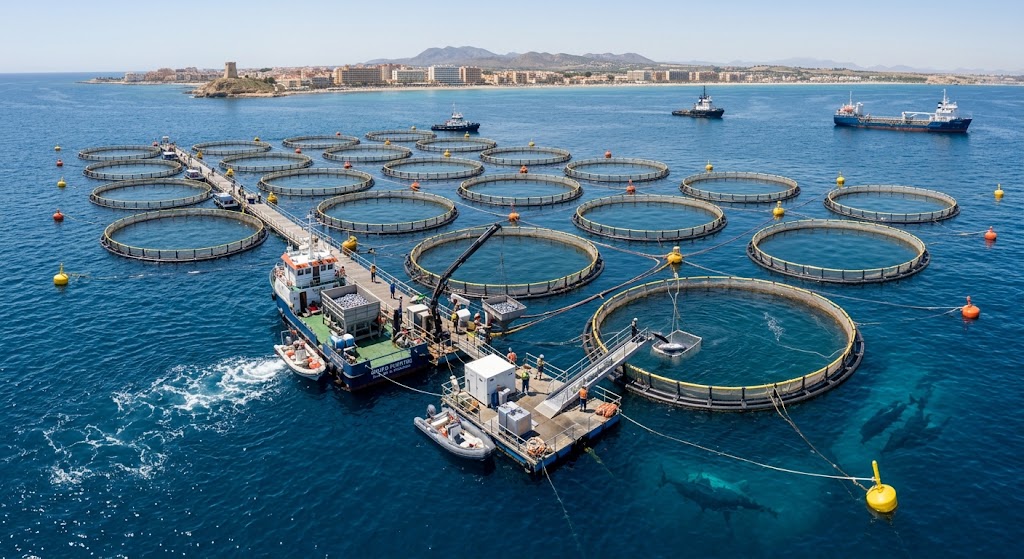
The Generalitat has authorised the first bluefin tuna fattening farm in Valencian Community waters, situated off the coast of Pilar de la Horadada. The project stems from a marine aquaculture concession originally approved in 2021 for gilthead seabream and European seabass. However, the Directorate General for Fisheries has now validated a change of species, allowing the facility to dedicate its operations to Atlantic bluefin tuna (Thunnus thynnus). The current licence holder is Piscifactorías del Mediterráneo, S.L., a company linked to the Murcia based Ricardo Fuentes group, one of Spain’s leading operators in bluefin tuna fishing, fattening, processing and marketing. The firm took over a project that has undergone several changes of ownership since its initial authorisation.

50-metre diameter cages
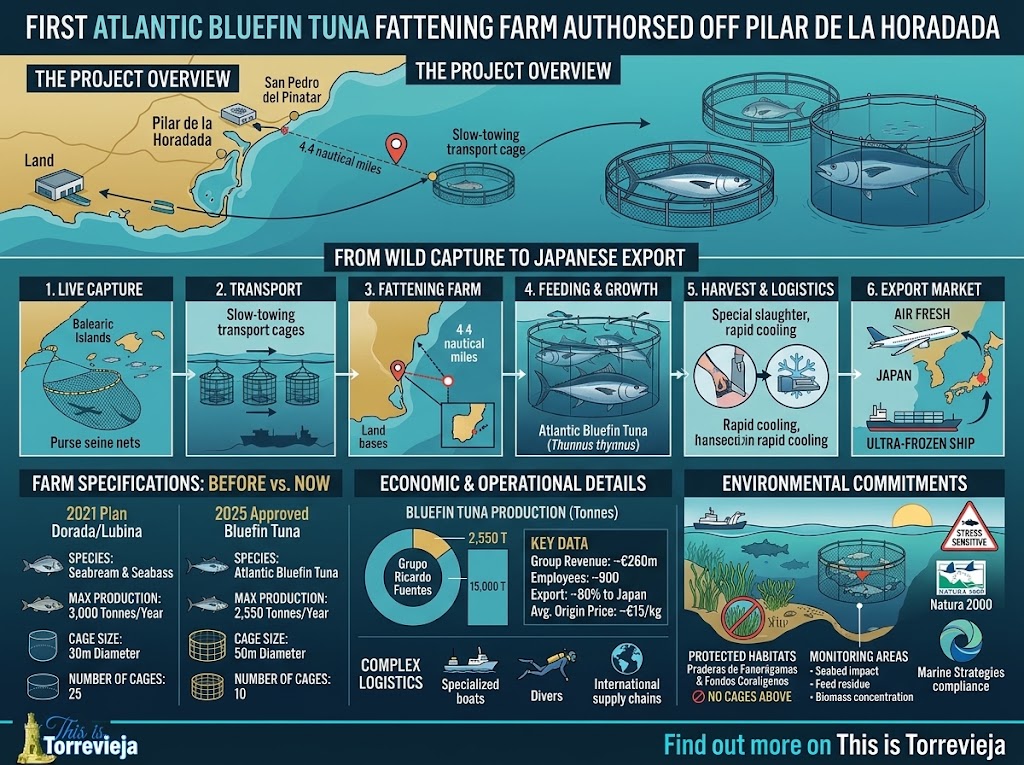
The installation will occupy the same area authorised five years ago, covering 45 hectares of maritime-terrestrial public domain off the Pilar de la Horadada coast. The initial project envisaged 25 cages with a diameter of 30 metres and a maximum annual production of 3,000 tonnes of seabream and seabass. The approved modification reduces the number of cages to ten, but expands their size to 50 metres in diameter. Maximum capacity is set at 2,550 tonnes of bluefin tuna per year. The farm will be located in the open sea, roughly 4.4 nautical miles (around six kilometres) from the fishing port of San Pedro del Pinatar in Murcia, according to the original authorisation.
Fattening process
Bluefin tuna fattening operates through methods distinct from conventional aquaculture used for seabream or seabass. Adult tuna are captured alive during their migration using purse seine nets near the Balearic Islands. They are then transferred to transport cages, which are towed slowly to the marine farms. Once there, the specimens remain in floating cages for several months and are fed to gain weight and fat. Mediterranean bluefin tuna is especially prized in Japan, where most of the production is exported: fresh by plane, and ultra-frozen by ship, fetching a high average origin sale price of 15 euro per kilo. It is an activity subject to strict administrative control.
Corporate backing
Bluefin tuna operations require specialised fishing vessels, live transport towing, large cages, feeding with wild fish often caught by professional artisanal fleets, health monitoring, divers, specialised slaughter, refrigeration and international logistics. Bluefin tuna are powerful fish, yet sensitive to stress when captured, concentrated, transferred or towed. Setting up a farm with these characteristics requires significant expertise. Profitability relies on the high value of the final product compared to other fattening species, balanced against higher operational costs. The Ricardo Fuentes Group, which is driving the project, generates a turnover of around 260 million euro and employs roughly 900 people. It produces around 15,000 tonnes of tuna per year, exporting 80 percent to Japan. The group manages farms in Spain—in Cartagena and San Pedro del Pinatar, where the Pilar de la Horadada installation will have its land base—as well as in Malta and Tunisia, alongside almadraba trap fisheries in Cádiz, Morocco and Portugal.
Aquaculture in Alicante
The province of Alicante already hosts aquaculture activity, though focused on different species. Facilities operating in Santa Pola and Guardamar work with seabream, seabass, meagre, amberjack, molluscs and other produce. Across the Valencian Community as a whole, fattening aquaculture reached 22,791 tonnes in 2025, valued at 165.9 million euro, with seabream, seabass and meagre as the main species.
The project comes with environmental conditions. The resolution prevents placing cages over sensitive habitats such as seagrass meadows and coralligenous sea beds, while maintaining obligations established by the environmental declaration, coastal authorities, the Natura 2000 network and marine strategies. In farms of this nature, main monitoring focuses on biomass concentration, feed residue, excrement, seabed impact and the use of wild fish for feed.
Steps remaining before launch
The administrative authorisation published in the Official Gazette of the Generalitat in July does not mean the farm will be operational immediately. The resolution allows the activity to be modified, establishes new conditions and maintains the validity of the establishment. The original file required notification before the start and end of works, alongside passing a prior inspection before operating the site. Public records do not confirm whether the facility authorised in 2021 ever produced seabream or seabass. The province is thus entering the bluefin tuna fattening industry with a large-capacity facility off Pilar de la Horadada, situated on the southern limit of the Valencian coastline adjacent to an area in Murcia where the industry is already well established. The Town Hall of Pilar de la Horadada was unaware of this authorisation.
Stalled experimental attempts
Elsewhere in the Valencian Community, the Generalitat authorised German company Next Tuna Spain in 2025 to build a facility at the port of Castellón for amberjack and bluefin tuna, featuring recirculation tanks and a maximum output limited to 60 tonnes of tuna per year, planned for 2030. That experimental project sought to complete the full breeding process from larvae through to adulthood within fish farm tanks. However, its six-month execution window from authorisation has expired, leaving doubts over whether it will proceed.
In contrast, the Pilar de la Horadada project is designed as an open-sea marine farm with floating cages and a vastly superior capacity. The Castellón port initiative was an experimental attempt at land-based closed-loop breeding—a process that researchers in Murcia have also been attempting to scale commercially since 2015 without yet making the leap to full-scale production.
Other Articles

Man arrested in Monovar following country house burglary
Man arrested after staging fake 6,500 euro robbery in Alicante