


Torrevieja Town Council has awarded CHM Obras e Infraestructuras, S.A. the first phase of the redevelopment works for the Casa Grande industrial estate for 1,543,596 euro, VAT included. The works will have an execution period of seven months starting from their formalisation and the signing of the layout agreement.

The processing of the project was accelerated after the business association of the commercial park publicly reported the non-fulfillment, during this term, of the commitment acquired by the mayor, Eduardo Dolón (PP), to carry out these works during the current term. The action covers approximately 30% of the total area of Torrevieja’s main industrial zone.
The award process alone extended for six months, following the tender last April. The affected surface reaches 109,000 square metres of the 359,000 occupied by the estate, according to data from the Valencian Institute for Business Competitiveness.
The president of the association, Pepe Ríos, announced in March that he was leaving his position, one month before the Town Council tendered the contract, and resumed it after the municipal announcement that the project announced and signed by the PP with these same business owners during the 2023 electoral campaign would be taken up again.
Torrevieja Town Council chosen an offer 61,000 euro more expensive than the cheapest without incorporating into the Contracting Portal the report explaining its decision. It is not the most economical option.
The Contracting Department of Torrevieja Town Council has failed to comply with public contract legislation by not incorporating into the Public Sector Contracting Portal the minutes reporting the award proposal with the total scoring of the technical and economic criteria of each of the offers. Only the minutes setting out the economic and technical proposals appear, but not their scores.
This is relevant information, given that CHM was awarded the tender without presenting the most advantageous economic offer for the Town Council, despite price being the award criterion that adds the most points. Five companies submitted tenders: CHM Obras e Infraestructuras, Construcciones Urdecon, Continental Obras y Mantenimiento, Involucra, and Mediterráneo de Obras y Asfaltos. The offer finally awarded to CHM, for 1,543,596 euro (VAT included), represents a reduction of 22.08% compared to the base tender budget, set at 1,981,001 euro, which means a difference of 437,405 euro. Mediterráneo de Obras y Asfaltos and Involucra presented cheaper offers. The former was 61,000 euro lower than the one presented by CHM.
According to the local government team, the action was promoted by the Department of Urban Management, Accessibility and Urban Services, led by Sandra Sánchez, and will involve the renovation of a business area that currently presents, and has for decades, deficiencies related to accessibility, urban service networks, and road and pedestrian safety.
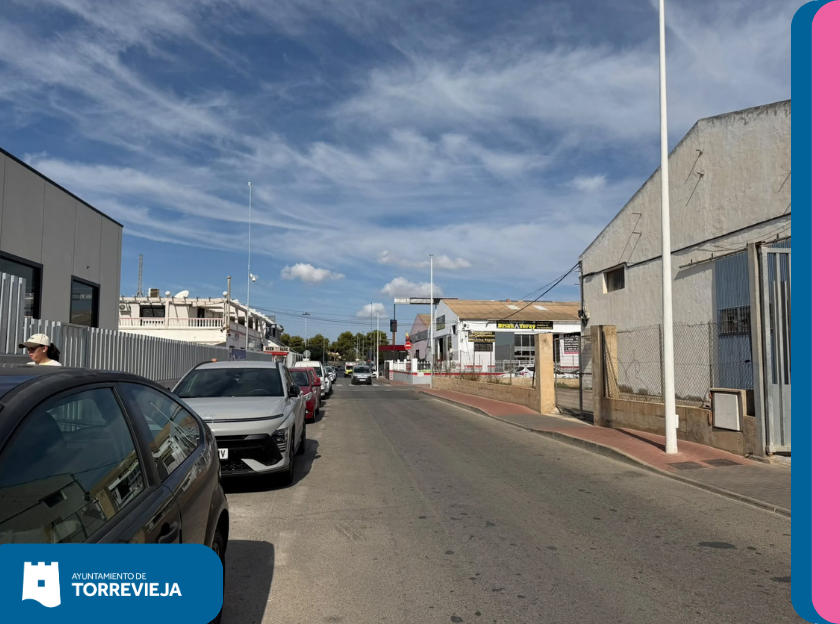
On the ground, these are more than just deficiencies: the industrial zone, which in Torrevieja also hosts service activities, hospitality, and leisure, presents a regrettable image and service delivery.
The project was prepared jointly with the members and the board of directors of the Casa Grande Business Park, incorporating the needs raised by the companies installed in this area, according to the Town Council. Among the planned actions is a new arrangement of traffic and parking, the improvement of pedestrian travel, and the creation of accessible routes for people with reduced mobility. The remodelling of the roads also aims to prevent the parking of vehicles on pavements, a practice that currently occupies pedestrian routes, deteriorates pavements, and hinders mobility.
The first phase covers eight streets and part of Delfina Viudes Avenue. It comprises the sector located between Pañol Street and Rosa Mazón Avenue, including both full roads and all internal streets between them. Specifically, the works will affect Obenque, Estay, Ballestringe, Ciaboga, Gabia, Calabrote, and Pañol streets, as well as the corresponding part of Delfina Viudes Avenue.
This is the northern area of the estate, closest to the water park, Antonio Soria park, the nightlife area, and the sports city. This intervention is integrated into the global redevelopment project of the Casa Grande Business Park and will be executed to maintain technical consistency with subsequent phases of action.
The works will involve a renovation of road infrastructure and urban services. Kerbs, pavements, ducting, and inspection chambers in poor condition will be demolished, and earthworks, excavations, levelling, and compaction will be carried out.
The project includes the complete paving of pavements—there are areas where none exist—the installation of new kerbs, and various accessibility improvements. On the roadways, current asphalt layers will be milled to later place a new pavement across the entire surface included in this first phase.
The redevelopment will reorganise traffic and parking areas to recover pavements for pedestrians and prevent vehicles from occupying these spaces. New vertical and horizontal signage, speed reducers, and rumble strips will also be installed, along with the renewal of road markings in all affected streets.
The intervention aims to improve pedestrian safety as well as traffic flow and internal functioning of the Casa Grande Business Park. The action also includes the complete renovation of the public lighting network ducting and the installation of new cabling. Existing streetlights will have a point-to-point remote control system to facilitate more efficient management of lighting infrastructure.
In terms of telecommunications, new underground ducting will be built to bury existing overhead networks, improving both facilities and the urban image of the business park. The project is completed with corresponding waste management and health and safety measures during execution.
This first phase marks the start of the comprehensive renovation of the Casa Grande Business Park, with actions on its infrastructure, accessibility, mobility, safety, and urban services to adapt the space to current needs of businesses and workers in the area.
By surface area, Torrevieja’s industrial estate is one of the largest in the Vega Baja, ahead of Puente Alto (Orihuela), though exceeded by Las Maromas (Almoradí), Mos del Bou (Albatera), and La Granadina (San Isidro). However, this area has suffered severe deficits in basic services since its construction in the 1980s.
In total, it has 358,000 square metres, of which the oldest phase, Casa Grande I, totals 243,000, and the most recent, Casa Grande II, 109,000. The industrial park catalogue of the Valencian Institute for Business Competitiveness officially classifies the state of its amenities—roads, pavements, and lighting—as deficient.
The image of poor maintenance, especially visible on internal roads, is not helped by the accumulation of dumped household items or the significant lack of parking spaces, which daily causes users to park on pavements along both sides of the streets. Nor does the minority presence of activities carried out outside regulation help improve the image.
The estate, definitively approved in 1982, was born on the periphery of the urban area, although for over twenty years it has formed part of the city layout. Alongside companies dedicated to storage and supply of building materials, food warehouses, waste recycling, or mechanical workshops, it hosts other service activities, such as hospitality and nightlife establishments—a nightclub and some of the region’s main terraces—gyms, private sports facilities, and wholesale supermarkets.
There are also shops and vehicle dealerships, especially facing Cortes Valencianas. Furthermore, the area is crossed by one of the municipality’s main avenues, Rosa Mazón, which divides the two phases of the industrial area. In recent years, investments focused on an essential matter: preventing the estate from flooding during rains, and in the current term, a very limited intervention to deploy a video surveillance network in just one sector.
The lack of urban planning has meant that now, in barely 400 metres between Avenida Delfina Viudes, Avenida Rosa Mazón, and Calle Ruiz Coves, there are alternate uses such as education—the Habaneras Public School—with a funeral home located directly opposite; a centre for people with disabilities; the main bus parking area for urban transport; a padel sports club; industrial units; a water park; three low-cost petrol stations; the provincial headquarters of a Protestant church; and the workshops and parking area for municipal rubbish collection. Added to all this is a plot of wasteland intended as a green area that is used as a car park.
Other Articles

