


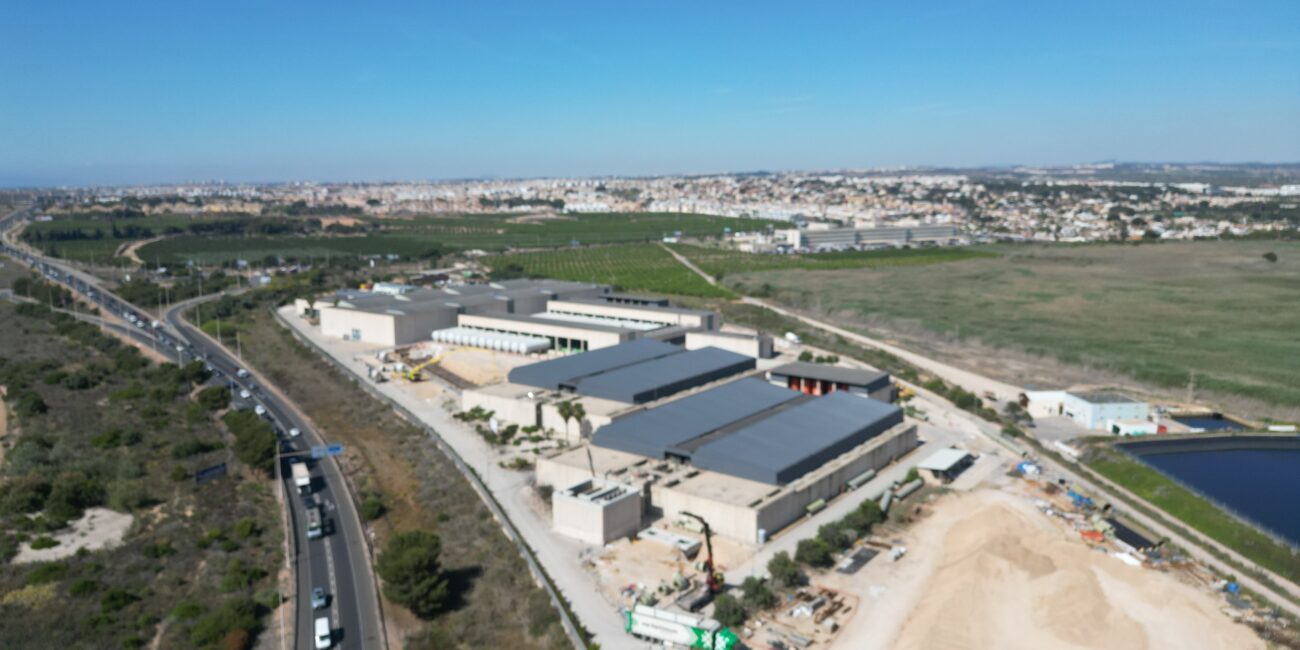
The expansion works at the Torrevieja desalination plant will not be completed soon, nor during the first quarter of 2027 as previously suggested. The board of directors of Acuamed, the state-owned public company responsible for the project, approved a new extension of six months and 18 days on 24th September, pushing the expected completion date to 18 May 2027. This represents the second delay for a project aimed at increasing the facility’s production capacity from 80 to 120 cubic hectometres annually, bringing the total accumulated delay to more than 13 months beyond the original completion date of February 2026.

For the end consumers of the water, which include agricultural communities using the Tagus-Segura inter-basin transfer and the Mancomunidad de Canales del Taibilla responsible for supplying 27 municipalities in Vega Baja, alongside Elche, Alicante, San Vicente del Raspeig, Crevillent, Santa Pola, and Aspe, this means the new supply volumes will not be available until the second half of 2027 at the earliest, as commissioning will also require testing.
With this resolution, Acuamed confirms that the planned duration of the expansion works has increased to 33 months and 24 days, compared to the 20 months set out in the initial contract, amounting to an overall delay of more than a year. Work began in July 2024 after the contract was awarded to a joint venture comprising Ferrovial, Cadagua, and Sacyr. Acciona, the company that built the plant between 2006 and 2013 and operated it until then, launched an unsuccessful legal appeal against the award.
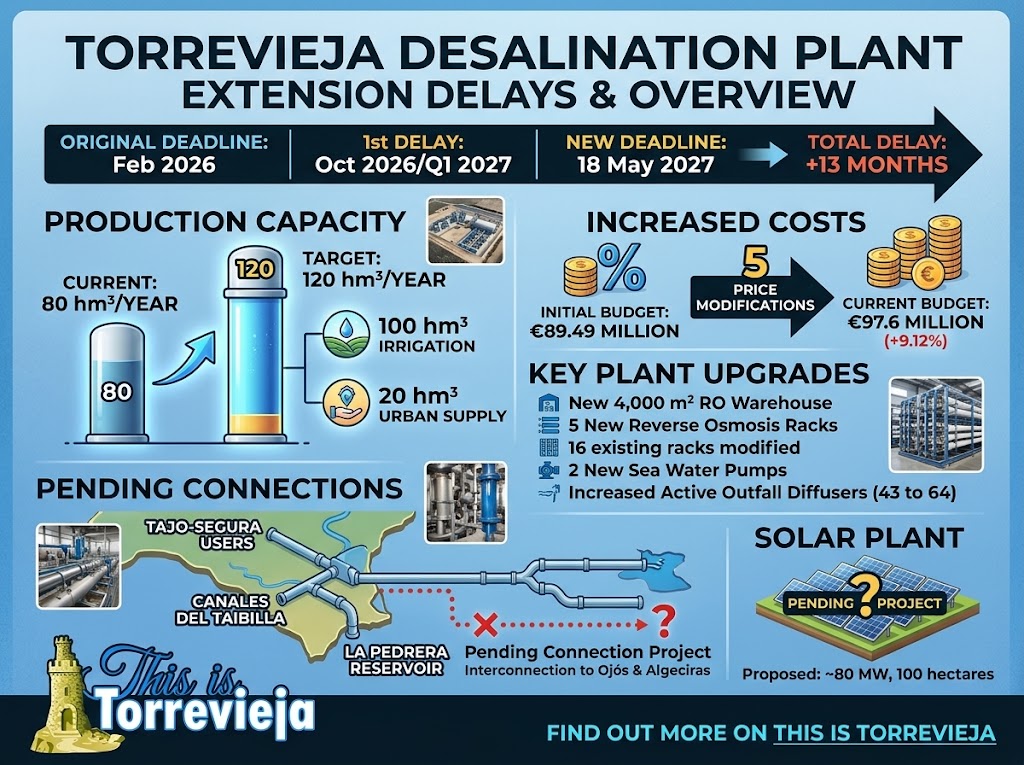
In addition to the two timeframe extensions, the project has undergone five price adjustments during the same period. The infrastructure expansion was originally awarded for 89.49 million euro, including VAT. Following five modifications, the main contract budget has risen to 97.6 million euro, representing a 9.12 per cent increase. The fifth modification approved last September resulted in a slight reduction in the overall total.
The production capacity increase will be achieved by reinforcing the pre-treatment and reverse osmosis phases at the plant through expanded equipment and facilities. Two new pumps will be installed to draw seawater at the Poniente dock in the port of Torrevieja, close to Los Náufragos beach. A new 4,000-square-metre building will house five new reverse osmosis racks, while the 16 existing racks will be modified to boost output. The works also include adapting the current pumps, installing new electrical equipment, and expanding the pumping systems that drive desalinated water to distribution points.
To produce the planned 120 cubic hectometres per year, approximately 267 cubic hectometres of seawater will need to be drawn. The remaining 147 cubic hectometres will be returned to the Mediterranean as brine via the existing underwater outfall running parallel to the Levante breakwater in Torrevieja. The outfall will increase its active diffusers from 43 to 64 by opening the 21 that are currently closed.
Construction of the bypass chamber, service channels, and foundations for the new sand filters has already been completed. The structure of the new reverse osmosis building is finished, and its roof is well advanced. Works to expand the water delivery system to the Tagus-Segura transfer canal and the La Pedrera reservoir have also been completed.
The expansion will add 40 cubic hectometres of annual capacity to the plant, taking total production to 120 cubic hectometres. Around 100 cubic hectometres are allocated for agricultural irrigation and 20 cubic hectometres for urban supply. However, several farmers with water rights remain without a direct connection to receive the flow, particularly within the Riegos de Levante Margen Izquierda network serving thousands of users in Vega Baja and Camp d’Elx, as well as other communities in Vega Baja around La Pedrera and the Region of Murcia.
That connection remains dependent on a separate project involving a multi-million euro interconnection project to pump water from the La Pedrera reservoir to the Ojós weir and the Algeciras reservoir in Murcia, distributing it via the post-transfer infrastructure to Alicante and the interior of the Region of Murcia. Regarding this preliminary draft, it is only known that routing through the Sierra Escalona natural park has been ruled out, and the pipeline route will start at Cabezo de Hurchillo following negotiations between the Segura Hydrographic Confederation and the Generalitat.
The revised schedule also arrives while the self-consumption solar plant announced by the Spanish government in February 2024 remains in the preliminary project phase. Acuamed is studying a photovoltaic facility of between 71.6 and 84.5 megawatts to lower the electricity bill of the desalination plant, which has a projected energy cost of 48.61 million euro including VAT for 2027. The preliminary design for the solar plant announced by Spanish Prime Minister Pedro Sánchez during a visit to Torrevieja is yet to be finalised. The latest proposal suggested using land currently under agricultural production in Los Montesinos, Almoradí, San Miguel de Salinas—where the largest areas would be located—and Orihuela. The solar facility requires around 100 hectares of land to generate the planned energy.
Other Articles