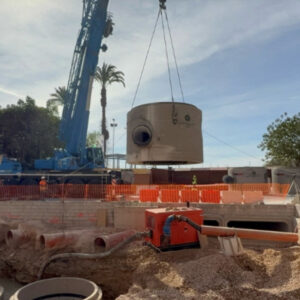

In September 2026, the new Infant and Primary School Number 4 in Almoradí will open. The building of this centre, which will have three lines (three classrooms for each level of education), is already well underway. On Tuesday, March 17th, the Municipal School Council (CEM), a group made up of parents, teachers, the City Council, and the Ministry of Education, talked about some details of how it will be built.

At that meeting, it was declared that this public school will not provide the option of the Islamic Religion subject. This subject has been offered in the other three public schools in the municipality since the 2018–2019 school year.
Team in charge
On Wednesday, the Popular Party’s governing team, led by Mayor and regional deputy María Gómez, said that the decision is up to the Regional Ministry of Education. People in that region of the Generalitat said they couldn’t comment on the decision right now. Daniel McEvoy, the Regional Secretary of Education, is going to visit the location of the new infrastructure next week.
Vicent Marzà, the Minister of Education at the time, started the programme that lets students of Islamic faith choose Islamic religious studies instead of Catholic religious education. It was started in the towns of Crevillent, Catral, and Almoradí, which have a lot of students from North African families. It has been available since the 2018–2019 school year in the Doctor Francisco Mas Magro, Miguel Hernández, and Párroco Francisco Mas schools in Crevillent; the Manuel de Torres, Canales y Martínez, and Pascual Andreu schools in Almoradí; and the Azorín school in Catral. It was also used for evangelical studies in a school in La Vila Joiosa and two schools in the provinces of Valencia and Castellón. The initiative was put into place at the three schools in Almoradí, although not without some problems and threats of protests from parents.
The issue
According to sources among parents and teachers, the measure could have two direct effects on the local school community: families of Maghrebi origin might choose not to send their kids to the new school, which would mean that there would be more Maghrebi students in the current schools, and the new school could become an enclave with a much lower percentage of migrants, making it more appealing to local families.
They also said that this choice makes it harder for people to get along, goes against religious freedom, and makes things worse instead of better. There are more than 30% North African students in every school in Almoradí. It goes up to 40% at the Manuel de Torres school. There are usually twice as many students in Islamic Religion classes as there are in Catholic religion programmes. “It’s not a pilot programme at all when that’s the ratio,” they said.
El CEM
The decision did cause some dispute, as the municipal members of the School Council said it would. The inspector was less certain. Principals, parent-teacher associations, and union leaders all asked how they should let families know. Another source of disagreement is that the Inspectorate has made it plain that Islam will be a choice at the new school that is also opening in Catral. The Inspectorate says that anything different would lead to unequal educational chances. Municipal sources, on the other hand, say that this is not yet certain.
The Municipal Education Council (CEM) said again that they would “listen to the families” and change their minds about the decision once the new school number 4 was open and had its own faculty and school council. They would also put off making a decision about whether to keep or get rid of the option until the next school year. At that time, parents, teachers, and unions said that the School Council meeting that was going on at the time was the right place to talk about these things.
The Islamic Group
The Islamic Cultural Association was careful about what they said about this topic. “We have asked the City Council for a meeting to get more information.” The Islamic group stressed that almost a third of all preschool and primary school classrooms in the city are made up of pupils from North Africa. Since the programme began, most of these students have chosen Islamic Religious Education, which they see as a very beneficial experience. The Islamic Commission picks the teachers who are qualified to teach the topic.
The disciplinary rules for teachers in the Valencian Community apply to this teacher, so they must have been trained in the same way and through the same structures as the rest of the faculty they work with. They must also have the same qualifications and a declaration of suitability or equivalent certification from their religious denomination.
About 15% of Almoradí’s more than 23,000 registered population are from the Maghreb, mostly Morocco. In 1989, the first Moroccan moved to the town. More over 3,000 people live in this village currently, and most of them work in the primary sector, which means they work in the orchards. The sector would have fallen apart without this work since there weren’t enough workers to keep it going.
8.1 million and a long wait
The new centre will contain three classrooms for the first cycle of preschool, nine for the second cycle, and a café that can seat 588 people in two shifts. The facility is on a plot of land that is 17,378 square metres on Avenida Algorfa (CV-935). The investment is 8.1 million euros, which is 600,000 euros more than what the winning bidder, Perfesán, asked for. During a site visit in January 2024, the Regional Ministry of Education said that the building will be finished in October 2025.
Other Articles