



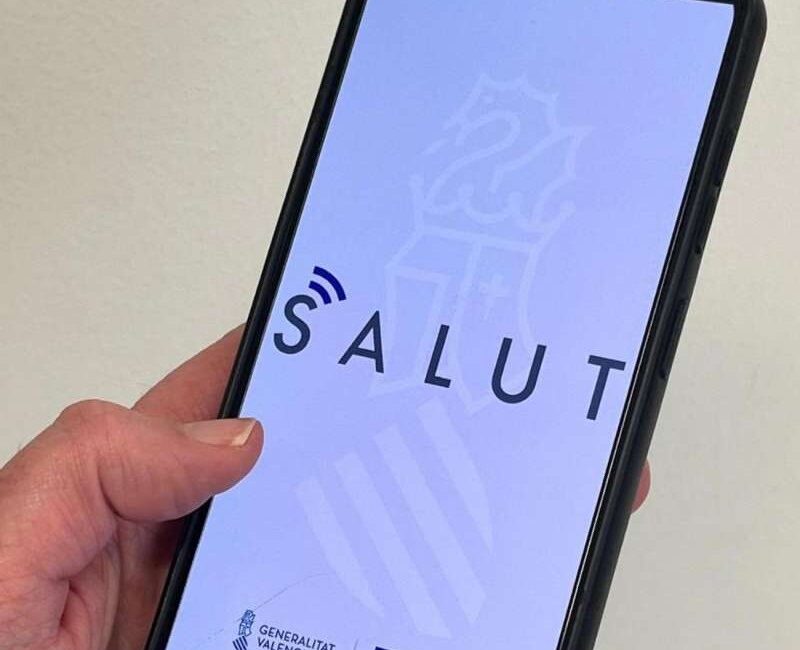
The GVA+Salut app has been updated by the Valencian Ministry of Health. EFE/Ministry of Health of Valencia

The GVA+Salut app has been updated by the Ministry of Health to incorporate new features, including the virtual SIP card and access to clinical images of patient reports or diagnostic tests. The purpose of this update is to align the app with the current healthcare reality of the citizens.
Bernardo Valdivieso, the Regional Secretary for Planning, Information, and Digital Transformation at the Ministry of Health, presented the design and operation of the new GVA+Salut application in this context. He also noted that this digital tool has already become the primary digital communication channel between the health system and its citizens.
Vadivieso stated that the new version enables patients to quickly access their reports, tests they have undertaken, or view specific clinical images, among other features. He also confirmed that there are currently over 65 million medical images stored, which are already accessible to each user.
In addition, the regional secretary emphasised that a virtual SIP card is a new feature that expedites access to healthcare services, as patients do not require a physical card to identify themselves, as reported by the Generalitat yesterday, Thursday March 26th.
The application has already integrated these features; therefore, citizens are required to upgrade the GVA+Salut application on their mobile device in order to utilise them. In the near future, they will receive an SMS containing a link to an instructional video that will provide instructions on how to complete the update.
It is also important to mention that in order to ensure the utmost level of security as outlined in the Data Protection Law, it is necessary to use Cl@ve, a digital certificate, or an electronic ID card to access the Electronic Health Record, the virtual SIP card, or any other function.
Pharmaceutical dispensing
Valdivieso clarified that all pharmacies in the Valencian Community are enabled to view prescriptions using a QR code generated by the application. Additionally, he stated that the electronic SIP system will be accessible throughout the country once all autonomous communities have integrated it into their networks.
He elaborated, “The objective is to simplify the patient’s interaction with public healthcare, reduce paperwork, and provide individuals with greater autonomy in managing their healthcare requirements. This will be accomplished through the digital transformation process that we are currently implementing at the Ministry, resulting in a more personalised and intimate healthcare system.”
New digital obstacles for 2026
Valdivieso has declared that this digital health tool will “experience a significant transformation” by 2026. The tool will include a health promotion section that will compile personalised information on emotional well-being and healthy lifestyles.
The application is currently in the process of enhancing healthcare management and appointments through the application, with the primary goal of reducing unnecessary administrative burdens, improving transparency for citizens, and simplifying procedures. Additionally, it will record information on pollen levels, which will be particularly beneficial for allergy sufferers.
For instance, the citizen will have the ability to generate the supporting documents automatically, obtain them in PDF format, or select multiple dates. Additionally, the application will incorporate real-time monitoring of patients during surgical interventions.
The user will have the ability to review the vaccines that have been administered and the anticipated next dosage based on the current schedule in the Electronic Health Record section.
Other Articles

