

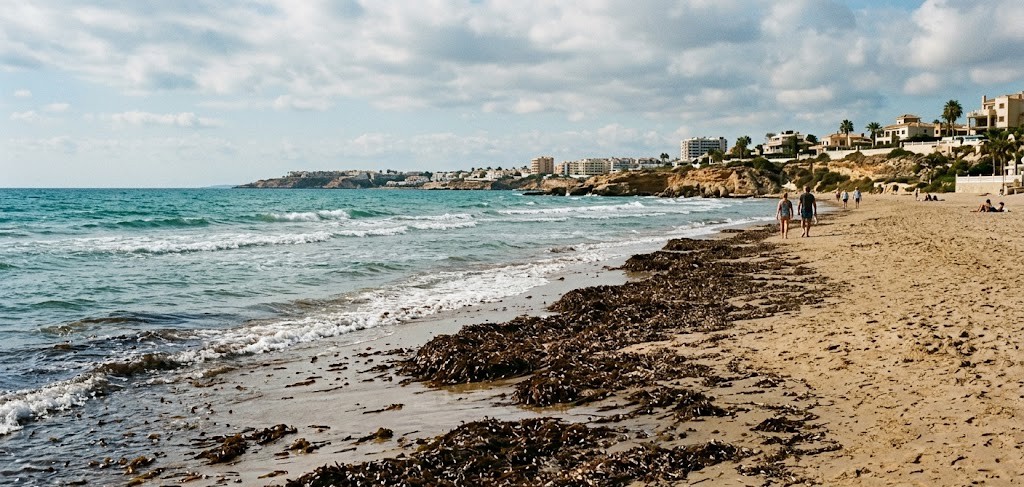
Residents and beachgoers are growing increasingly concerned about the piles of seaweed accumulating on the beaches of Orihuela Costa, with complaints about unpleasant odours and other inconveniences becoming more common at this time of year. In response, the City Council’s Street Cleaning and Solid Waste Management Department has put out to tender the removal of the Posidonia seagrass to ensure that coastal conservation is compatible with the enjoyment of the beaches.

The council department, which is headed by Rocío Ortuño, has approved the contract file for the service of collecting, removing and transporting Posidonia oceanica remains from the municipality’s beaches to a treatment plant. The project has a base tender budget of 80,520 euro.
This price is a maximum estimate based on data from previous years and is strictly contingent upon the presence of the Posidonia oceanica seagrass wrack on the local shorelines. The wrack is a natural phenomenon caused by the accumulation of leaves washed ashore by maritime storms. The final amount of material to be removed, alongside the overall cost, will depend entirely on the frequency and intensity of these storms as well as applicable regulations. Because of this, the initial contract price may be adjusted by up to 20%.
Orihuela removes these natural remains from the shoreline from Easter until 15th October each year because many beachgoers consider them a nuisance and litter. For the rest of the year they are left in place, as they contribute to the protection and stabilisation of the coastline and coastal dunes, whilst also promoting biodiversity and reducing sand erosion during the winter months.
The City Council points out that this action will allow the beaches to be kept in the best possible condition during the peak holiday season, whilst simultaneously ensuring environmentally friendly management and the conservation of the coastline.
The work will take place across the eleven beaches and coves of the Orihuela coastline: Punta Prima, Cala Mosca, Cala Estaca, Cala Cerrada, Cala Bosque, Cala Capitán, La Caleta, Aguamarina, La Glea, Barranco Rubio and Mil Palmeras.
The contract includes the removal, transport and management of these plant remains when environmental conditions and the influx of users require it. The active provision of the service will be conditioned by the natural episodes of posidonia accumulation caused by maritime storms.
Last March, the Department of Street Cleaning and Solid Waste Management requested authorization to remove the waste to authorized drying facilities. This coincides with the entry into force of Royal Decree 191/2026, of 11 March, for the conservation of seagrass meadows in Spanish Mediterranean waters, which further emphasizes their protection.
It remains important to remember that Posidonia oceanica seagrass meadows are fundamental ecosystems for marine biodiversity. The debris that washes ashore serves an essential function. During the months with fewer beachgoers, this plant matter helps to stabilize the sand, reinforce the dunes and reduce erosion caused by winter storms. For this reason, it is not routinely removed all year round. The seaweed remains on the coast because it helps protect beaches from sand loss and coastal erosion.
Ortuño explained that it is important for residents to know that the presence of posidonia on local beaches does not mean dirt or a lack of maintenance. Instead, she noted that it is a protected marine plant of great ecological value, and its presence is actually an indicator of the excellent quality of the waters.
The councilwoman also highlighted that the temporary piling of seagrass in designated drying areas is an authorized practice recommended by the Directorate General of Coasts, as it minimizes sand loss during removal operations. She added that residents often see accumulations of seagrass and think that no action is being taken, when in reality it is a necessary step in the process to ensure proper and respectful management of the beaches.

