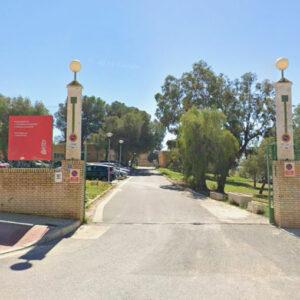
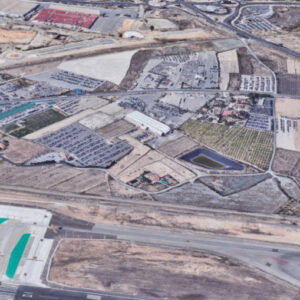

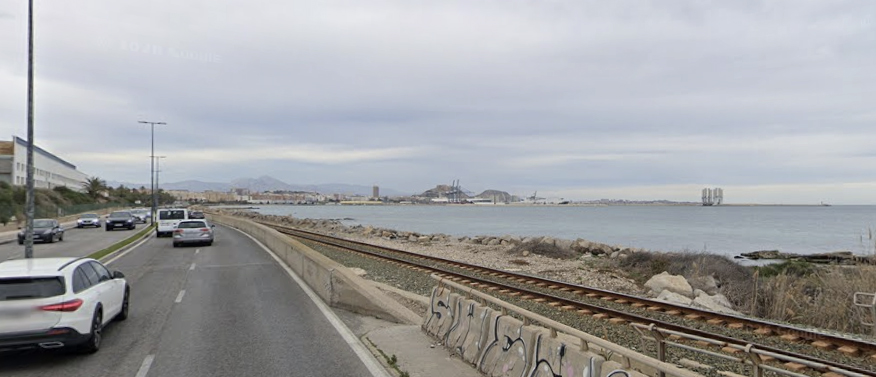
Adif is installing new fencing in San Gabriel to prevent unauthorised crossing of the railway tracks at one of the most problematic points on the coastline of Alicante. The work is being carried out on the section between the EUIPO area and El Palmeral park, a zone used for years by pedestrians to cross to the seafront, despite the risk posed by the proximity of the railway line. The closure comes in an area marked by a long history of accidents. Between San Gabriel and Aguamarga, ten people have died from train collisions so far this century.

The project involves the construction of a 1,360-metre-long enclosure using a modular system of electro-welded galvanised steel wire panels. The installation is being carried out on the existing wall, parallel to Avenida Elche, where the railway tracks run just metres from the road and the coastline. Images of the work already show a continuous barrier between the roadway, the railway platform, and the coastal area.
The project represents an investment of approximately 110,000 euro and is being carried out through the maintenance contract of Adif. The work is expected to be completed next week. Crews are working from Sunday to Thursday, as the necessary road closures are not permitted on Fridays and Saturdays. The new fence will extend the existing one and connect with the section already completed up to the Aguamarga ravine.
The immediate objective is to close access to the railway tracks in an area where unauthorised pedestrian use has been common. The area effectively serves as an informal connection point between San Gabriel, the waterfront, the EUIPO area, and El Palmeral. It has also been used by people who come to the coast to fish or walk along the seafront. This coexistence of road, railway, and coastline has made the area particularly sensitive from a safety perspective.
The incident occurred in a corridor with a history of serious accidents. The most tragic event took place on 28th September 2002, when a long-distance train between Barcelona and Cartagena struck a group of hikers between the San Gabriel and Torrellano stations, near the then-OHIM. Three people died: a 12-year-old girl, her 50-year-old mother, and a 65-year-old man. A dozen participants in the night hike were injured.
Four years later, on 8th October 2006, another 65-year-old man was killed when he was struck by a train in the Aguamarga area, at kilometre 3.6 of the Alicante-Cartagena line, about 900 metres from the San Gabriel train stop. According to initial reports, the victim had entered the tracks after leaving the beach.
On 17th October 2012, another fatal accident occurred in the same area where the hiking accident had taken place. A couple, a 27-year-old man and a 17-year-old girl, were struck and killed by a commuter train while crossing the tracks, according to eyewitnesses.
The list continued in 2013. On 7th June of that year, an 18-year-old woman died in Torrellano, within the municipality of Elche, after being hit by a train while crossing the tracks while wearing headphones. Just three months later, on 16 September, a 59-year-old fisherman from El Campello died in front of the EUIPO after being struck by a train travelling towards Elche.
The two most recent fatal accidents occurred recently. On 6th October 2022, a 56-year-old man was killed when he was struck by a train while crossing the tracks to go fishing near the San Gabriel neighbourhood. On 6th January 2025, a 24-year-old woman also died near the tracks after going fishing with her husband. According to reports at the time, she got too close to the railway line while talking on her mobile phone and was hit by the train.
The fencing alone does not resolve the long-standing debate about the coastal railway tracks, whose removal is planned as part of the railway transformation of the waterfront. However, it does address one of the points where the risk has been most evident. The new barrier aims to prevent pedestrians from continuing to access the railway platform in a section that combines informal passage, recreational use of the coast, and train traffic alongside the road.