

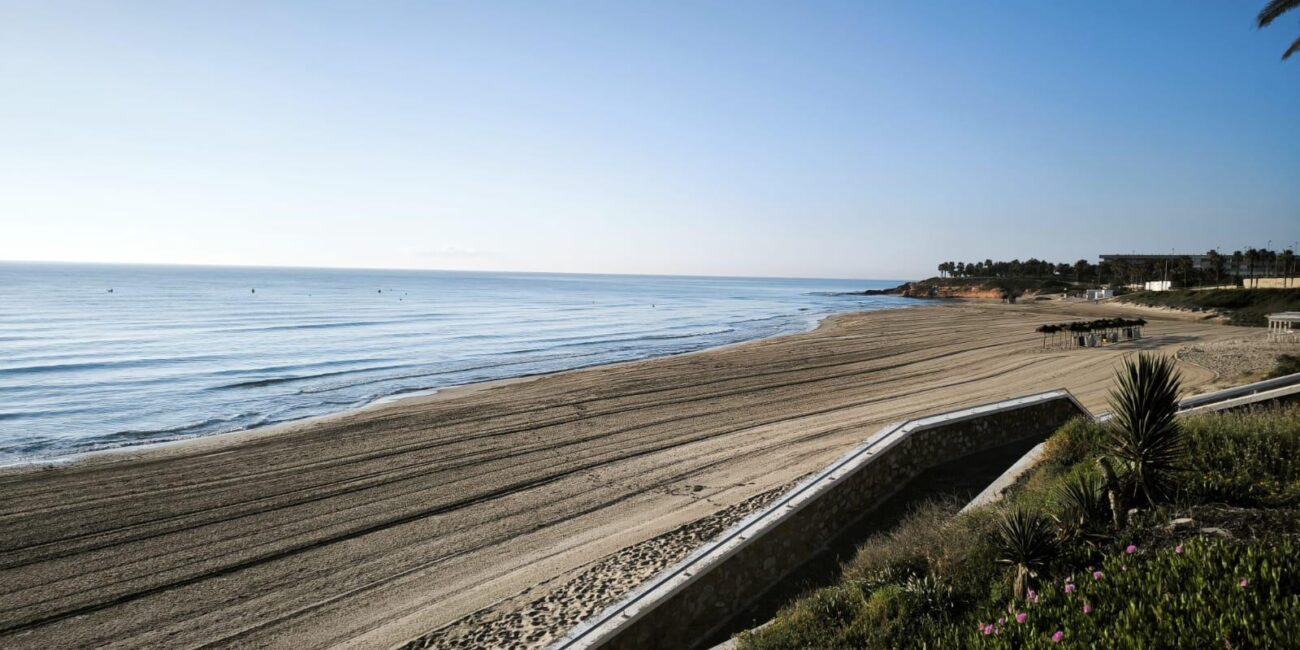
Pilar de la Horadada Town Council has requested that the Ministry for Ecological Transition (MITECO) promote a long-delayed project to restore the beaches of El Mojón, Higuericas, and Las Villas. The local authority has also demanded that the Generalitat Valenciana, which holds jurisdiction over marinas, or the concessionaire of the Torre de la Horadada marina itself, assume responsibility for the permits, work, and costs associated with sand replenishment and seaweed removal needed to maintain the coastline. The municipality maintains that it has been paying for years for actions outside its responsibility to mitigate sand loss along its southern coastline and the accumulation of sediment and seagrass debris on Puerto beach.

As the southernmost municipality in the Valencian Community, Pilar de la Horadada boasts nearly five kilometres of coastline, eleven beaches and coves recognized with the Q for Tourist Quality, and six Blue Flags. Despite these distinctions, the Town Hall states that residents and visitors continue to complain about the lack of sand on the beaches of El Mojón, Higuericas, and Las Villas during the peak summer season. Consequently, formal requests have been sent to both the Ministry and the regional government asking each administration to take up its respective duties.
The local council is relying on its General Urban Development Plan, approved in February 2000. Article 102 of the plan specifies that coastal impacts caused to adjacent beaches up to Las Villas must be corrected, as sand has been reduced or eliminated along a significant length largely due to the port’s development. Under the plan, this correction must be carried out through regeneration and the addition of sufficient sand for summer use at the expense of the port, as the party responsible for the impact and environmental damage.
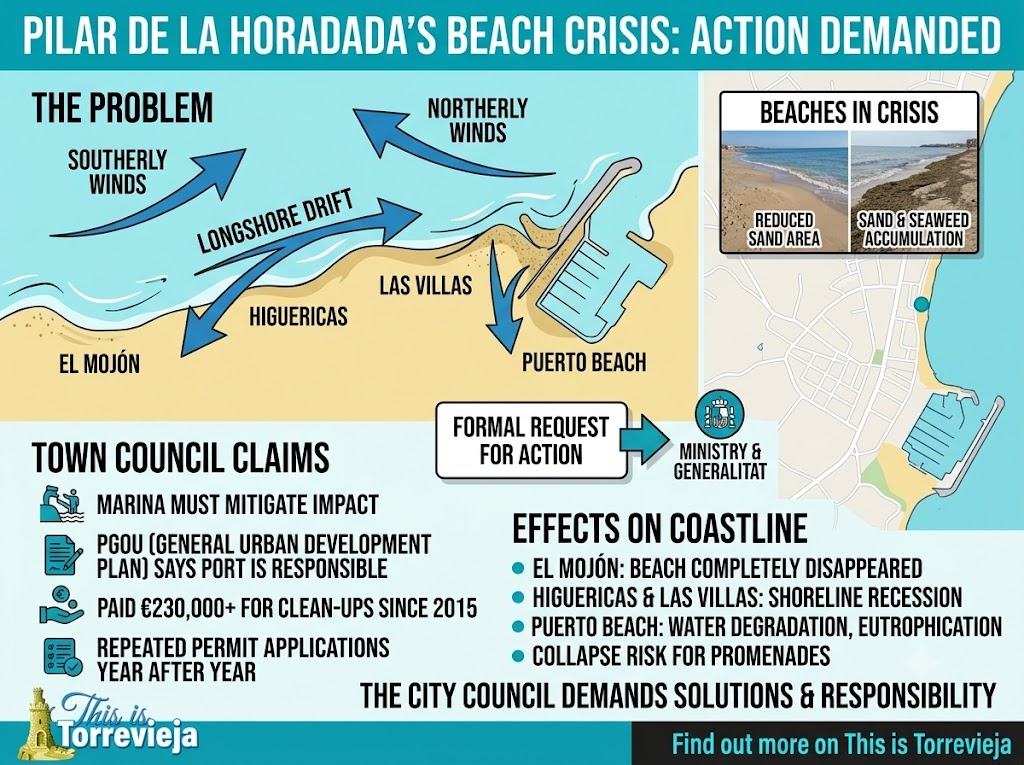
Despite this provision, the Town Council maintains that it has had to undertake the removal of seaweed and the movement of sand accumulated due to the morphology of the breakwaters in the Torre de la Horadada marina since 2015. These tasks have incurred a municipal expenditure of 230,640 euro. The only exceptions occurred in 2016 and 2017, when sand was replenished directly by the Alicante Provincial Coastal Service under the Ministry of the Environment.
Local officials point out that the problem stems directly from the port’s impact on coastal dynamics. An unpublished environmental report details the effects of the breakwater on nearby beaches, and various studies have previously proposed removing or modifying the length of the structure to solve the issue.
The altered sedimentation is most noticeable on Puerto beach, where sand and marine debris gather in the northern section. The Town Council highlights that this is compounded by water degradation caused by confinement, hypersedimentation blocking the harbour entrance, and eutrophication linked to port activity. The consequences are evident across the coastline: no beach remains in front of the Mojón promenade, the shoreline has receded significantly at Higuericas and Las Villas, the connection between Las Villas and Puerto beach has been lost, and a breakwater had to be constructed to protect the Sardinero promenade during storms.
Due to the lack of agreement between the Ministry and the regional government, the Town Council has been funding occasional sand transfers from Puerto beach to the southern beaches to ensure accessibility, safety, and the installation of foot showers, walkways, and platforms for people with reduced mobility. These temporary measures must be processed annually and rely on the marina dredging the harbour entrance before depositing the sand for transfer.
In 2026, the amount of sand available on the beach is significantly lower than in previous years. While the port holds a large stockpile of sand on its breakwater, it requires authorization from the Coastal Authority to move it to the beach. The Town Council emphasizes that the same permit applications and emergency actions recur every year without resolving the underlying structural damage.
The natural dynamics of wind and sea currents explain part of the ongoing erosion. Southerly and southeasterly winds push sand northward away from El Mojón, Higuericas, and Las Villas towards Puerto beach, where the harbour structure traps it. When northerly winds blow, the drift carries sand south toward San Pedro del Pinatar, where it becomes trapped near the breakwater of the port of Murcia. Storms also bring remains of Posidonia oceanica seagrass that mix with the sand on Puerto beach, creating a muddy appearance that dismays beachgoers.
In 2021, a specific solution was proposed to recover El Mojón beach after it had completely disappeared. The proposal included constructing a breakwater on the border with the Region of Murcia alongside sand replenishment in El Mojón, Higuericas, and Las Villas. The Ministry awarded the project and environmental impact study under the file “El Mojón Beach Recovery Project, Municipality of Pilar de la Horadada”, but physical work remains stalled.
In the interim, the Town Council has paid for an emergency breakwater to protect the seafront promenade and beachfront properties in El Mojón from further damage. The local government insists the Ministry must complete the full restoration project while demanding that the regional Directorate General of Coasts and Ports or the marina concessionaire handle the immediate authorizations, sand replenishment, seaweed removal, and associated costs.
While the management of the Torre de la Horadada Nautical Club—which features 540 mooring points—has not commented on the requirements of the General Urban Development Plan, the entity has carried out renovation works validated by the Generalitat Valenciana to extend its concession, expand commercial space, and dredge the area to accommodate longer recreational vessels.