


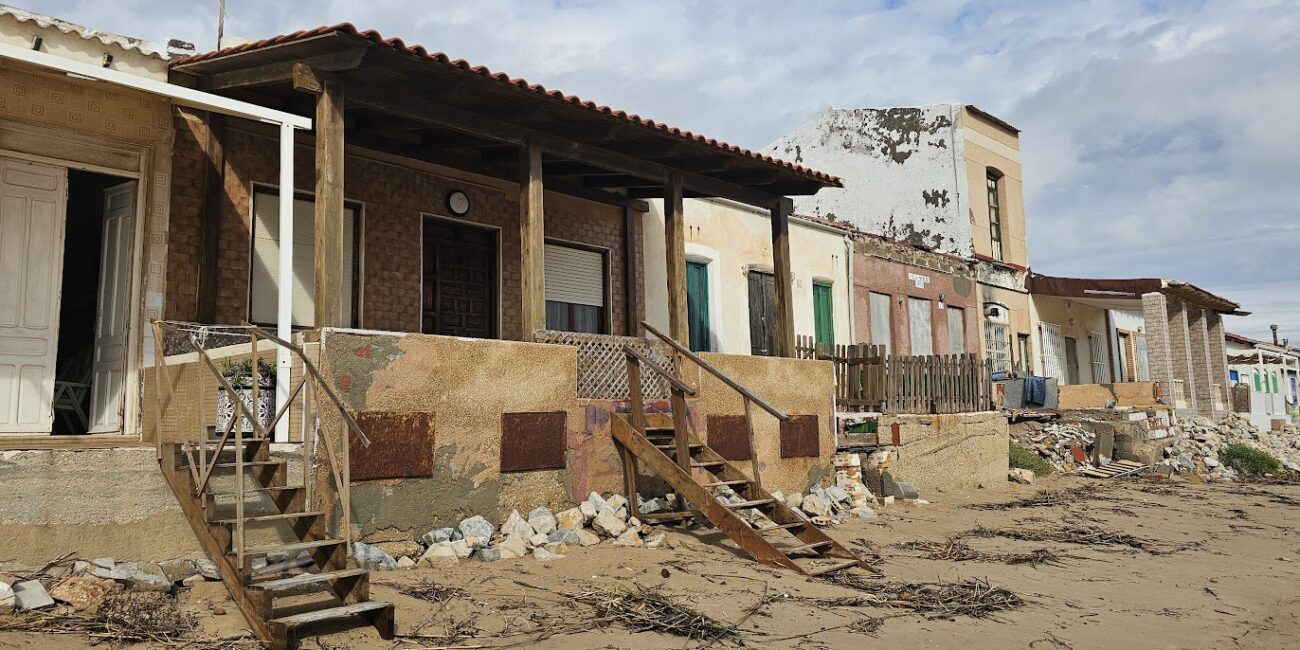
The long-standing battle between the owners of the beach houses on Babilonia beach in Guardamar del Segura and the Directorate General of Coasts, under the Ministry for Ecological Transition, has reached a temporary pause thanks to intervention by the regional government.

The properties, positioned directly in front of Guardamar del Segura’s dune belt—a designated Site of Community Importance and part of the Natura 2000 network—were built at the start of the 20th century. Situated entirely within the public maritime-terrestrial domain, their concessions are destined for extinction, in line with successive democratic coastal laws.
Owners of the Babilonia beach properties have fought this termination in court. However, both the National Court and the Supreme Court rejected their claims to extend the concessions.
The 60 properties on Babilonia beach were scheduled for demolition from 15 September 2025. Demolition was halted after the regional government introduced precautionary measures to protect the heritage, promoting the declaration of the Babilonia beach house settlement in Guardamar as an urban area of special ethnological value.
At that stage, administrative procedures for the demolitions were advanced. Property owners had already contracted a firm to carry out the work—as concession holders are legally required to cover demolition costs—to avoid central government charging them for a public company to perform the task. A municipal building licence for the work had also been granted.
This intervention provided a reprieve for the properties on Babilonia beach, allowing residents to experience an additional summer in 2026 beyond the expected final season in 2025.
However, the regional government’s actions prompted the Constitutional Court to provisionally suspend Article 17 of the Valencian coastal law, which regulates ethnological areas, while considering whether it is unconstitutional and invades state powers alongside two additional provisions.
The State Legal Service argued that the regional action prevents planned environmental regeneration by the state, prolongs the deterioration of a public maritime-terrestrial domain within Natura 2000, compromises coastal regeneration, hinders dune system recovery, and impacts public safety.
The interruption of the demolitions and the delayed recovery of the public maritime-terrestrial domain led the Constitutional Court to suspend the article concerning ethnological areas.
Active since June 2025, this planning classification had only been formally applied for by the municipalities of Guardamar del Segura and Moncofa, according to regional environment department sources. Other municipalities, such as Denia, Nules, and Oliva, were considering applying. None can now use Article 17 until the Constitutional Court delivers its final ruling.
Legal expectations remain low for the owners. The National Court and Supreme Court previously dismissed an appeal by a homeowner seeking a concession extension. The property had been legalised as a dwelling on 21st September 1942, transferred to a new owner on 21st March 1994, and subsequently involved in the rejected appeals.
The Supreme Court ruling on 2nd March 2023 resolved the legal battle between owners and the Ministry for Ecological Transition, establishing legal precedent. The decision upheld that coastal authorities can deny extension requests for concessions granted under the 1988 coastal law, which set a 30-year limit for residential concessions within the public maritime-terrestrial domain. A subsequent extension to 75 years was overturned by the Constitutional Court in 2015.
The High Court confirmed that the ministry’s refusal to extend the concessions for the Babilonia beach properties was valid based on environmental grounds, coastal protection, and public safety concerns.
Other Articles

Valencian health appointment system crashes across the region
