


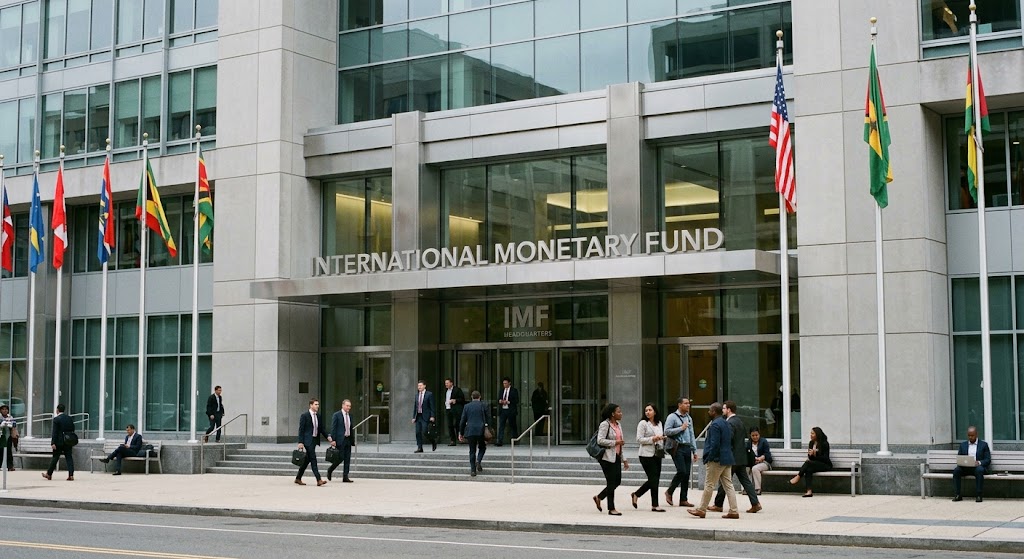
Developed nations continue to deliver positive surprises despite facing major economic hurdles including inflation and elevated public debt. The International Monetary Fund (IMF) has revised its growth projections upwards, with Spain leading the upward momentum. The organisation now forecasts Spanish economic growth at 2.5%, an increase of four-tenths of a percentage point compared to earlier predictions, although still slightly below figures projected by independent analysts and the Spanish government.

The IMF, holding its autumn gathering alongside the World Bank in Bangkok, maintained its 2027 projection for Spain at 1.8%, while other analysts foresee expansion reaching 2.2%. Inflation projections remain moderate at 2.7% for next year, a full percentage point below 2026 estimates. The Bank of Spain recently published a higher inflation estimate of 3.7% for 2027, anticipating potential price pressure in energy markets. Because the IMF finalises forecasts well in advance, its estimates can lag behind institutions incorporating real-time data. Unemployment in Spain is expected to stay below 10%, representing a historically low level for the country. Analysts attribute Spanish economic strength to job market resilience, robust domestic consumption, and strong service exports.
Overall growth across developed economies reflects notable resilience against recent energy price shocks. The IMF attributes this stability to flexible supply adjustments, inventory management, reduced energy intensity, and the adaptability of businesses and households. Spain and Ireland have notably driven the performance of the eurozone, which is expanding at 1.1%. In comparison, the United States economy is expanding at 2.3%, positioning Spanish economic growth ahead of major developed peers.
Meanwhile, economic performance across other wealthy nations remains mixed. Growth in France has been revised to four-tenths of a percent for the year, falling behind initial expectations. Canada is projected to expand by 1.1%, affected by international trade and tariff pressures. Developing and emerging markets face downward revisions, with global economic expansion expected to reach 3.1% in 2026 before recovering to 3.4% in 2027.
Technological investment and geopolitical developments continue to shape the international outlook. Rapid investment in artificial intelligence and infrastructure provides positive economic momentum, though the IMF notes that long-term productivity gains remain uncertain. Conversely, ongoing geopolitical tensions and public debt levels continue to pose risks to international fiscal stability.
Other Articles