


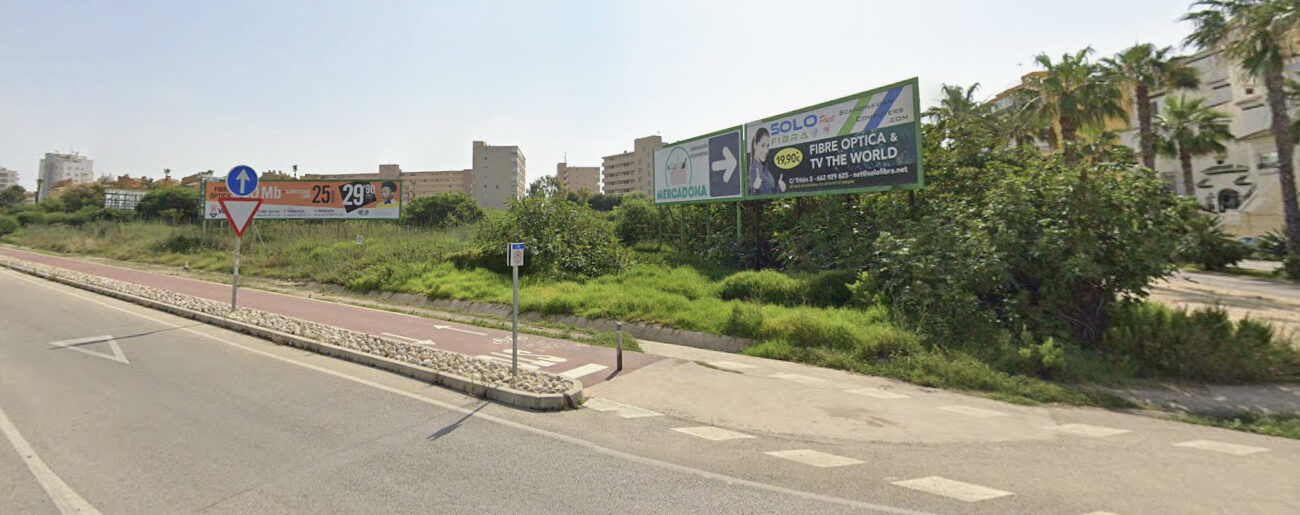
Duly Investment Home, a company that builds tourist accommodations, has asked the Torrevieja City Council to amend the zoning of a piece of land in La Mata that is between the N-332 highway and Avenida de los Europeos. The intention is to create two ten-storey structures that will house a hotel and tourist apartments. An Interior Reform Plan (PRI) is being used to make the transformation. People can now comment on the strategic environmental assessment and the environmental impact study that must be done before the urban planning process can start.

The design asks for the plot’s building footprint to be smaller but the number of storeys to be higher so that the total buildable space stays the same. This means that the property, which is already zoned for hotel usage, will have its maximum occupancy cut from 40% to 25%, and the height limit raised from four to ten storeys. The plan also suggests letting hotels manage tourist homes, which the legal reason for the paper says is already allowed by law. It also says that making the building smaller will make room for common areas for leisure, entertainment, and services, as well as “complementary commercial and recreational activities.”
The plan calls for two blocks of staggered, “unique buildings” that would be ten stories tall at their highest point. This size puts the project a few storeys above most of the region around it, but in the last several years, structures of a similar size have also been built in the same part of La Mata, including the Mahersol towers near to the village’s sports centre.
In the last three months, this is the third time that the Interior Reform Plan (PRI) has suggested changing the zoning of residential properties in Torrevieja to hotel usage. Masa Rental is likely to send in a plan to develop a four-star hotel on Avenida de La Libertad. This project was first talked about at the last Fitur. Insaura, another developer, has already filed its own plan for a three-star or higher hotel in La Veleta.
Duly plans to build 8,000 square metres of space on a 12,000-square-meter property in La Mata. This plot will also have a green area and roads leading to it. The construction company, which is based in Torrevieja and used to only build hotels for tourists, says that this scale will allow for the building of a lodging complex with a combined capacity for both long-term and short-term guests.
The developer has not, in principle, chosen not to take advantage of the chance to add extra storeys to this building, which the Torrevieja General Plan would allow. This plan sets extra building coefficients dependent on the hotel’s category, which the proposal doesn’t say. The proposal does include managing the entire hotel, which has 120 two-bedroom apartments that are all available for rent to tourists. Once the City Council approves the Special Plan (PRI), the building will take 30 months to finish.
The concept is based on a volumetric reorganisation that puts the building’s footprint first. This decision is meant to free up land for recreational areas and improve visual permeability, while also diminishing the building’s “screening” impact by lowering its occupancy. The proposal aims to change the use of the building to meet the present need for tourist apartments, in line with Law 15/2018 and Decree Law 9/2024. This means that the original idea of using the building as a hotel would now include temporary lodging blocks. From a technical point of view, the design keeps the buildable area set by the General Urban Development design (PGOU) without using the increase for hotel category set by Amendment 74. This makes sure that the total built area stays at the projected 12,800 m². This setup doesn’t change the buildable area or the infrastructure, thus it makes sense to have a simpler environmental process since it’s a little change to land that is already urbanised, as required by current regional rules.
The Lloyds Club is the sole hotel and apartment hotel in La Mata, and it is right on the beach. The SH Hotels Group group, which also runs the Hotel Masa in Torre del Moro, owns it and has already sent in a plan to fix up its facilities. The Hotel Playas de Torrevieja (previously Cabo Cervera) is also a great hotel along the La Mata shore.
The three developers that have put together a Comprehensive Reform Plan for residential land, or in this latest case, hotel land where the heights are being raised, have agreed that their plans are direct and constructive contributions to the town of Torrevieja.
The first is to promote tourism. A new hotel hub is thought to help the local tourism industry grow by bringing in new types of guests and boosting the number of high-quality places to stay. It also connects a larger number of hotels to the diversification of the local economy, which means that the economy is less reliant on one market segment and the peak season lasts longer. This is good for other sectors including hospitality, retail, and ancillary services.
The promoters say that it won’t hurt the environment.
The developers say that even though the site is “near” the La Mata and Torrevieja Lagoons Natural Park, “the N-332 highway acts as a barrier that minimises the impact on the protected area.” Because of this, the permitting process is “being carried out through a simplified procedure at the municipal level,” since it is a “non-structural” change that doesn’t change the overall urban plan and includes measures to fix problems during construction, like limiting work outside of wildlife breeding season and controlling waste. In fact, the only thing that separates the plot from the natural park’s buffer zone is the width of the highway. This road has been the border for building to the east of the natural park for the previous 40 years. The paper also says that there is no chance of floods. The Roads Department and the Generalitat (the regional government of Valencia) worked quickly to drain the water from the dry riverbed that used to flood that part of the road directly at the entry to Avenida de Los Europeos, which is the primary southern entrance to La Mata.