


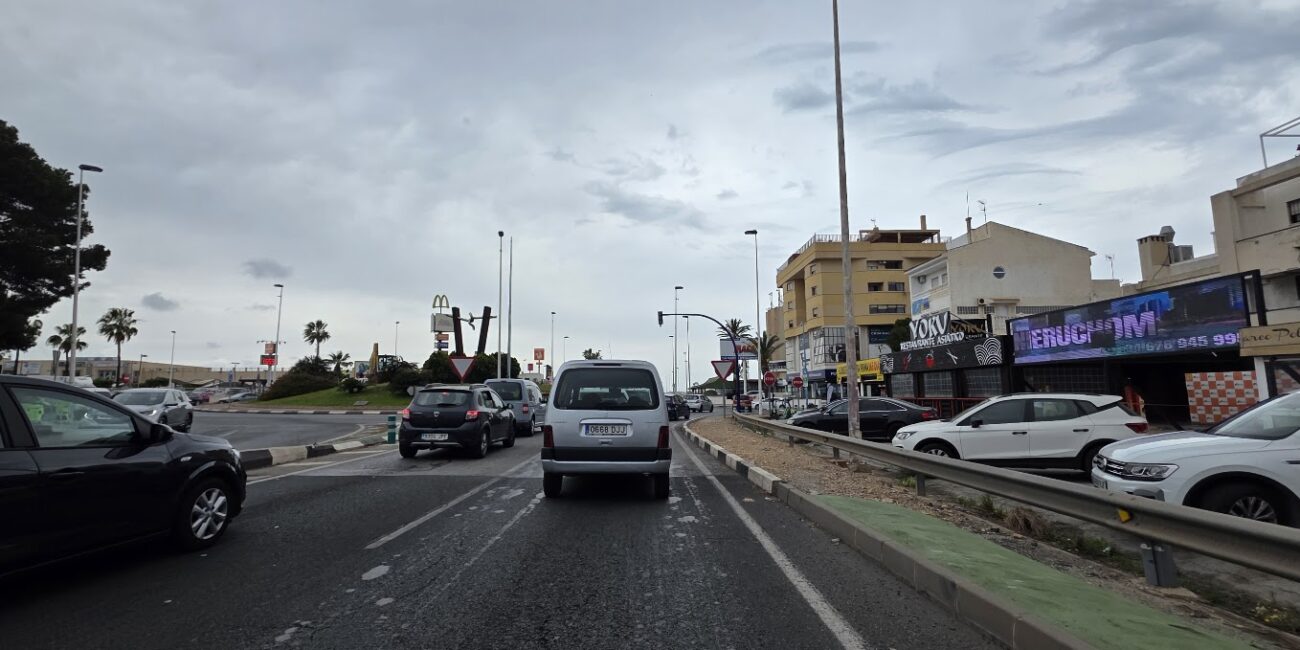
The Ministry of Transport and Sustainable Mobility has completed the installation of a pioneering traffic light system based on artificial intelligence at the Punta Prima roundabout. The system is located at kilometre 52.8 of the N-332 highway, on the stretch between Torrevieja and Orihuela Costa. In fact, the project is an experiment, as it is the first roundabout in Spain to feature this type of technology.

Financed by European funds from the Recovery, Transformation and Resilience Plan, the project has finally cost 357,534 euro, a figure slightly lower than the 409,000 euro initially planned. The works have included the installation of traffic light poles at the access points, in both directions of the national highway and at its confluence with the avenues of Las Olas and Escorpiones. It has also seen the placement of detection cameras and traffic data collection devices at each access point, alongside the implementation of a control system based on artificial intelligence which is capable of automatically regulating traffic light cycles according to the actual intensity of traffic.
According to the ministry, this intervention has sought not only to improve traffic flow at the roundabout, but also to lay the groundwork for the incorporation of intelligent systems in the road management of the State Road Network and to place the user at the centre of decision-making.
In theory, this sounds ideal, but in practice, at least in these first few days of its implementation, there is chaos and confusion. This is partly due to the unfamiliarity of drivers who find themselves facing traffic lights in a roundabout, generating major traffic jams during rush hour in all directions, especially on Avenida de Las Olas and Calle Escorpiones. On the ground, the result is that some drivers ignore the traffic lights, acting as if they do not exist and running red lights out of desperation.
The system prioritises passage for vehicles on the national highway, which often accumulates traffic jams of hundreds of metres, especially in the direction of Torrevieja. Therefore, those arriving at the roundabout from the two roads, Los Altos and Rocío del Mar, sometimes find that when the traffic lights are amber they do not have the actual capacity to pass, and when they are red they could actually pass. As a result, some drivers, after having been stuck in a queue, decide to skip the light to take advantage of the gap.

Consequently, many users are wondering if these traffic lights are really smart, if it was necessary to invest in this experiment, or if traditional ones would have sufficed. They are also questioning if there was not another solution to regulate traffic at one of the busiest roundabouts, which handles an average of 45,000 vehicles daily.
The other big question is what will happen at this spot, which is usually congested all year round, when the season is in full swing. This period brings the arrival of more tourists and the floating population occupying second homes and tourist apartments, whilst the roundabout remains the only way out for all the residents of Rocío del Mar and Señorío de Punta Prima, where numerous buildings have been constructed in recent years and continue to be built.
Time will tell if these new elements really work in complex road infrastructures such as roundabouts. It is also a case of letting the artificial intelligence train itself, since the system learns to optimise traffic light regulation from the experience of use and the data collected. To this end, a monitoring and management system for intelligent traffic lights is included, based on machine learning and reinforcement learning techniques. These are combined simultaneously with neural networks, big data, traffic modelling and traditional traffic engineering methods to analyse the operation of the roundabout and select the most efficient solution for all users.